What Is the Best Email Marketing Software for Ecommerce?
Klaviyo vs Omnisend vs Mailchimp: Compare ecommerce email features, Shopify integrations, pricing, and which platform fits your store.

Klaviyo is best for data-rich ecommerce automation; Omnisend suits straightforward email and SMS selling, while Mailchimp fits stores that want broader marketing tools.
Choose based on your platform, list size, and how much customer behavior you want to use in campaigns. The starting prices below are entry-level paid plans, not estimates for a larger contact list.
At a glance
| Option | Best for | Starting price (paid plan) | Free plan | Shopify integration | Source |
|---|---|---|---|---|---|
| Klaviyo | Advanced ecommerce personalization | $20/mo | Yes | Yes | klaviyo.com |
| Omnisend | Easy email + SMS | Not confirmed, see source | Yes | Yes | omnisend.com |
| Mailchimp | General-purpose marketing | $13/mo | Yes | Yes | mailchimp.com |
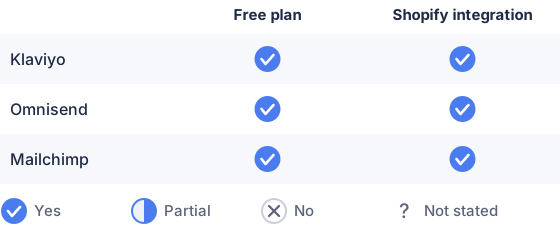
From the sourced table above, checked November 2026.
Klaviyo: best for behavior-based personalization
Klaviyo connects store activity, customer profiles, email, and other marketing channels, making it a fit for brands that want to build campaigns around browsing and purchase behavior. Its Shopify integration syncs store and customer data, and Klaviyo also lists integrations for platforms including WooCommerce, BigCommerce, Wix, and Magento. The trade-off is that the toolset may be more than a small shop needs, and the price rises with the number of active profiles. (help.klaviyo.com)
Omnisend: best for email and SMS workflows
Omnisend combines email, SMS, web push, forms, and automation workflows in one platform. Its Shopify connection syncs customers, products, and orders, enabling campaigns and workflows based on store activity. It also supports native integrations with platforms such as WooCommerce and BigCommerce. Its main limitation is that plan limits matter: the free tier has a small monthly email allowance, and paid email capacity depends on the plan. (support.omnisend.com)
Mailchimp: best for stores that want broader marketing tools
Mailchimp suits businesses that want email alongside other marketing features, such as landing pages, forms, and integrations with a wider set of apps. Its Shopify integration syncs customer and order data and shares customer events that can be used to trigger automations. It also supports ecommerce integrations for WooCommerce and Magento. Compared with ecommerce-focused tools, check carefully whether your preferred store events and automation steps are available on the plan you intend to buy. (mailchimp.com)
What is the best email marketing software for ecommerce businesses?
Klaviyo is the best fit when you want customer data and store activity to drive detailed segmentation and automated campaigns; Omnisend is a strong alternative for brands that want email and SMS together, while Mailchimp suits businesses seeking a broader marketing platform. Klaviyo’s published plan includes email campaigns, flows, and segmentation, and it connects with major ecommerce platforms. (klaviyo.com)
There is no single best option for every store. A small list and occasional newsletters may not need the detailed segmentation of Klaviyo. If you plan to use email and text messaging together, Omnisend brings those channels into one platform; if your team already uses Mailchimp’s wider marketing tools, its store connection may be convenient. Compare the data each product syncs from your specific platform, not just whether it offers an integration.
Also consider how the team will use it week to week. A powerful automation builder is valuable only if you have the time and data to set up, monitor, and improve flows. Start with the campaigns you expect to run, such as welcome messages or post-purchase follow-ups, then confirm that the software supports the triggers and reporting you need.
Which email marketing tools integrate with ecommerce platforms like Shopify?
Klaviyo, Omnisend, and Mailchimp all offer Shopify integrations, and each supports connections to other ecommerce platforms too. Klaviyo lists Shopify, WooCommerce, BigCommerce, Wix, and Magento among its ecommerce integrations; Omnisend has native connections for Shopify, WooCommerce, and BigCommerce; Mailchimp documents integrations for Shopify, WooCommerce, and Magento. (help.klaviyo.com)
An integration can do more than add customer email addresses to a list. For example, Shopify data can include orders and customer activity, which can inform segmentation and automated campaigns. Mailchimp documents Shopify events such as product views, cart activity, and checkout starts; Klaviyo describes syncing customer and order data; Omnisend says its Shopify connection syncs customer, product, and order information. (mailchimp.com)
Before choosing, verify that the integration supports your store platform and the events your planned campaigns depend on. Check whether setup requires enabling an app embed or tracking script, whether data syncs in the direction you need, and whether the integration is included in your chosen plan. If your store runs on a less common platform, confirm that a native connector exists or that an available app or API can cover the gap.
What features should ecommerce brands compare when choosing email marketing software?
Compare ecommerce data syncing, automation triggers, segmentation, channel support, reporting, and pricing limits. The most useful differences often concern what customer and order activity the platform can access and how easily you can turn that data into relevant campaigns. (help.klaviyo.com)
For automation, check whether the software can trigger messages for the store events you care about, such as a new subscriber, a started checkout, or a completed order. For segmentation, look at whether you can group customers by purchase and engagement behavior rather than relying only on broad lists. These capabilities determine how specifically you can target campaigns.
If you want to send SMS as well as email, compare the channels included in the plan and how text-message charges are calculated. Omnisend includes email and SMS as product capabilities, while Klaviyo lists its email plan separately from mobile messaging add-ons. (omnisend.com)
Finally, compare practical workflow needs: template editing, signup forms, team access, support, testing, and reporting. Look at the plan limits as well as the feature list. An entry-level plan may have contact or sending caps, or restrict automation features, so check that your expected list size and campaign volume fit before migrating.
How much does ecommerce email marketing software cost?
These are entry-level prices, and each platform’s pricing page should be checked against your contact count and expected usage before you sign up. (mailchimp.com)
The three also publish free plans, but the limits are modest. Klaviyo’s free plan covers up to 250 active profiles and 500 emails per month; Omnisend’s free plan allows up to 250 contacts and 500 emails per month; Mailchimp’s free plan is capped at 250 contacts. (klaviyo.com)
Your bill can rise as your list grows or you need additional sending capacity, channels, or features. Omnisend says its Standard plan’s email allowance depends on list size, while Klaviyo’s entry-level paid email plan lists a 500-profile tier and 5,000 emails per month. Mailchimp also sets plan limits for contacts and monthly sends. Compare those limits with your actual audience and sending pattern rather than choosing on the starting price alone. (omnisend.com)
Which should you choose?
| Your situation | Best fit |
|---|---|
| You want detailed targeting from store behavior | Klaviyo |
| You want email and SMS workflows together | Omnisend |
| You already use Mailchimp’s wider marketing tools | Mailchimp |
| You are starting with a small list and want a free plan | Omnisend |
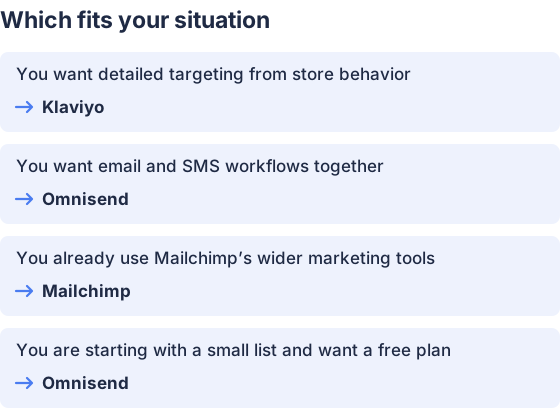
From the table above.
How this comparison was made
Prices and features come from each vendor’s published pricing and product pages, checked in November 2026; prices and limits may change. The products were not tested hands-on.


