Best influencer platforms for ecommerce automation, targeting, tracking?
GRIN vs Upfluence vs Impact.com: compare pricing, Shopify integration and full-funnel attribution for ecommerce influencer programs.

Use GRIN or Upfluence for commerce-first creator programs; impact.com for partner-style attribution; CreatorIQ, Aspire or Tagger fit enterprise needs.
GRIN publishes a Shopify-friendly price ladder and a free tier; Impact publishes a $30/mo Starter plan for partnership tracking; Upfluence, CreatorIQ, Aspire and Tagger/Sprout are demo-gated enterprise products (prices on sales call). (grin.co)
At a glance
| Option | Best for | Starting price (paid plan) | Free plan | Full-funnel tracking? | Source |
|---|---|---|---|---|---|
| GRIN | Shopify-native creator programs | $200/mo | Yes | Yes | grin.co |
| Upfluence | AI outreach + large creator DB | Quote only | No | Yes | upfluence.com |
| CreatorIQ | Enterprise measurement & governance | Quote only | No | Yes | creatoriq.com |
| Aspire | Marketplace + UGC for ads | Quote only | No | Yes | aspire.io |
| Tagger (Sprout Social) | Social intelligence at enterprise scale | Quote only | No | Partial | sproutsocial.com |
| impact.com | Partner & affiliate-style attribution | $30/mo | No | Yes | impact.com |
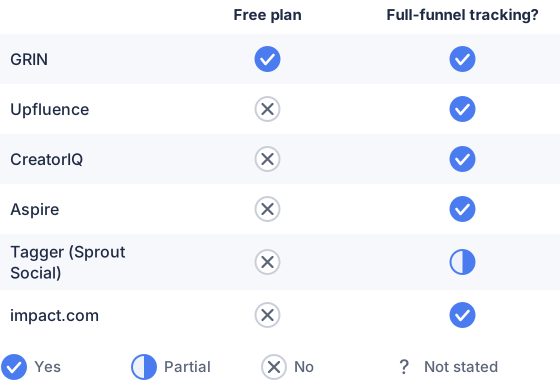
From the sourced table above, checked November 2026.
GRIN: best when you want Shopify-native tracking and program automation
GRIN is built for ecommerce creator programs: it automates discovery, outreach, gifting, affiliate links and creator payments, and it lists Shopify among first-class integrations. GRIN publishes plans (Free, Starter $200/mo, Growth $500/mo, Scale $1,500/mo) and says affiliate tracking is included on every plan (prices checked November 2026). (grin.co). Where it falls short: deeper enterprise measurement (multi-touch attribution across non-commerce channels) often requires custom work or other partners.
Upfluence: best when you want AI outreach and a huge creator database
Upfluence emphasizes a large searchable creator database, AI drafting of outreach, automated campaign workflows and native ecommerce integrations (Shopify, WooCommerce, etc.). Pricing is modular and custom-quoted (no published flat monthly plan). Upfluence documents Shopify setup and an “Agnostic Sales Tracking” approach to attribute sales to creators. (upfluence.com). Shortcomings: you must talk to sales to get a final price and to confirm which tracking options will be enabled for your store.
CreatorIQ: best for enterprise governance, measurement and analytics
CreatorIQ targets mid-market and enterprise teams that need governance, global data and deep measurement; it supports integrations to Shopify and affiliate/ad networks and offers ecommerce metrics (orders, gross/net sales) in its docs. Pricing is not published and requires a demo. CreatorIQ is strong for cross-channel program reporting but is enterprise priced and may be overkill for smaller merchants. (creatoriq.com)
Aspire: best if you want a marketplace plus paid-ads support for top creator content
Aspire promotes a marketplace, automated workflows, promo codes, affiliate links and a Sales Dashboard that ties revenue to creator activity. Aspire does not publish subscription pricing on its site, plans are quoted after a demo, so expect enterprise sales conversations. Aspire is useful if you want branded recruitment pages and to boost creator content into paid social, but you will need to confirm reporting granularity and onboarding cost on a call. (aspire.io)
Tagger (Sprout Social Influencer Marketing): best for discovery and social intelligence at scale
Tagger’s product (now sold as Sprout Social’s Influencer Marketing) offers semantic discovery across millions of profiles, brand-fit scoring and brand-safety screening; Sprout documents UTM/pixel based conversion tracking and paid-amplification integrations. Pricing is not published and is sold via demo. It is strong for insights and vetting but organizations that need shop-native, first-party Shopify attribution may prefer GRIN or impact.com for direct order-level tracking. (lbbonline.com)
impact.com: best when you need partner-style attribution and low-cost entry
impact.com is built around partnership and affiliate operations; it publishes a clear pricing ladder (Starter $30/mo, Essentials $500/mo, Pro $2,500/mo) and offers API-based tracking, multi-touch attribution, and built-in payouts and fraud protection (prices and tiers checked November 2026). The Starter tier supports Shopify, WooCommerce and other storefronts and is a low-cost way to run tracked creator/affiliate programs, but it follows an affiliate/partner model rather than a creator-CRM first approach. (impact.com)
What are the best influencer marketing platforms for ecommerce brands that automate outreach, target audiences, optimize campaigns, and track creator-driven sales?
GRIN, Upfluence and impact.com are the most straightforward fits for ecommerce brands that want automation plus measurement; CreatorIQ, Aspire and Tagger target enterprise needs.
- GRIN automates outreach, gifting, affiliate links and payments and publishes Shopify support and public plan prices. (grin.co)
- Upfluence provides AI-driven outreach and large creator discovery plus Shopify integrations, but pricing is modular and quoted. (upfluence.com)
- impact.com focuses on partner/affiliate tracking, multi-touch attribution and low starting pricing for commerce brands. (impact.com)
These choices are consistent with independent platform comparisons and buyer notes on enterprise gating for CreatorIQ/Aspire/Tagger. (seedinfluencers.com)
Which platforms offer full-funnel tracking from creator content to sales?
Answer: impact.com, GRIN, Upfluence and CreatorIQ offer full-funnel sales attribution to varying degrees.
- impact.com publishes API and cookie-less tracking, multi-touch attribution and explicit ecommerce starter tier support for Shopify and others. (impact.com)
- GRIN provides affiliate links, promo codes and product syncing to Shopify for creator-to-order tracing; it states affiliate tracking is available on every plan. (grin.co)
- Upfluence documents Shopify integrations and an agnostic sales tracking option to capture purchases without discounts. (upfluence.com)
- CreatorIQ reports ecommerce metrics (orders, gross/net sales) through its integrations and Convert product, though pricing and some integrations are enterprise-gated. (21030792.fs1.hubspotusercontent-na1.net)
Tagger/Sprout supports UTM and pixel tracking and can feed conversion data, but its depth for order-level attribution depends on the integrations you configure; some enterprise features are demo-gated. (influencersupport.sproutsocial.com)
Which platforms integrate with Shopify and campaign managers?
Answer: GRIN, Upfluence, impact.com, Aspire, CreatorIQ and Tagger all list Shopify integrations; the integration models differ.
- GRIN lists Shopify in its App Marketplace and explains ecommerce integration workflows. (grin.co)
- Upfluence documents a Shopify integration and step-by-step connection guide. (help.upfluence.co)
- impact.com’s Starter tier explicitly supports Shopify and other storefronts. (impact.com)
- Aspire describes Shopify fulfillment and a Sales Dashboard tied to creator activity. (aspire.io)
- CreatorIQ lists Shopify among its integrations and Convert connectors to affiliate networks and commerce. (creatoriq.com)
- Tagger (Sprout) also documents Shopify product catalog integrations for campaign workflows. (lbbonline.com)
Always verify the specific Shopify features you need (promo codes, discount code tracking, first-party order attribution, or ad permissions) with each vendor during your demo, because the integration depth and setup differ by product and plan. (impact.com)
How do platforms compare by pricing, scale, and features?
Answer: pick by program scale and the attribution model you need.
- Budget / low-friction start: impact.com Starter at $30/mo gives partner-style tracking and a self-serve entry point for Shopify merchants (as of November 2026). It scales up into Essentials/Pro for larger partner payout volumes. (impact.com)
- Ecommerce-first SMBs: GRIN offers a free tier and published Starter at $200/mo (plus wallet management fees) so smaller teams can begin tracking creator links and manage gifting without a sales call. GRIN scales to $500 and $1,500 plans for larger programs. Prices checked November 2026. (grin.co)
- AI-driven outreach and discovery: Upfluence is focused on large creator databases and automation; pricing is modular and quoted, which suits teams that want tailored modules rather than fixed plans. (upfluence.com)
- Enterprise governance and advanced analytics: CreatorIQ and Tagger/Sprout are sold via demos and are positioned for global, regulated, multi-team operations with richer metadata, but they require larger budgets and contracts. Aspire is also demo-gated and emphasizes marketplace recruiting plus paid-ads activation; none of these publish standard monthly list prices. (creatoriq.com)
Feature tradeoffs to expect: public pricing vendors (GRIN, impact.com) give predictable entry costs but may limit advanced enterprise connectors; demo-only vendors (Upfluence, CreatorIQ, Aspire, Tagger) let you pick tailored modules, integrations and support levels but require sales negotiation and longer onboarding. Independent buyer guides note that demo-gated platforms often quote very different totals depending on required integrations and seats. (microinfluencers.io)
Which should you choose?
| Your situation | Best fit |
|---|---|
| Shopify store, tight team, want predictable pricing | GRIN |
| Low-cost, affiliate-style tracked creator sales | impact.com |
| Large database + automated outreach (AI) | Upfluence |
| Enterprise program needing governance and cross-channel reporting | CreatorIQ |
| Marketplace recruitment + boost creator content into ads | Aspire |
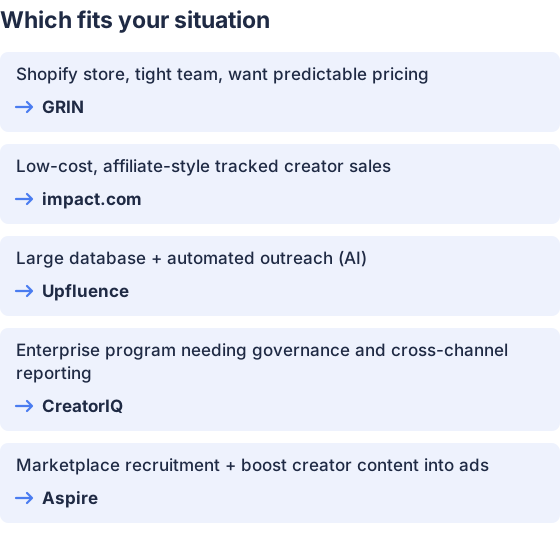
From the table above.
How this comparison was made
Prices and feature claims were taken from each vendor’s published pages and documentation and rechecked in November 2026; independent articles were used when vendors do not publish list prices. The products were not tested hands-on for this comparison. (grin.co)


