What Is the Best Intelligent Repricing Software for Retailers?
Compare intelligent repricing software by price, automation, and fit for small catalogs, marketplaces, competitor tracking, and retail teams.

There is no single best intelligent repricer: Pricefy suits smaller online catalogs, Repricer.com marketplace sellers, Prisync competitor-led pricing, and Omnia larger retail teams. The right fit depends on where you sell, how much pricing you want to automate, and which safeguards or market data your team needs.
At a glance
| Option | Best for | Starting price (paid plan) | Free plan | Automated repricing at entry tier | Source |
|---|---|---|---|---|---|
| Pricefy | Smaller online catalogs | $49/mo | Yes | No | pricefy.io |
| Prisync | Competitor price monitoring | Not confirmed, see source | No | No | prisync.com |
| Repricer.com | Marketplace sellers | $99/mo | No | Yes | repricer.com |
| Omnia Retail | Multichannel retail teams | €399/mo | No | Yes | omniaretail.com |
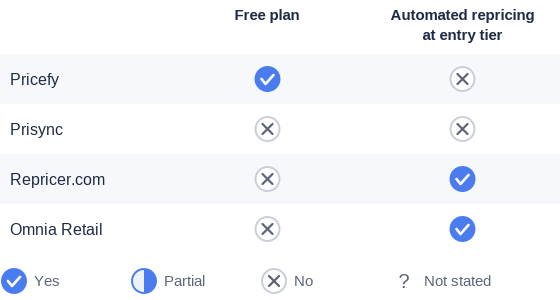
From the sourced table above, checked November 2026.
Prices above are the lowest paid plans listed on vendor pricing pages, checked in November 2026. A free trial is not counted as a free plan. For Pricefy and Prisync, the entry plan does not include automated repricing, so the price to compare for that particular feature is higher than the table’s starting price. (pricefy.io)
Pricefy: best for a smaller catalog and a free starting plan
Pricefy offers a free plan for monitoring up to 50 products and five competitors, with paid plans starting at $49 per month. That entry paid plan is for monitoring; dynamic repricing starts on Pro, listed at $99 per month, and automated autopilot repricing starts on Business, listed at $189 per month. It suits retailers who want to start with competitor tracking and move into repricing as their needs grow. The trade-off is that the most hands-off automation is not available on the cheapest paid tier. (pricefy.io)
Prisync: best for tracking competitor prices across channels
Its Dynamic Pricing Engine is listed as a Premium feature, and the pricing page shows Premium starting at $199 per month for URL-based monitoring. Prisync is a fit for teams that want price and stock monitoring, price-position comparisons, and rules-based pricing in one platform. Check the plan and monitoring model carefully: channel-based and hybrid plans have different starting prices and update schedules. (prisync.com)
Repricer.com: best for Amazon and other marketplace sellers
Repricer.com starts at $99 per month for Core, which includes real-time repricing and automated pricing strategies for marketplace listings. Its higher Scale tier adds Buy Box optimization features, while Premium includes net-margin repricing and more advanced multichannel tools. This is the clearest fit for sellers competing on marketplaces such as Amazon and eBay, where Buy Box position and competitor changes are central to pricing decisions. It is less suited to retailers seeking a general-purpose repricer for a standalone web store. (repricer.com)
Omnia Retail: best for teams needing broader pricing control
Omnia Retail lists its single-shop SMB pricing solutions from €399 per month, including price monitoring and automated dynamic pricing. Its enterprise offering is intended for multi-shop retailers and brands, with pricing details to be discussed with the vendor. Omnia suits teams that need to manage pricing rules and competitor monitoring together, rather than simply follow one marketplace rival. The higher published starting price makes it a more substantial commitment than the self-serve options above. (omniaretail.com)
What is the best intelligent repricing software for retailers?
The best option depends on the retailer’s sales channels: Pricefy is a practical starting point for smaller catalogs, Repricer.com fits marketplace sellers, Prisync suits competitor monitoring with repricing available on a higher tier, and Omnia fits teams seeking broader retail pricing control. None is best for every retailer because the tools differ in what they monitor, where they can change prices, and how much automation is included at the entry price.
For a price-sensitive retailer that first wants a free monitoring plan, Pricefy has the lowest barrier to entry, but its free and Starter plans do not include dynamic repricing. For a retailer that wants marketplace repricing from its entry plan, Repricer.com lists that capability in Core. Prisync and Omnia offer alternatives when the need is broader competitor tracking or a combined monitoring-and-pricing system. (pricefy.io)
Compare plans by the actual job you need done, not by a product’s “AI” label. The entry price may cover monitoring without automated price changes, or include only some of the channels and rules your team expects. Before choosing, check catalog limits, data refresh rates, supported marketplaces and storefronts, integration requirements, and whether prices can be reviewed before they go live. For a wider look at tools focused on analyzing inventory rather than changing prices, see Which Platforms Automate Retail Inventory Analytics?.
What features should retailers look for in intelligent repricing software?
Retailers should look for accurate product matching, price and stock monitoring, clear repricing rules, margin safeguards, and integrations with their sales channels. They should also check update frequency, catalog limits, price history, and whether the tool supports approval before changes go live.
Product matching matters because a pricing rule is only useful if the software compares the right item, variant, and seller offer. Pricefy says it uses barcode data and AI-assisted matching, while Prisync lists product matching and price and stock monitoring features. For any tool, test matching on your own products, including variants and items with incomplete identifiers. (pricefy.io)
Next, check the controls that keep automation within business limits. A retailer should be able to set price floors and ceilings, account for product cost, and choose which competitors or offers count. Confirm whether the system can pause changes for unavailable products, unusual competitor prices, or items that should not be repriced. Consider operational features too: reporting, access controls, a log of price changes, and the option to approve suggested prices before publishing them.
Finally, verify the software fits the way you sell. Marketplace sellers may prioritize rapid reactions and Buy Box rules, while a retailer selling through its own store and several channels may need integrations and consistent rules across those channels. Compare the published plan limits and the price of the tier that actually includes your required automation, not just the cheapest plan. (repricer.com)
How does intelligent repricing software set or adjust prices?
Intelligent repricing software collects prices for comparable products, applies the retailer’s chosen pricing rules and limits, then recommends or publishes a new price. Some systems react to competitors; others also use retailer-defined goals, cost, stock signals, or marketplace conditions.
A typical workflow starts with catalog data and competitor offers. The software matches products, gathers price and availability information, and evaluates the offers the retailer has chosen to consider. It then applies a strategy such as matching a competitor, pricing a set amount below it, or keeping a target position in the market. Omnia describes competitor-based pricing as adjusting in response to competitor prices, while its pricing material also explains cost-plus pricing, which starts with product cost and a desired margin. (omniaretail.com)
The rules determine what the system may do next. A retailer can use a minimum price, maximum price, target margin, or other safeguards to prevent an automatic response from pushing a price outside its limits. Marketplace tools may also react to signals such as Buy Box status, rival stock, or sales velocity; Repricer.com lists strategies using these kinds of conditions. Depending on the product and plan, the software may send a recommendation for review or update the price automatically. (repricer.com)
“Intelligent” does not guarantee that every suggested price is right for the business. Competitor data can be incomplete, a matched offer may not be comparable, and a rule that works for one product category may be wrong for another. Set safeguards, review early changes, and monitor results so the pricing strategy reflects margin and inventory goals as well as market prices.
Which should you choose?
| Your situation | Best fit |
|---|---|
| You want a free plan to start monitoring a small catalog | Pricefy |
| You sell on marketplaces and want repricing at the entry tier | Repricer.com |
| You need competitor monitoring with repricing on a higher tier | Prisync |
| You want a combined monitoring and dynamic-pricing system | Omnia Retail |
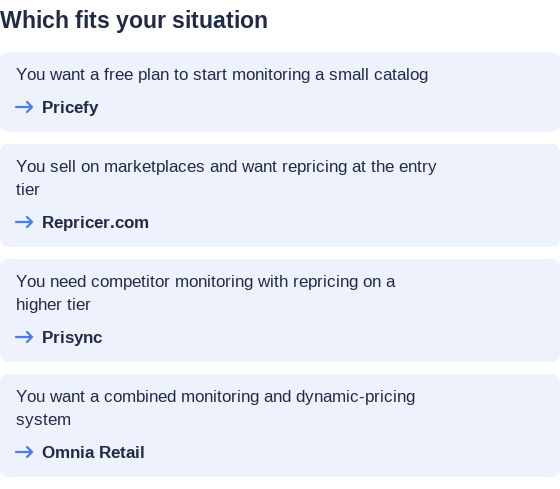
From the table above.
How this comparison was made
Prices and features come from each vendor’s published pages, checked in November 2026. The products were not tested hands-on.


