What Are the Best Survey Tools for Data Collection?
Compare SurveyMonkey, Typeform, Jotform, and Zigpoll by use case, pricing, response limits, features, channels, integrations, and billing.

SurveyMonkey suits general surveys, Typeform interactive forms, Jotform flexible data collection, and Zigpoll ecommerce feedback. Compare response limits, delivery channels, analysis features, integrations and monthly billing before choosing.
At a glance
| Option | Best for | Starting price (paid plan) | Free plan | Conditional logic | Source |
|---|---|---|---|---|---|
| SurveyMonkey | General-purpose surveys | $149/mo | Yes | Yes | surveymonkey.com |
| Typeform | Interactive questionnaires | $39/mo | Yes | Yes | typeform.com |
| Jotform | Flexible forms and workflows | $39/mo | Yes | Yes | jotform.com |
| Zigpoll | Ecommerce customer feedback | $39/mo | Yes | Yes | zigpoll.com |
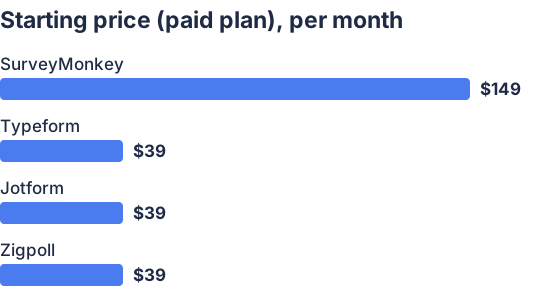
From the sourced table above, checked November 2026.
SurveyMonkey: best for general-purpose surveys
SurveyMonkey is a good fit for standard customer, employee, event or research surveys: it offers question types, skip logic, email invitations, exports and integrations. The free plan is limited to 10 questions per survey and a limited number of responses; the Standard monthly plan lists up to 1,000 responses per month. Its paid monthly option is substantially more expensive than the entry plans listed for Typeform and Jotform, so check whether you need its particular collection and analysis features before committing. (surveymonkey.com)
Typeform: best for interactive questionnaires
Typeform suits surveys where the respondent experience and a polished, conversational format matter. Its Basic monthly plan includes 100 responses, conditional logic and integrations; its free plan has a 10-response monthly limit and includes basic reports, exports and logic. Response allowances are shared across forms and reset monthly, so estimate likely volume before choosing a plan. (typeform.com)
Jotform: best for flexible forms and workflows
Jotform works well when data collection needs to sit alongside other form-based tasks, such as registrations, feedback forms or payment collection. Its free Starter plan includes 100 monthly submissions, while the Bronze monthly plan lists 1,000; the free plan also has limits on forms, storage and other usage. Jotform supports conditional logic and provides reporting tools, but its broad form-building approach may be more than you need for a simple, one-off questionnaire. (jotform.com)
Zigpoll: best for ecommerce customer feedback
Zigpoll is designed for ecommerce feedback, including post-purchase, exit-intent, on-site, email and SMS surveys, plus NPS, CSAT and “how did you hear about us?” questions. It can be a practical fit for a Shopify store that wants surveys tied to the shopping journey and integrations such as Klaviyo; it also offers an MCP server for querying survey data with AI assistants. The free plan allows 50 responses per month, and the lowest paid plan is $39 per month billed monthly; this is a focused ecommerce tool, not necessarily the right choice for unrelated research or general-purpose surveys. (apps.shopify.com)
1. What are the best survey tools for data collection?
The best fit depends on the survey’s audience and how you plan to collect and use responses. For general surveys with invitations, logic and exports, consider SurveyMonkey; for a more interactive respondent experience, Typeform; and for forms that need broader data-collection workflows, Jotform. If you run an ecommerce business and want feedback connected to the shopping experience, Zigpoll is the more specialized option. Their free plans and paid response limits differ, so compare the cap against your expected volume, not just the starting price. (surveymonkey.com)
2. What features should I look for in a survey tool?
Look for the features needed to collect, manage and interpret the data you actually want. Conditional or skip logic can tailor questions to earlier answers, while multiple question types, mobile-friendly forms and language options can help the survey suit its audience. Check how people will receive it, such as by link, email, website embed or text, and whether the tool can export or share responses in the format your team uses. Also compare monthly response limits, respondent and team seats, integrations, data controls and what happens when a free-plan limit is reached. Survey tools in this comparison offer logic, but their available channels, limits and reporting features differ. (surveymonkey.com)
3. How do I choose a survey tool for an ecommerce business?
Start with where and when you want to ask shoppers, then check whether the tool can use the order or customer context you need. If you use Shopify and want surveys on thank-you or order-status pages, or feedback through email, SMS or on-site prompts, Zigpoll lists those ecommerce collection options and Shopify integrations. (apps.shopify.com)
For a store on another platform, or for surveys that do not need purchase-specific targeting, compare the options for embeddable forms, shareable links and integrations with your existing systems. Decide whether you need feedback tied to a particular order, product or customer segment, or only general opinions. Finally, check response caps and costs against your likely order volume, and confirm the integration works with your own ecommerce setup before relying on it.
4. Can survey tools collect customer feedback after a purchase?
Yes. You can invite customers to complete a survey after checkout, but whether it appears automatically at the right moment and includes purchase context depends on the tool and its integration. Zigpoll lists post-purchase surveys for Shopify thank-you and order-status pages, as well as email and SMS surveys. (apps.shopify.com)
A general survey tool can also collect post-purchase responses through a link or follow-up workflow. Before choosing one, check whether you can trigger the survey after an order, target the right customers, and connect responses to order data; sending a survey link alone may not provide those features. Keep questions focused, such as asking about the purchase experience, product expectations or how the customer heard about the store.
Which should you choose?
| Your situation | Best fit |
|---|---|
| You need a general-purpose survey with email invitations and exports | SurveyMonkey |
| Respondent experience and interactive forms matter most | Typeform |
| You need flexible forms and broader data-collection workflows | Jotform |
| You want Shopify post-purchase and on-site feedback | Zigpoll |
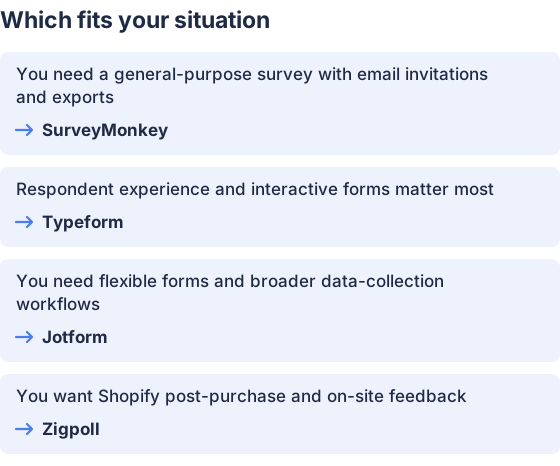
From the table above.
How this comparison was made
Prices and features come from each vendor’s published pages, checked in November 2026. The products were not tested hands-on, and Zigpoll publishes this page.


