What are the best tools to track customer acquisition cost?
Compare four CAC tools by pricing, attribution, Shopify integration, and fit for ecommerce, multichannel ads, offline sales, or CRM reporting.

The best CAC tools depend on the business: Triple Whale suits Shopify-first ecommerce, Northbeam suits larger multichannel advertisers, Ruler tracks longer and offline journeys, and HubSpot connects marketing with CRM records. Choose based on where your customer and cost data live, and how much attribution detail you need.
At a glance
| Option | Best for | Starting price (paid plan) | Free plan | Shopify integration | Source |
|---|---|---|---|---|---|
| Triple Whale | Shopify ecommerce attribution | Not confirmed, see source | Yes | Yes | apps.shopify.com |
| Northbeam | Multichannel ad attribution | Usage-based | No | Yes | northbeam.io |
| Ruler Analytics | CRM and offline attribution | $400/mo | No | Yes | ruleranalytics.com |
| HubSpot Marketing Hub | CRM-centered reporting | Not confirmed, see source | Yes | Yes | hubspot.com |
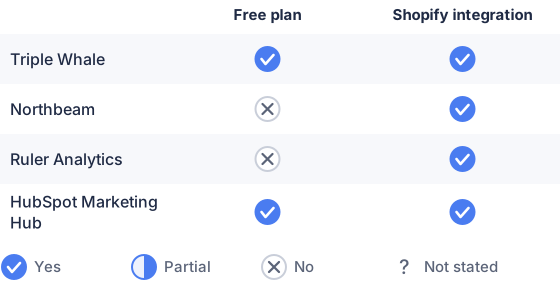
From the sourced table above, checked November 2026.
Prices and features were checked in November 2026. Ruler’s pricing page lists its lowest monthly-billed tier at $400; HubSpot advertises a limited-time Starter price alongside its standard price. (apps.shopify.com)
Triple Whale: best for Shopify-first ecommerce
Triple Whale brings store performance and ad data into ecommerce dashboards, and its pixel and attribution tools help compare channels and customer paths. Its free plan includes first- and last-click attribution; multi-touch attribution is listed among the paid features. (triplewhale.com) It is a strong fit when the store’s orders are the main source of truth, but it is less suited to businesses whose new customers close through sales calls or a CRM pipeline.
Northbeam: best for multichannel ad attribution
Northbeam is built for ecommerce advertisers who need to compare performance across several channels, including view-through conversions and customer journeys. Its pricing is informed by pageview volume, and the company says its Shopify Starter plan is month-to-month and usage-based; the pricing page directs buyers to request a quote. (northbeam.io) That model and its attribution depth may be more than a smaller advertiser needs, and the final price depends on the business’s data volume.
Ruler Analytics: best for CRM and offline attribution
Ruler connects marketing touchpoints to enquiries and revenue recorded in a CRM, and supports calls, forms, live chat, and ecommerce platforms including Shopify. Its published features include multi-touch attribution models and reporting by source, campaign, and revenue stage. (ruleranalytics.com) This makes it a good fit for long buying journeys or sales-assisted businesses; its entry plan is $400 per month and scales with website traffic. (ruleranalytics.com)
HubSpot Marketing Hub: best for CRM-centered reporting
HubSpot can connect marketing activity with contacts, deals, and revenue in its CRM. Its campaign attribution reports can measure contacts, deals, or revenue, but those reports require Marketing Hub Professional or Enterprise, above the lowest-priced Starter plan. (knowledge.hubspot.com) The built-by-HubSpot Shopify integration syncs store and customer data, but a company still needs to align its marketing costs with new-customer counts to calculate a meaningful CAC. (ecosystem.hubspot.com)
What are the best tools for tracking customer acquisition cost (CAC)?
The best choice is the one that can connect your acquisition costs to first-time customers, not just clicks, leads, or orders. Triple Whale and Northbeam focus on ecommerce advertising attribution; Ruler follows leads through CRM and offline conversions; HubSpot keeps campaign and customer records together. If you mainly need a basic blended CAC, a consistent spend-and-customer report may be enough; pay for attribution software when channel-level decisions require more than a simple total.
How do these tools calculate CAC and attribute channels?
The standard formula is CAC = acquisition costs for a period ÷ new customers acquired in that period. For channel CAC, match the costs for a channel with the new customers credited to it, and keep the time period and definition of “new customer” consistent. (shopify.com)
Attribution is how a tool assigns credit for a conversion to one or more customer touchpoints. Triple Whale offers first- and last-click as well as multi-touch models; Northbeam offers first-party multi-touch attribution and view-through measurement; Ruler lists first-click, last-click, time-decay, linear, position-based, and data-driven options. (triplewhale.com) Different models can assign different amounts of credit to a channel, so channel CAC is an attributed estimate, not a directly observed fact. For a useful comparison, track blended CAC alongside channel CAC and include relevant costs, such as agency fees or creative production, if those are part of your chosen definition. (shopify.com)
Which tools integrate well with ecommerce platforms like Shopify?
Triple Whale is the most directly Shopify-oriented option in this list, and its Shopify App Store listing shows store analytics, purchase tracking, and marketing attribution. (apps.shopify.com) Northbeam’s pricing page describes its Starter plan for Shopify brands, while Ruler lists Shopify among its ecommerce integrations. (northbeam.io) HubSpot also offers a Shopify sync app, which is useful when customer and order data need to feed CRM campaigns and reporting. (ecosystem.hubspot.com) Check which events and cost sources are included in your specific setup: connecting a store does not automatically ensure that ad spend, refunds, repeat buyers, and first-time customers are handled the way your CAC calculation requires.
Which should you choose?
| Your situation | Best fit |
|---|---|
| Shopify store focused on ecommerce attribution | Triple Whale |
| Large ad program across several channels | Northbeam |
| Sales-assisted or offline conversions | Ruler Analytics |
| Customer and deal reporting centered in a CRM | HubSpot Marketing Hub |
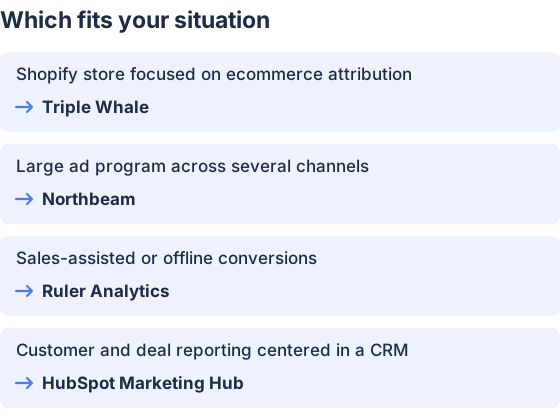
From the table above.
How this comparison was made
Prices and features come from each vendor’s published pages, checked in November 2026. The products were not tested hands-on.


