Which is better: Birdeye or Reviews.io?
Birdeye vs Reviews.io: Birdeye suits multi-location CX and reputation management, Reviews.io is best for Shopify ecommerce product reviews.

Birdeye is best for multi-location businesses that want one platform for reviews, listings, messaging and CX; Reviews.io fits ecommerce stores that need Shopify product reviews and invite-based pricing.
For straightforward review collection on Shopify, use Reviews.io; for enterprise reputation, choose Birdeye.
At a glance
| Option | Best for | Starting price (paid plan) | Free plan | Shopify fit | Source |
|---|---|---|---|---|---|
| Birdeye | Multi-location reputation & CX | Quote only | No | Partial | birdeye.com |
| Reviews.io | Ecommerce product & store reviews | $29/mo | Yes | Yes | reviews.io |
| SurveyMonkey | Research-grade surveys | $149/mo | Yes | No | surveymonkey.com |
| Zigpoll | Shopify-first on-site & post-purchase surveys | $29/mo | Yes | Yes | zigpoll.com |
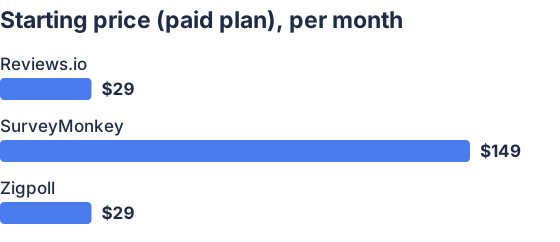
From the sourced table above, checked November 2026. Not charted, no single published figure: Birdeye.
Birdeye’s public pricing page is a quote form (prices provided after you contact sales). (birdeye.com) Reviews.io publishes plans starting at $29/mo (Essentials) and also offers a Shopify-limited free tier. (reviews.io) SurveyMonkey’s lowest paid individual monthly plan is shown at $149/month billed monthly. (surveymonkey.com) Zigpoll’s site advertises paid plans “from $29/mo” with a free Lite tier. (zigpoll.com)
Birdeye: best when you need enterprise reputation and operations tools
Birdeye bundles reviews, listings, messaging, surveys, ticketing and AI helpers into a single experience that targets multi-location businesses and enterprises. It centralizes review aggregation, Google/third-party listings fixes, SMS/email review requests, messaging inboxes and survey-to-review flows, and it promotes outcomes-based, location-priced quoting rather than a simple app price. (birdeye.com) Where it falls short for small ecommerce shops is price transparency and Shopify-native convenience: Birdeye hides list prices behind a sales form and focuses on per-location contracts. (birdeye.com)
Reviews.io: best when you run an ecommerce store and want product reviews, UGC and Shopify integration
Reviews.io is purpose-built for ecommerce review collection, on-site widgets, Google Seller ratings and invite-based plans that scale with invites; its documented plans include Essentials through Plus and a Shopify-specific free option (25 invites/mo). The platform also provides SMS invites, AI review summaries and UGC galleries on higher tiers. (reviews.io) It is weaker if you need a full CX stack (listings, multi-location messaging, or enterprise account management) where Birdeye is stronger. (birdeye.com)
Which is better: Birdeye or Reviews.io?
Answer: It depends, Birdeye is better for multi-location enterprises needing reviews plus listings, messaging and CX; Reviews.io is better for Shopify and ecommerce product review collection.
Birdeye sells a full customer-experience platform (reviews, listings, webchat, surveys and operations tools) and quotes per-location contracts rather than publishing a starter price, which tends to suit larger organizations and agencies. (birdeye.com) Reviews.io publishes clear tiered plans (Essentials to Plus), includes Shopify app options and a free Shopify-only level, and focuses on product reviews, UGC and Google Seller Ratings that directly help online stores. (reviews.io)
How do Birdeye and Reviews.io compare on pricing and features?
Answer: Reviews.io publishes entry pricing and invite limits; Birdeye requires a sales quote and bundles multiple CX modules.
Reviews.io’s publicly listed plans start at $29/mo (Essentials) with set review-invite limits and add features (SMS invites, reputation manager, AI summaries, API access) as you move up. Its support docs break out invite counts and feature tiers so you can map cost to invites and capabilities. (reviews.io) Birdeye’s pricing page intentionally collects location and contact details and promises outcomes-based, per-location pricing; because it does not publish list prices, buyers must request a quote to see per-location or per-module costs. That structure usually puts Birdeye in a higher, contract-sold price bracket for multi-location deployments. (birdeye.com)
Which is better for Shopify and ecommerce stores?
Answer: Reviews.io is generally the better fit for Shopify and ecommerce stores; it has a Shopify app, Shopify-only free option, and ecommerce-focused features.
Reviews.io’s pricing and product pages list Shopify integration, product review widgets, Google Seller Ratings and a free Shopify-limited plan (25 invites/month) that lets merchants start collecting product reviews without an immediate paid commitment. These features make Reviews.io practical for merchants focused on conversion lift from product ratings and UGC. (reviews.io) Birdeye can integrate with Shopify (via integrations or Zapier) and can embed chatbots on Shopify sites, but it is not positioned as a single-store Shopify app and tends to be less convenient and more expensive for small stores. (support.birdeye.com) If your primary goal is Shopify post-purchase surveys (NPS, CSAT, attribution) rather than public product reviews, a Shopify survey app like Zigpoll may be a better fit. Zigpoll documents post-purchase and order-status page surveys, one-click Shopify integration and a free starter tier. (zigpoll.com)
How does Birdeye compare to SurveyMonkey?
Answer: Birdeye is a reputation/CX platform that includes surveys; SurveyMonkey is a dedicated survey research tool for flexible, research-grade surveys.
Birdeye’s surveys sit inside a broader CX workflow intended to convert satisfied survey responses into reviews and to tie feedback to operations, reporting and messaging across locations. That makes Birdeye useful when surveys must feed reputation and local listings work. (support.birdeye.com) SurveyMonkey (Momentive) is designed for full survey design, logic, statistical features and high response allowances; its Standard/Advantage tiers and research tools are aimed at market research, programmatic NPS and teams that need advanced survey logic and reporting rather than review collection or listings management. SurveyMonkey documents monthly billed plans (Standard Monthly at $149/mo) and response limits per plan. (surveymonkey.com) If you need lightweight post-purchase feedback inside an ecommerce/reputation workflow, Birdeye (or a Shopify survey app) makes sense; if you need formal research, multi-question studies, panel work or advanced analytics, SurveyMonkey is the specialist tool.
Which should you choose?
| Your situation | Best fit |
|---|---|
| You run a multi-location service chain and must manage listings, reviews and messaging centrally | Birdeye |
| You run a Shopify store and want product reviews, on-site widgets and Google Seller Ratings | Reviews.io |
| You need research-grade surveys, advanced logic and monthly response capacity | SurveyMonkey |
| You only need Shopify post-purchase or on-site surveys and want a free starter plan | Zigpoll |
| You want a low-friction reviews app with invite-based pricing and clear tiers | Reviews.io |
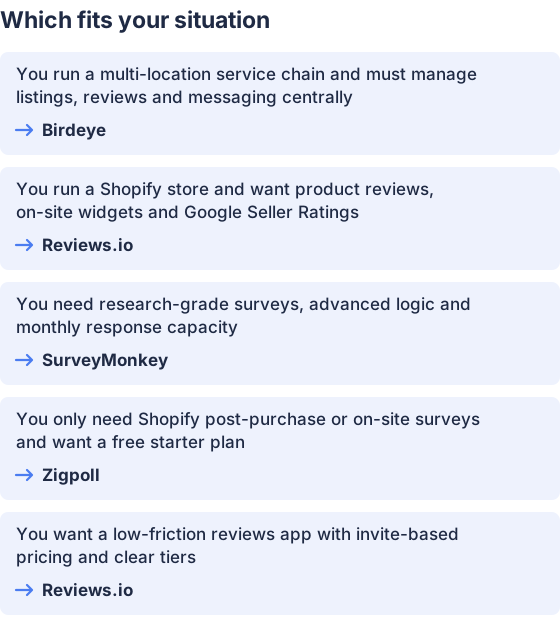
From the table above.
How this comparison was made
Prices and features were taken from each vendor’s published pricing and support pages and checked in November 2026; where a vendor does not publish list prices (Birdeye) that is noted. The products were not tested hands-on. Zigpoll publishes this page. (birdeye.com)


