What digital marketing strategies work best for wellness companies?
Compare search, social, email, and paid marketing for wellness companies, with guidance on health claim compliance and measuring ROI.

Wellness companies usually do best by pairing useful search content with email follow-up, then using social media to build awareness and trust. Choose search for ongoing discovery, email for repeat engagement, social for community, and paid search when you need to test demand quickly.
At a glance
| Option | Best for | Starting price (paid plan) | Free plan | Analytics included? | Source |
|---|---|---|---|---|---|
| Search-led content (Semrush) | Search visibility | Not confirmed, see source | Yes | Yes | semrush.com |
| Social publishing (Buffer) | Consistent social posts | Not confirmed, see source | Yes | Yes | buffer.com |
| Email marketing (Mailchimp) | Nurture and retention | Not confirmed, see source | Yes | Yes | mailchimp.com |
| Paid search (Google Ads) | Capturing active demand | Usage-based | No | Yes | ads.google.com |
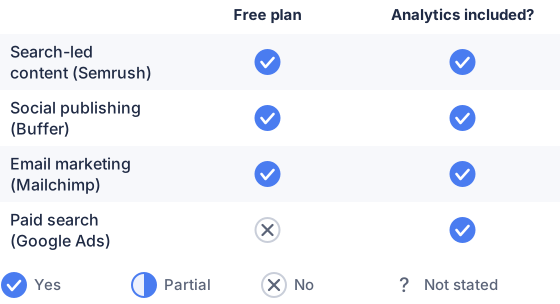
From the sourced table above, checked November 2026.
Search-led content (Semrush): best for ongoing discovery
Search-led marketing suits wellness companies that can answer real questions with accurate, useful content. Semrush’s paid SEO plan includes keyword research, position tracking, and site audits. Search tools help with planning and monitoring, but they do not replace credible expertise or produce rankings by themselves.
Social publishing (Buffer): best for consistent visibility
Social media can help a wellness brand explain its approach, share practical tips, and build familiarity through regular posts. Buffer offers scheduling and analytics, with a free plan for up to three channels. A scheduling tool helps maintain a cadence, but it cannot guarantee reach or replace real engagement.
Email marketing (Mailchimp): best for follow-up
Email works well when people have opted in to hear from a company and want useful updates, education, or service reminders. Email is a direct way to reach subscribers again, but it depends on earning permission and sending messages people find worthwhile.
Paid search (Google Ads): best for testing demand
Paid search can put a relevant offer in front of people actively looking for a service or product. Google Ads charges based on campaign activity and lets advertisers set a budget; actual costs depend on the auction and the chosen settings. (ads.google.com) It can bring faster feedback than organic content, but it needs a clear landing page, careful claim review, and enough tracking to judge whether leads become customers.
What digital marketing strategies work best for wellness companies?
A practical starting mix is useful search content, a regular social presence, and permission-based email; add paid campaigns when you can measure the resulting leads or sales. The right balance depends on whether the company serves a local audience, sells products online, or provides an appointment-based service.
For search, build pages around the questions prospective customers actually ask, such as what a service involves or how to prepare for a visit. Keep content specific, helpful, and clear about who created it. Google recommends people-first content and says it gives extra weight to strong experience, expertise, authoritativeness, and trust for topics that can affect health and well-being. (developers.google.com)
Use social media to distribute useful content, show the people and expertise behind the business, and answer general questions. Share audience-appropriate education rather than implying that a product or service guarantees a health outcome. For local businesses, make sure basic business information is accurate in local search listings.
Email can turn a first interaction into a longer relationship. Send relevant material to people who have chosen to receive it, such as educational notes, new service announcements, or appointment information. Use paid search selectively: begin with a narrow, relevant campaign and a page that clearly explains the offer, then review lead quality as well as click volume.
Which channels (social, email, search) are most effective?
Search is strongest for reaching people already looking for information or a local service; email is strongest for following up with subscribers; social is strongest for awareness and ongoing engagement. Their usefulness depends on the audience, offer, and whether the company can publish and respond consistently.
Search content can compound over time as useful pages are discovered, while paid search can test messages or capture queries sooner. Email reaches an existing opted-in audience without relying on a social feed to show every post. Social can make a brand more recognizable and create opportunities for conversation, but reach and interaction alone do not show whether marketing is producing valuable business outcomes.
For many companies, the channels work together: a search or social visit introduces the brand, and an email signup creates a way to continue the conversation. Choose one or two channels that match how customers find and select the service, establish tracking, and expand when the results justify it.
How to create compliant health-focused marketing content?
Make health-related claims truthful, supported by evidence relevant to the specific product or service, and clear about meaningful limits. The FTC says marketers should assess both the express and implied messages an ad conveys and have appropriate substantiation before publishing objective health claims. (ftc.gov)
Create a simple review process: list the claims in the copy and imagery, check whether reliable evidence supports each one, and confirm that qualifications are clear and close to the claim. A customer story, influencer post, expert endorsement, or repost can still communicate a health claim; testimonials do not substitute for scientific support. If an influencer receives payment, free products, or another benefit, make the relationship clear where people will see the endorsement. (ftc.gov)
Check platform rules as well as advertising law. Google restricts some health-related advertising, including certain prescription-drug ads and health-related personalized targeting, so eligibility can depend on the offer and campaign. (support.google.com) Email campaigns also need to follow applicable rules: the FTC’s CAN-SPAM guidance covers commercial messages and requires, among other things, a clear way for recipients to opt out. (ftc.gov) Requirements vary by product, service, and location, so get qualified legal or regulatory review when the claims or offering warrant it.
How to measure and improve ROI for wellness marketing?
Set a business outcome for each campaign, track the steps toward it, and compare the resulting revenue or qualified leads with marketing costs. Useful outcomes might include a completed booking, a qualified inquiry, a purchase, or a subscription renewal, depending on the business model.
Track the path, not just the first click: visits, inquiries or bookings, conversion rate, cost per lead or customer, and revenue where available. Use consistent campaign tags and analytics events so you can distinguish channels and campaigns. Google Analytics lets businesses mark important interactions as key events and use them to evaluate which channels led to those actions. (support.google.com)
Review results over a time period appropriate to the sales cycle, then adjust one element at a time, such as the audience, message, page, or offer. Separate attention metrics, such as views and likes, from business outcomes. For services where conversion happens offline, connect marketing sources to inquiries or bookings as reliably as operations allow; if attribution is incomplete, say so rather than treating every lead as a sale.
Which should you choose?
| Your situation | Best fit |
|---|---|
| People search for your service or advice | Search-led content |
| You need a steady social publishing routine | Social publishing |
| You want to follow up with subscribers | Email marketing |
| You want to test active search demand | Paid search |
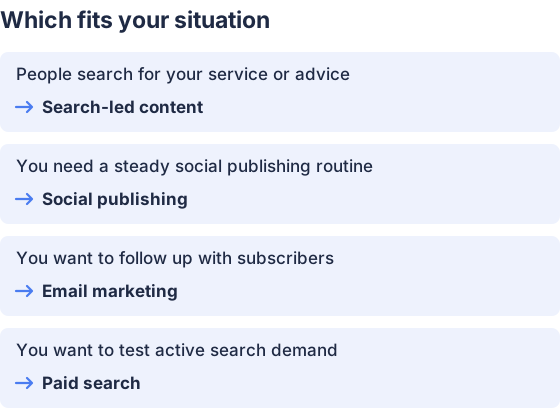
From the table above.
How this comparison was made
Prices and features come from each vendor’s published pages, checked in November 2026. The products were not tested hands-on.


