How do email marketing software options compare?
Compare email marketing software by pricing, automation, integrations and use case, from broad marketing tools to creator and ecommerce platforms.

Email marketing software options can be compared by automation depth, pricing model and data integrations. Mailchimp suits broad marketing needs, Brevo combines email with other channels, Constant Contact emphasizes support, Kit focuses on creators, and Klaviyo is built around ecommerce data.
At a glance
| Option | Best for | Starting price (paid plan) | Free plan | Automation | Source |
|---|---|---|---|---|---|
| Mailchimp | Broad marketing toolkit | $13/mo | Yes | Yes | mailchimp.com |
| Brevo | Email and multiple channels | $9/mo | Yes | Yes | brevo.com |
| Constant Contact | Small businesses needing support | Not confirmed, see source | No | Yes | constantcontact.com |
| Kit | Creators and newsletters | Not confirmed, see source | Yes | Yes | kit.com |
| Klaviyo | Ecommerce customer-data marketing | $20/mo | Yes | Yes | klaviyo.com |
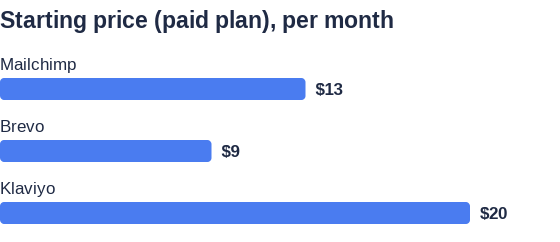
From the sourced table above, checked November 2026. Not charted, no single published figure: Constant Contact, Kit.
Mailchimp: best for a broad marketing toolkit
Mailchimp pairs email campaigns with templates, forms, audience segmentation, reporting, and marketing automation, and its integrations include ecommerce services such as Shopify and WooCommerce (features). Its free plan is limited to 250 contacts and 500 monthly sends; the paid Essentials plan starts at $13 per month for up to 500 contacts, with monthly send limits and price rising as the audience grows (pricing). That makes it a reasonable fit for businesses wanting multiple marketing tools in one account, but check the audience and sending limits against your actual list before comparing the headline price.
Brevo: best for email plus other channels
Brevo brings email together with SMS, WhatsApp, chat and other marketing functions; its pricing and tools are organized around monthly email volume as well as contact storage (platform). The free plan allows 300 email sends per day, while Starter starts at $9 per month for 5,000 monthly sends and up to 500 stored contacts (pricing details). The low entry price can suit a business that sends to a large stored list infrequently, but the daily free-plan limit and paid sending tiers matter if you send large campaigns at once.
Constant Contact: best for businesses that want hands-on support
Constant Contact includes email marketing, social media tools, integrations, and live phone and chat support across plans (plan details). Price and send allowances increase with contact count (pricing). Automation, segmentation, scheduling and reporting vary by tier, so a business that needs more than basic welcome or birthday messages should compare the relevant higher plan rather than the entry price.
Kit: best for creators and newsletters
Kit is aimed at creator businesses such as authors, coaches, podcasters and newsletter writers, with tools for broadcasts, forms, audience tagging, paid newsletters and digital products (features). Visual automations and email sequences are paid-plan features (pricing, plan comparison). Kit can suit a solo publisher who wants email and creator monetization in the same service, but a business focused on store purchase events, inventory or retail lifecycle campaigns should verify that its integrations cover those needs.
Klaviyo: best for marketing based on ecommerce data
Klaviyo is designed to connect customer and order data from ecommerce platforms to email campaigns, segments and automated flows. Its integrations cover platforms including Shopify, BigCommerce and WooCommerce, and its documentation describes using events such as checkout started and placed order to trigger messages (integrations, flows). The free plan allows up to 250 active profiles and 500 monthly emails; the paid Email plan starts at $20 per month for 500 profiles and 5,000 sends (pricing). Its strengths are most useful when a business will use that event and purchase data; a simpler newsletter program may not need that depth.
How do email marketing software options compare?
The best fit depends on whether your priority is general-purpose marketing, multi-channel messaging, creator publishing or ecommerce behavior. Mailchimp covers a wide set of marketing tasks; Brevo is notable for combining several channels and charging by email volume; Constant Contact emphasizes phone and chat support; Kit centers on creator workflows; and Klaviyo connects marketing to store and order activity. (Mailchimp, Brevo, Constant Contact, Kit, Klaviyo)
The table’s entry prices are starting points, not a like-for-like quote for every list size or send volume. In particular, Mailchimp and Constant Contact price around contact tiers, Brevo’s Starter plan is based on send-volume tiers, and Klaviyo counts active profiles. Kit’s price also scales by subscriber tier. Compare the bill at your current audience size and expected sending frequency, not only the smallest published monthly price. (Mailchimp, Brevo, Constant Contact, Kit, Klaviyo)
Which features should I compare when choosing email marketing software?
Compare the cost at your likely contact count and send volume, automation triggers, segmentation, reporting, available integrations, user access and support. Also check practical campaign needs such as templates, signup forms, A/B testing and whether the plan you would buy includes the tools you expect: some vendors reserve more advanced automation or reporting for higher tiers. (Mailchimp, Constant Contact, Kit)
Consider how you will move data into and out of the platform, and whether the integration keeps the customer details and events you need current. If several people will manage campaigns, compare seats and permissions; if you need help migrating or troubleshooting, compare support channels and onboarding. A trial can help you check whether the editor and workflow builder suit your team before committing.
What should ecommerce brands consider when comparing email marketing platforms?
Ecommerce brands should check which store integrations are supported, what order, product and browsing events sync, and whether those events can trigger the messages they need. For example, Klaviyo documents using store data for segmentation and flows, while other platforms may meet a brand’s needs through broader integrations or simpler automations. (Klaviyo, Mailchimp)
Review how each platform handles purchase-related messages such as abandoned-checkout reminders, post-purchase follow-ups and product recommendations, and test whether its reporting aligns with the store’s own revenue records. Also compare whether pricing counts stored contacts, marketable profiles or sends, since those approaches can produce different bills as a list grows. Finally, keep consent and opt-out records in sync: Shopify advises sending promotional content only to customers who agreed to receive marketing, and its subscriber management includes unsubscribe and suppression handling (Shopify, Klaviyo).
Which should you choose?
| Your situation | Best fit |
|---|---|
| Need email plus a broad set of marketing tools | Mailchimp |
| Want to combine email with other channels | Brevo |
| Prefer live phone and chat support | Constant Contact |
| Publish a newsletter or sell creator products | Kit |
| Need campaigns based on store events and orders | Klaviyo |
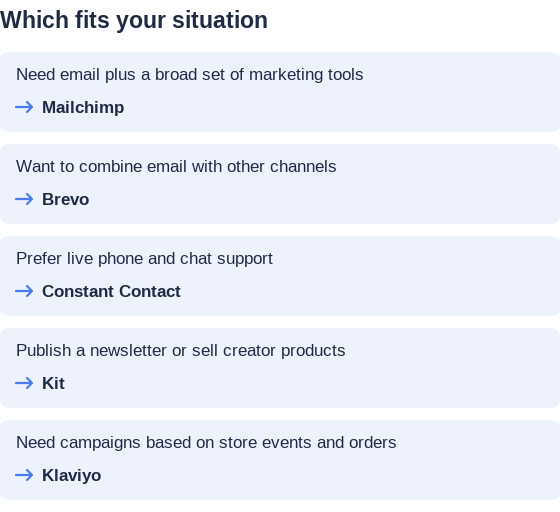
From the table above.
How this comparison was made
Prices and features come from each vendor’s published pages, checked in November 2026. The products were not tested hands-on.


