Which Experimentation Platforms Support Server-Side Testing?
Compare GrowthBook, Statsig, LaunchDarkly, and Optimizely for server-side experiments, pricing, analytics, SDKs, and use cases.

Statsig, GrowthBook, LaunchDarkly, and Optimizely support server-side experiments for backend product changes. GrowthBook suits warehouse-first teams, Statsig combines experiments with product analytics, LaunchDarkly fits flag-led releases, and Optimizely suits teams seeking a broader enterprise experimentation platform.
At a glance
| Option | Best for | Starting price (paid plan) | Free plan | Server-side testing | Source |
|---|---|---|---|---|---|
| GrowthBook | Warehouse-first teams | $40/seat/mo | Yes | Yes | growthbook.io |
| Statsig | Product analytics and experiments | $150/mo | Yes | Yes | statsig.com |
| LaunchDarkly | Flag-led release experiments | Usage-based | Yes | Yes | launchdarkly.com |
| Optimizely Feature Experimentation | Enterprise feature testing | Quote | No | Yes | optimizely.com |
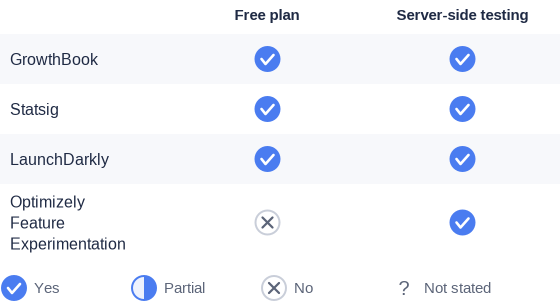
From the sourced table above, checked November 2026.
GrowthBook: best for warehouse-first teams
GrowthBook offers server-side feature-flag and experiment SDKs, and teams can analyze experiment data in their own warehouse. Its pricing page lists a free Starter plan and Pro at $40 per seat per month; using warehouse-based analysis means the team needs suitable data and a working warehouse connection. (growthbook.io)
Statsig: best for experiments with product analytics
Statsig provides server SDKs for backend services as well as client SDKs for web and mobile, with experiments, feature gates, and analytics in the same platform. Its free Developer tier includes experimentation; Pro is $150 per month and includes a usage allowance, with additional charges above it. (docs.statsig.com)
LaunchDarkly: best for flag-led release experiments
LaunchDarkly supports server-side and client-side SDKs, letting teams test flag variations while rolling out backend changes. Its current pricing page lists a free Developer plan and a paid Foundation plan billed by usage; check how service connections and monthly active users affect the bill before sizing a rollout. (developers.launchdarkly.com)
Optimizely Feature Experimentation: best for enterprise feature testing
Optimizely Feature Experimentation is designed for experiments and feature flags across an application stack, with SDKs for server languages and mobile platforms. The vendor’s plans page offers tailored pricing rather than a published paid monthly rate, so costs need to be confirmed with sales. (docs.optimizely.com)
Which experimentation platforms support server-side testing for backend product changes?
GrowthBook, Statsig, LaunchDarkly, and Optimizely Feature Experimentation all support server-side testing. Their SDKs let application code evaluate a feature or experiment on the backend, which is useful when the change affects server logic, APIs, ranking, or other behavior that a browser-only test cannot control. (growthbook.io)
They differ in how teams handle results and costs. GrowthBook suits teams that want to use their warehouse for analysis; Statsig combines experimentation and product analytics; LaunchDarkly centers testing around feature flags and release workflows; and Optimizely offers a broader commercial experimentation suite. The best fit depends on your existing data setup, required SDKs, and how much pricing predictability matters.
What should I look for in a server-side experimentation platform?
Start with SDK coverage for the languages and runtimes where the change will run, then check how the tool identifies users or accounts across requests and devices. Stable assignment depends on using consistent identifiers; if your web or mobile app also participates, check that it can receive or reproduce the server’s assignment. Optimizely, for example, documents consistent bucketing across SDKs when they share a datafile and user ID. (docs.optimizely.com)
Next, look at how exposures and outcome events are recorded, whether you can use your own analytics or warehouse, and what statistical checks are available. For backend tests, also check evaluation latency, behavior when an SDK cannot fetch updated configuration, and whether sensitive targeting attributes stay in an appropriate environment. Finally, compare pricing units: a per-seat plan, event-based fees, service connections, and a sales quote can lead to very different cost estimates.
How do server-side testing platforms handle experiment assignment and measurement?
A server SDK evaluates the experiment using a user or account identifier and targeting rules, then returns the assigned variation to application code. The code uses that result to serve the control or treatment behavior. For reliable measurement, the assignment and later outcomes, such as purchases or completed tasks, must be associated with a consistent identifier. (docs.statsig.com)
Platforms differ in when they record exposure. Statsig’s SDK logs exposure when an experiment is checked, while Optimizely records an impression from a qualifying decision; Optimizely also lets teams track conversion events separately. GrowthBook can send exposure information to an analytics system or warehouse, so teams should verify that their experiment assignment and outcome data are correctly joined there. (docs.statsig.com)
A practical implementation should record exposure when the user actually receives the changed experience, not merely when backend code evaluates a flag. If a server assigns a variation that a client later displays, pass the same user identity and assignment through that flow; otherwise, exposure counts or conversion attribution can be incomplete. (docs.optimizely.com)
Which tools support server-side tests across web and mobile?
All four options support server-side testing alongside web or mobile SDKs. Statsig lists server SDKs as well as browser, iOS, Android, React Native, and Flutter SDKs; GrowthBook describes server, client, and mobile SDK support; LaunchDarkly offers server-side and mobile SDKs; and Optimizely lists both backend-language and mobile SDKs. (docs.statsig.com)
For a test that spans backend logic and a web or mobile experience, check how each platform keeps assignment consistent across SDKs and how it attributes client-side conversions to server-side exposure. Optimizely documents deterministic bucketing across SDKs when they use the same datafile and user ID. Statsig also cautions that evaluating the same experiment for the same person in both client and server SDKs can create crossover issues, so teams should plan where assignment happens. (docs.optimizely.com)
Which should you choose?
| Your situation | Best fit |
|---|---|
| Experiment analysis should use your data warehouse | GrowthBook |
| Experiments and product analytics belong in one platform | Statsig |
| Tests are part of a feature-flag release workflow | LaunchDarkly |
| You need a broader enterprise experimentation suite | Optimizely Feature Experimentation |
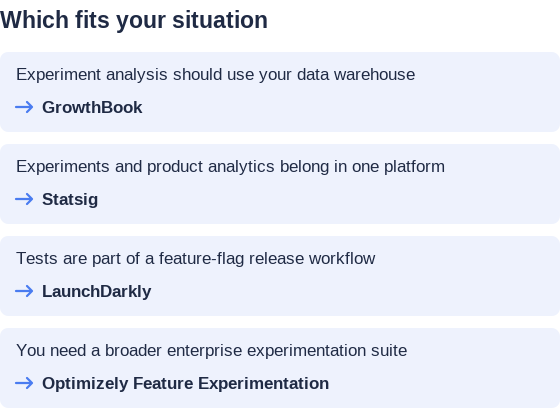
From the table above.
How this comparison was made
Prices and features come from each vendor’s published pages, checked in November 2026. The products were not tested hands-on.


