Which loyalty platforms are best for small DTC brands with lean teams?
Compare loyalty platforms for small DTC brands and lean teams, covering pricing, analytics, integrations and best use cases.

Smile and Rise.ai fit very small DTC brands; LoyaltyLion and Yotpo suit brands planning scale with analytics and integrations. Marsello sits between them for small omnichannel shops needing built-in automation and POS support.
At a glance
| Option | Best for | Starting price (paid plan) | Free plan | Lean-team friendly? | Source |
|---|---|---|---|---|---|
| Smile.io | Starter DTC shops, simple launch | $15/mo | Yes | Yes | smile.io/pricing |
| Yotpo Loyalty & Referrals | Full-suite retention for growth | $199/mo | Yes | Partial | yotpo.com/pricing/loyalty |
| LoyaltyLion | Brands that want analytics & growth | $199/mo | No | Partial | loyaltylion.com/pricing |
| Marsello | Small omnichannel stores, POS + e-com | $60/mo | No | Yes | marsello.com/pricing |
| Rise.ai | Store credit, gift-cards and cashback | Not confirmed, see source | No | Partial | rise.ai/pricing |
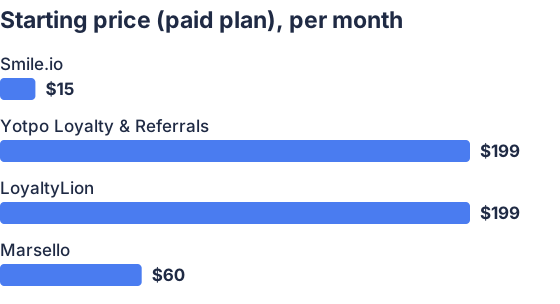
From the sourced table above, checked November 2026. Not charted, no single published figure: Rise.ai.
Smile.io: best when you want the fastest, lowest-friction launch
Smile is built for small DTC brands and offers a usable free tier plus very low-cost paid plans, so you can launch a points + referrals program quickly. The vendor publishes a Free tier and an Essential plan at $15/month (monthly billing), with higher tiers for more orders and features; this page was checked November 2026. Smile’s limits (order caps, integrations per plan) and deliberate “for startups” wording show it targets lean teams, but deeper analytics and API access sit behind higher tiers. Evidence: Smile pricing and plan feature table. (smile.io)
Yotpo Loyalty & Referrals: best when you want a full retention suite and native review/UGC integration
Yotpo offers a broad loyalty product that ties into its reviews, UGC and other marketing tools. It publishes a Free plan and a Pro tier starting at $199/month (Pro covers the first 500 orders and becomes usage-based beyond that); this pricing page was checked November 2026. That breadth means stronger integrations and features (fraud prevention, VIP tiers on higher plans), but it also increases setup scope and cost for small teams. (yotpo.com)
LoyaltyLion: best when you want built-for-growth loyalty with analytics
LoyaltyLion’s pricing page lists a Classic plan starting at $199/month (includes 500 orders) and higher custom plans for VIP tiers, advanced automations and AI recommendations. The product positions itself for brands that want analytics, Klaviyo-ready event flows and a dedicated onboarding experience, but the starting price and scope mean it’s a bigger commitment than simple point-and-redeem apps. Published pricing and feature list checked November 2026. (loyaltylion.com)
Marsello: best when you need built-in marketing automation plus POS support
Marsello publishes loyalty plans aimed at retail and e-commerce together; pricing shows a small-business entry band (USD starting from $60/month for Loyalty Launch or comparable tiers) and higher tiers with RFM segmentation, wallet passes and automations. Marsello bundles email/SMS automation with loyalty, so small teams that want one product for loyalty + basic CRM can save time that would otherwise go into stitching tools together. Pricing and features checked November 2026. (marsello.com)
Rise.ai: best when your program revolves around store credit, gift cards or cashback
Rise.ai focuses on store-credit, gift cards and membership-style loyalty. Its published pricing shows a Starter monthly plan around $19.99/month (monthly billing available) and per-order scaling; the pricing page was checked November 2026. Rise.ai is strong where loyalty is executed as credit/cashback rather than complex points+tiers, but it is less about advanced loyalty analytics or large loyalty program design out of the box. (rise.ai)
What are the best loyalty platforms for small direct-to-consumer brands with lean teams?
Answer: Pick a simple, low-friction product (Smile or Rise.ai) for quick launch; choose Marsello if you also need built-in email/SMS and POS support; pick LoyaltyLion or Yotpo if you plan fast growth and need analytics and deep integrations. Small teams should prioritize quick setup, a free or low-cost entry plan, and direct integrations to their core stack. Smile’s low entry price and free tier make it easiest to launch fast, while Rise.ai is focused on credit/gift-card mechanics; both vendors publish clear limits so you can scale consciously. Yotpo and LoyaltyLion publish higher starting costs and more features geared at brands that will maintain and iterate loyalty programs over time. (smile.io)
What features matter most for lean teams (setup, integrations, automation)?
Answer: Lean teams need fast setup, plug-and-play integrations, prebuilt automations, and usable analytics without lots of manual work. Specifically:
- Quick install + templates: pre-built earning rules, a ready loyalty landing page and emails reduce launch workload (Smile, LoyaltyLion list these capabilities). (smile.io)
- Native integrations: direct links to your store platform, ESP (e.g., Klaviyo), SMS and subscriptions avoid engineering time (Yotpo and LoyaltyLion highlight Klaviyo integrations). (yotpo.com)
- Automation & workflows: built automations for points reminders, tier upgrades and redemption emails save manual campaigns (Marsello and Rise.ai publish workflows/automations on their pricing/features pages). (marsello.com)
- Low-touch analytics: dashboards that show program ROI, reward performance and member CLV without extensive data exports are high value for a one- or two-person marketing team (LoyaltyLion and Yotpo emphasize dashboards and ROI reporting). (loyaltylion.com)
Which vendors are recommended for small e-commerce stores?
Answer: For the smallest teams launch with Smile or Rise.ai; for teams that will run loyalty plus on-site marketing and moderate automation choose Marsello; for teams expecting quick scale and wanting analytics, evaluate LoyaltyLion or Yotpo. Reasoning: Smile’s free and low-cost plans let you test and iterate with minimal spend, and Smile documents per-plan order caps and features so you can upgrade deliberately. Rise.ai is practical if your rewards are store-credit/gift-card centric. Marsello bundles loyalty with email/SMS automation and POS connectors which reduces the number of apps to manage. LoyaltyLion and Yotpo give richer analytics and integrations but cost more and require more configuration or vendor onboarding. (smile.io)
How should I evaluate pricing, scalability and analytics?
Answer: Compare published entry pricing, what the price includes (orders, integrations, automations), how overage is charged, and the analytics surface you get out of the box. Steps:
- Read the vendor pricing page for order or user caps and the exact overage rates; some vendors publish usage-based pricing (Yotpo’s Pro starts at $199/month with per-order fees beyond 500 orders). Use the published numbers checked in November 2026 when budgeting. (yotpo.com)
- Watch what the plan includes: number of integrations, automations, loyalty landing pages, and API access. Some vendors lock API or advanced reports behind higher tiers. For example, Smile limits integrations and analytics on its Essential vs Growth tiers; LoyaltyLion places advanced flows and AI features on higher plans. Factor that into the total cost to scale. (smile.io)
- Forecast your orders and do the math: usage pricing matters at scale. Yotpo makes its Pro plan usage-based beyond an included orders band; Rise.ai and Smile show order bands and per-order fees. Multiply your projected monthly orders by the published rates (including overage) to compare true cost. (yotpo.com)
- Check analytics depth: does the product offer ROI and CLV dashboards, raw exports or data-warehouse syncs? If you need program optimization without heavy BI work, prefer vendors that show ROI dashboards at lower tiers (LoyaltyLion and Yotpo advertise these features). If you plan to export data to your own BI, confirm API or export availability and whether it’s on a paid tier. (loyaltylion.com)
Which should you choose?
| Your situation | Best fit |
|---|---|
| You have a solo marketer, need lowest friction and a free option | Smile.io |
| You want store-credit/gift-card mechanics as the program core | Rise.ai |
| You run both store and e-commerce and want built-in email/SMS automations | Marsello |
| You expect to scale quickly and want deep analytics & Klaviyo flows | LoyaltyLion |
| You want a full marketing+UGC+loyalty suite and can budget for it | Yotpo Loyalty & Referrals |
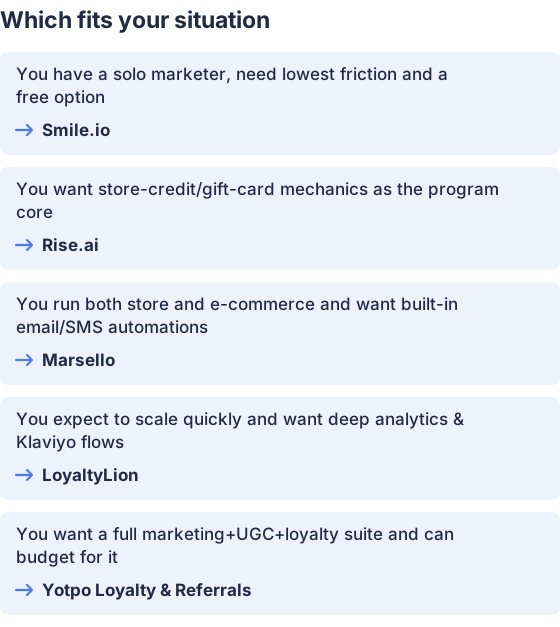
From the table above.
How this comparison was made
Prices and features were taken from each vendor’s published pricing and features pages and checked in November 2026. The products were not tested hands-on; statements reflect vendor documentation and published plan limits. (smile.io)


