What are open-source Hotjar alternatives for mobile apps?
PostHog vs OpenReplay vs Sentry: compare open-source self-hosted mobile session replay, heatmaps, and rrweb for hybrid apps.

Use PostHog or OpenReplay when you need open-source, self-hostable session replay for native mobile apps; use Sentry if you already use it for error monitoring and want replay tied to crashes; use rrweb only for hybrid/webview recording or as a building block. Each option trades ease-of-use and mobile polishing (PostHog/OpenReplay) against narrower focus (Sentry) or needing engineering work (rrweb). (posthog.com)
At a glance
| Option | Best for | Free plan | Mobile session replay | Mobile heatmaps | Self-hostable | Source |
|---|---|---|---|---|---|---|
| PostHog | All-in-one product analytics + mobile replay | Yes | Yes | Partial | Yes | posthog.com |
| OpenReplay | Full self-hosted session replay + heatmaps for teams wanting data control | Yes | Yes (beta) | Yes | Yes | openreplay.com |
| Sentry (Replay) | Teams that already use Sentry for errors and want replay tied to issues | Yes | Yes | No | Yes (self-hosted available) | sentry.help |
| Countly | Mobile-first analytics (crashes, events); good if you want mobile analytics not replay | Yes | No | No | Yes | support.countly.com |
| rrweb | Library for web (and WebView) recording, good for hybrid apps or custom builds | Yes | Partial | No | Yes | github.com/rrweb-io/rrweb |
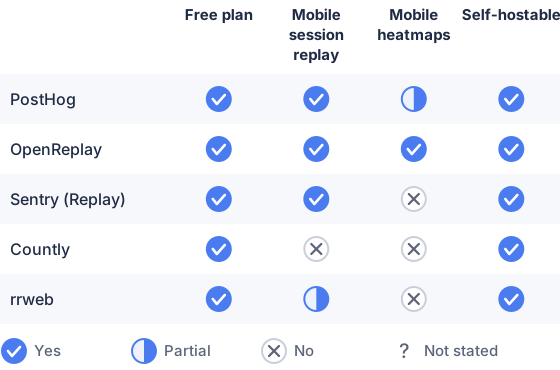
From the sourced table above, checked November 2026.
PostHog: best when you want an open-source, all-in-one product analytics stack with mobile replay
PostHog is an MIT-licensed product analytics platform you can self-host or use cloud; it includes mobile SDKs (iOS, Android, React Native, Flutter), session replay for mobile, and heatmap features derived from recordings. The cloud pricing model is pay-as-you-go (no fixed entry price shown on the public page) and there is a substantial free tier (1M events and thousands of replays per month as published). If you need analytics, feature flags and mobile replay in one system and can operate the stack, PostHog is the most turnkey open-source choice. (posthog.com)
OpenReplay: best when you must self-host an experience platform and keep full data control
OpenReplay is explicitly built as a self-hostable session-replay + product-analytics platform with mobile SDKs (iOS, Android, React Native) and heatmaps in its feature set; the open-source edition runs on your servers and the company also sells managed Dedicated plans starting at $199/mo. If data residency and running everything on your infrastructure are hard requirements, OpenReplay focuses on that use case and bundles replay, heatmaps and developer DevTools. Mobile support is marked in their docs (mobile is available; mobile features were in beta at times). (github.com)
Sentry (Session Replay): best when you want replay tied to errors and observability
Sentry is primarily an error/observability platform that added session replay and supports mobile SDKs; replay integrates tightly with crash/error events so you can jump from an exception to the user session that triggered it. Sentry is source-available and offers self-hosting; replay is available for mobile (iOS/Android/React Native/Flutter) but Sentry is not built to provide behavioral product heatmaps like Hotjar. Use Sentry when the prime goal is debugging and crash investigation rather than UX heatmaps. (sentry.help)
Countly: best when you want a mobile-first analytics platform (no native replay)
Countly began as a mobile analytics platform and still focuses on mobile SDKs, crash reporting, and messaging; however its Heatmaps and some recording features are web-SDK focused only. Countly is a legitimate self-hostable option for mobile analytics, but it does not provide native session replay or mobile heatmaps the way PostHog/OpenReplay do. (support.countly.com)
rrweb: best when you control a WebView or need a low-level recorder for hybrid apps
rrweb is an open-source DOM recording and playback library for the web; it is not a drop-in native mobile SDK. It can be used inside WebViews or as a component of a custom hybrid solution, but for true native iOS/Android apps you will need a mobile-focused recorder (PostHog/OpenReplay/Sentry) or build additional adapters. rrweb is a building block, not a full product. (github.locker)
What are open-source Hotjar alternatives for mobile apps?
PostHog, OpenReplay, and Sentry are the practical open-source or source-available alternatives that explicitly support mobile session replay; rrweb is available as a recorder for web and hybrid WebViews, and Countly covers mobile analytics but not native replays. PostHog documents mobile SDKs and mobile session replay support for Android, iOS, React Native and Flutter. OpenReplay lists native mobile session replay and includes heatmaps in its open-source feature set. Sentry provides replay tied to errors and supports mobile platforms, but it is focused on observability rather than behavioral heatmaps. (posthog.com)
Which support session replay and heatmaps in mobile apps?
PostHog and OpenReplay support session replay for native mobile apps; PostHog also offers heatmap generation that can be rendered over screenshots/recordings (PostHog’s heatmaps include screenshot and recording-backed heatmaps), while OpenReplay advertises heatmaps together with its replay features. Sentry supports mobile session replay but does not provide Hotjar-style aggregated behavioral heatmaps for app screens. Countly’s heatmaps functionality is documented as web-SDK only; it does not provide native mobile session replays. rrweb is web-focused and only applies to mobile web or WebView recording unless extended. (posthog.com)
How do features and integrations compare to Hotjar?
Hotjar (now part of Contentsquare) bundles session recordings, heatmaps and surveys with an easy UI focused on website UX and voice-of-customer flows. PostHog and OpenReplay aim to be broader product platforms: they combine replay with analytics, funnels, and developer DevTools, plus integrations and SDKs for mobile; they require more operational work if self-hosting but give full data control. Sentry ties replay into error traces and developer workflows rather than UX research. Countly is strong for mobile telemetry, crash reporting and messaging but lacks native replay/heatmap parity with Hotjar. If you need Hotjar-like survey widgets and low-friction site heatmaps on the web, Hotjar/Contentsquare remains the simplest; for native apps, PostHog/OpenReplay give the closest feature overlap but expect more engineering setup. (contentsquare.com)
How to self-host and deploy open-source options?
- PostHog: official docs provide several self-hosting options (Docker Compose, Kubernetes, and "Pay-as-you-go" cloud); self-hosting requires a database and ClickHouse/ClickHouse-adjacent storage and operational planning. Follow PostHog’s self-hosting guide and sizing notes before production use. (posthog.com)
- OpenReplay: the project is explicitly designed to run on-prem; the open-source repo and docs show deployment patterns. The vendor also lists a Dedicated managed offering if you do not want to run the stack yourself. Expect to provision storage for session blobs and a reliable backups/retention plan. (github.com)
- Sentry: Sentry publishes self-hosted instructions (onpremise/Docker Compose and Helm for larger installs). Replay in self-hosted Sentry can require enabling specific features and storage for attachments; Sentry’s community and docs list known operational caveats. (github.com)
- Countly: Countly Community Edition is runnable on your servers; heatmaps are web-only, and some features are enterprise-only. Countly docs explain SDK installation and the server-side components you must run. (support.countly.com)
- rrweb: rrweb is a library you integrate into your web or WebView code. For hybrid/native apps you must implement a bridge that collects events/screenshots and an ingestion/Play UI. Self-hosting here means building your own ingest, storage and playback front end (rrweb provides serialization and a player for the web). (github.locker)
Runbook notes common to all self-hosted replay systems: estimate sessions/day × average recording size × retention days to size storage; secure and redact PII at capture time; plan ingest/consumer scaling (replay processing can be CPU/disk intensive); and automate backups and retention. Independent guides and vendor docs highlight these operational costs. (openreplay.com)
Which should you choose?
| Your situation | Best fit |
|---|---|
| You want an open-source product analytics system with mobile replay and heatmaps | PostHog |
| You must fully control all session data and prefer self-hosting or a managed dedicated instance | OpenReplay |
| You already use Sentry for errors and want replay linked to crashes | Sentry |
| You need mobile crash reporting, push and event analytics but not replay | Countly |
| You have a hybrid app/WebView and want a low-level recorder to build on | rrweb |
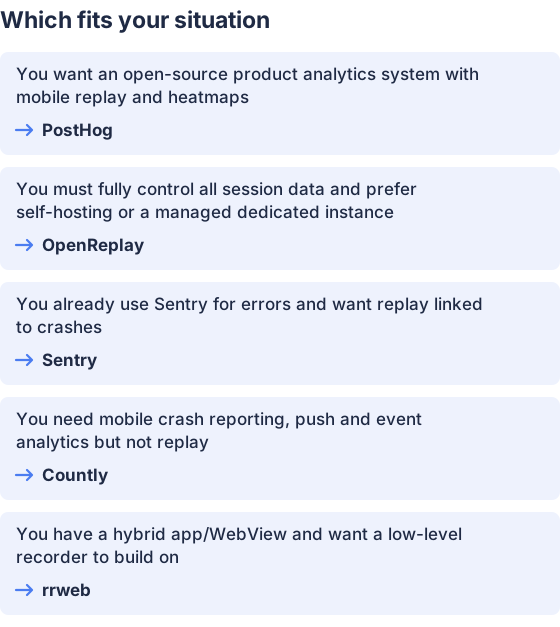
From the table above.
How this comparison was made
Prices and feature claims come from each vendor’s published pages and documentation, checked in November 2026. The products were not tested hands-on; statements reflect vendor docs, changelogs and official pricing pages. (posthog.com)


