Postscript vs. Subtext: Which SMS Platform Is Best for Shopify?
Postscript vs Subtext: compare Shopify integration, SMS automation, conversation tools, pricing, and which platform best fits your store.

Postscript is the better fit for Shopify-first promotional automation; Subtext suits stores that prioritize conversational SMS and offers API access. The main distinction is how closely you want SMS tied to Shopify out of the box, versus how much you value a flexible, conversation-centered platform.
At a glance
| Option | Best for | Starting price (paid plan) | Free plan | Native Shopify integration | Source |
|---|---|---|---|---|---|
| Postscript | Shopify ecommerce campaigns | $0/mo | No | Yes | postscript.io |
| Subtext | Two-way audience messaging | Usage-based | No | Not stated | joinsubtext.com |
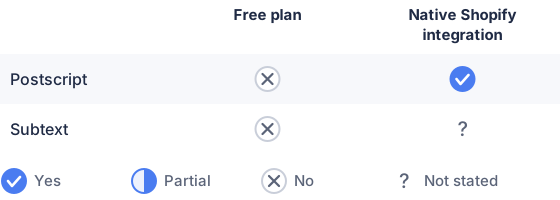
From the sourced table above, checked November 2026.
Postscript: best for Shopify-native ecommerce campaigns
Postscript’s main advantage is that it is designed around ecommerce messaging and Shopify customer data. Its published features include segments using Shopify data, customer-acquisition tools such as popups and checkout opt-ins, and automations for events such as cart abandonment, welcome messages, and shipping updates. That makes it a direct fit if you want SMS campaigns and customer journeys closely tied to store activity, rather than primarily sending audience-wide updates. (Postscript pricing and features; Postscript product features) (postscript.io)
The published Starter plan is $0/month, but it has a $49 monthly minimum spend and charges for messages and carrier fees; it is not a no-cost plan for ongoing use. Postscript also lists paid tiers at $100/month and $500/month, which add features such as unlimited opt-in keywords, support, and enhanced analytics. Check the message rates, carrier charges, and monthly minimum against your expected sending volume before comparing the headline plan prices. (Postscript pricing, checked November 18, 2026) (postscript.io)
The trade-off is that Postscript’s strongest fit is a store that wants to run and measure a dedicated ecommerce SMS program. If your priority is chiefly a flexible inbox for frequent personal conversations with an audience, Subtext’s positioning may suit that workflow better. (Postscript features; Subtext FAQ) (postscript.io)
Subtext: best for conversation-first SMS
Subtext emphasizes broadcast messages, direct replies, and managing audience conversations in one dashboard. Its published tools include audience tags and segments, auto-replies, drip sequences, analytics, and API access. For a retailer that uses texts for launches, restocks, or ongoing community engagement, those capabilities can be useful, especially if two-way messaging matters as much as automated promotional flows. (Subtext pricing and features; Subtext FAQ) (info.joinsubtext.com)
Subtext does not publish a fixed monthly plan price on its pricing page. It says pricing is built around expected message volume and integrations, and bills by message; its page also says U.S. and Canada carrier fees are included in the rate. Ask for a quote based on your sending volume and setup before treating it as cheaper or more expensive than Postscript. (Subtext pricing, checked November 18, 2026) (info.joinsubtext.com)
For Shopify owners, the important limitation is what I could verify about the connection: Subtext documents API and webhook integrations, including connections to business systems, but its published pages do not state that it offers a native Shopify integration. That does not rule out a custom connection; it means you should confirm whether your store events and customer data can be connected in the way you need, and whether implementation work is involved. (Subtext API and webhook information; Subtext pricing and integrations) (joinsubtext.com)
Postscript vs. Subtext: which SMS platform is best for Shopify store owners?
Choose Postscript if you want SMS campaigns, signup tools, segmentation, and automations tied directly to Shopify data. Its published pricing and features show an ecommerce-focused toolset, including cart and browse abandonment flows and checkout subscriber collection. (Postscript pricing and features) (postscript.io)
Choose Subtext if your store’s texting program centers on broadcasts and two-way audience conversations, and you are comfortable confirming or building the data connection your Shopify workflow needs. Its pricing is customized rather than listed as a fixed monthly tier, and its published integration route includes API and webhooks. (Subtext pricing; Subtext FAQ) (info.joinsubtext.com)
For a merchant who wants Shopify-linked campaigns without a separately verified integration project, Postscript is the more straightforward fit. If conversation-first messaging is the priority, or you already have technical support for connecting systems, Subtext is worth evaluating; request a quote and confirm the Shopify connection before deciding. (Postscript features; Subtext API information) (postscript.io)
Which should you choose?
| Your situation | Best fit |
|---|---|
| You want cart, welcome, and post-purchase SMS flows tied to Shopify | Postscript |
| You want Shopify-data-based segmentation and onsite opt-ins | Postscript |
| Your program depends on broadcasts and replies from subscribers | Subtext |
| You need a fixed public monthly price before contacting a vendor | Postscript |
| You can use an API connection and want a custom-volume quote | Subtext |
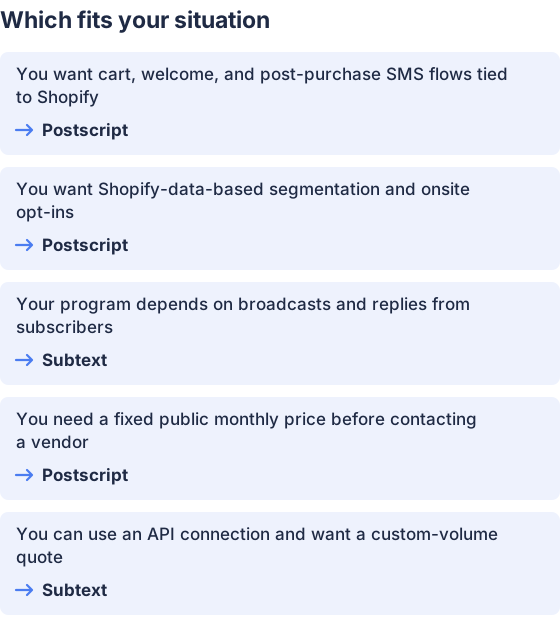
From the table above.
How this comparison was made
Prices and features come from each vendor’s published pricing and product pages, checked November 18, 2026. Neither product was tested hands-on.


