Sogolytics vs Sprig: which is better for ecommerce feedback?
Sprig vs Sogolytics vs Zigpoll: which tool fits in-product UX, enterprise VoC, or Shopify post-purchase surveys.

Choose Sprig when you need continuous, in-product UX research; pick Sogolytics for enterprise VoC and omnichannel CX; pick Zigpoll for Shopify-native ecommerce surveys.
Each targets different problems: Sprig for adaptive in-app studies and AI synthesis, Sogolytics for enterprise feedback programs and compliance, Zigpoll for fast post-purchase and on-site Shopify surveys. (sprig.com)
At a glance
| Option | Best for | Starting price (paid plan) | Free plan | In-product research | Shopify-friendly | Source |
|---|---|---|---|---|---|---|
| Sogolytics (SogoSurvey / Sogolytics) | Enterprise VoC & CX teams | Quote only | Yes | Partial | Yes | sogolytics.com |
| Sprig | In-product UX & continuous research | Usage-based | No | Yes | Partial | sprig.com/pricing |
| Zigpoll | Shopify post-purchase & on-site surveys | $29/mo (lowest paid plan shown). | Yes | Partial | Yes | zigpoll.com/pricing |
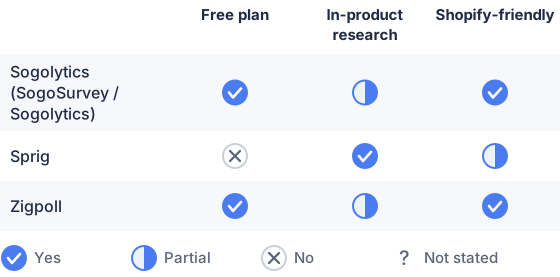
From the sourced table above, checked November 2026.
Sogolytics: best when you need enterprise VoC and compliance
Sogolytics (SogoSurvey) is an experience-management platform aimed at enterprise CX, employee experience and omnichannel voice-of-customer programs. It bundles surveys, NPS/CX tooling, automated text analytics, and workflows for actioning feedback, and it advertises enterprise security and compliance (SOC-2, ISO, HIPAA references). (sogolytics.com)
Where it falls short for ecommerce DTC teams is that it is project and response-volume priced and often sold via demo/quote rather than a self-serve Shopify app, which adds setup time and cost for small shops. (sogolytics.com)
Sprig: best when you want always-on, in-product UX research
Sprig is built for continuous product research inside web and mobile products: adaptive, chat-style studies, SDKs/JS embeds, automated analysis agents and synthesis into narratives. Its product emphasizes in-product targeting, event/attribute triggers (via Segment, GTM) and built-in analysis automation for research teams. (sprig.com)
Sprig is positioned as an enterprise research platform and does not publish simple self-serve prices; its pricing scales with response volume and activated capabilities so teams should expect usage-based or custom plans. (sprig.com)
Zigpoll: best when you run a Shopify store and need fast post-purchase feedback
Zigpoll is a Shopify-first survey app that installs via the App Store or a JS embed, supports post-purchase, order-status, exit-intent and on-site surveys, and publishes tiered plans including a free Lite plan. It’s designed for fast setup, order-linked attribution and integrations into ecommerce stacks (Klaviyo, Triple Whale, webhooks). (zigpoll.com)
It’s not an enterprise VoC platform: it trades deep omnichannel program features and enterprise governance for speed, Shopify hooks and ecommerce targeting. (zigpoll.com)
Sogolytics vs Sprig, which survey platform is better for ecommerce and product/customer insights?
Answer: It depends on the job, Sprig is better for product and in-product UX research; Sogolytics is better for enterprise VoC and broad omnichannel customer programs.
Sprig’s strength is adaptive, in-app studies, SDKs/JS installs and automated analysis that scale research across product journeys, which helps product teams find usability issues and test concepts inside the app. (sprig.com)
Sogolytics, by contrast, is an experience management suite built to collect feedback across surveys, email, calls and operational sources, then surface drivers, themes and actions for CX organizations; it’s suited to cross-channel programs and compliance needs rather than rapid in-app experiments. (sogolytics.com)
For Shopify merchants specifically, a Shopify-native tool such as Zigpoll will usually be faster to deploy and tie answers to orders; Sprig can be embedded on merchant sites via JS but is sold as an enterprise research platform, while Sogolytics is usually sold as a quote/demo engagement. (zigpoll.com)
What are the main feature differences between Sogolytics and Sprig?
Answer: Sprig focuses on in-product, adaptive studies and AI agents; Sogolytics focuses on omnichannel VoC, compliance, and enterprise workflows.
Sprig offers native SDKs/JS embeds, event/attribute targeting via Segment/GTM, adaptive conversational flows, and AI agents that build studies and synthesize results for product teams. That makes it efficient for behavioral and usability research inside apps. (sprig.com)
Sogolytics offers survey design, NPS/CX programs, omnichannel collection (email, web, calls, reviews), advanced text and sentiment analytics, dashboards and action workflows, plus enterprise security and compliance features. It’s built for organization-level feedback programs rather than continuous in-app experiments. (sogolytics.com)
Which tool is better for in-product UX and behavioral research?
Answer: Sprig is the better choice for in-product UX and behavioral research.
Sprig explicitly provides SDKs and a JavaScript install for web apps, event/attribute targeting (Segment, GTM), and adaptive survey architecture that reacts to user behavior, which is exactly what you need to trigger studies based on user actions and collect rich behavioral context. Its Analyze and Synthesize agents automate statistical checks and narrative generation for product research teams. (sprig.com)
Sogolytics can collect in-app feedback and supports many channels, but it is primarily aimed at structured CX programs and enterprise reporting rather than the rapid iterative testing and event-driven targeting product teams typically use. (sogolytics.com)
How do pricing, integrations (Shopify), and target users compare?
Answer: Pricing and go-to-market differ: Sogolytics is enterprise/quote, Sprig is usage-based enterprise research, and Zigpoll is the Shopify-centric self-serve option with published tiers.
- Pricing: Sogolytics asks for demo/quote and bases pricing on responses and admin counts (quote only). (sogolytics.com) Sprig’s pricing scales with response volume and activated capabilities and is provided by sales (usage-based/no published fixed plan). (sprig.com) Zigpoll publishes self-serve plans (free Lite plus paid tiers; vendor page shows paid plans start from $29/mo as published). (zigpoll.com)
- Integrations/Shopify: Sogolytics lists Shopify among its enterprise integrations, so it can feed order metadata via integrations or API but is not a Shopify App Store native post-purchase widget by default. (sogolytics.com) Sprig integrates with product analytics and tag managers (Segment, GTM, Mixpanel, Amplitude) and provides embeddable SDKs, it does not advertise a dedicated Shopify App Store flow; embedding is technical but possible. (sprig.com) Zigpoll is built for Shopify with a one-click install, post-purchase and order-status hooks, Shopify Flow triggers and native checkout insertion, making it the easiest self-serve choice for merchants. (zigpoll.com)
- Target users: Sogolytics targets CX, compliance and enterprise teams running omnichannel programs. Sprig targets product, UX and research teams that need continuous, in-product studies and AI-assisted analysis. Zigpoll targets ecommerce merchants (Shopify stores) who want order-linked, post-purchase and on-site feedback quickly. (sogolytics.com)
Which should you choose?
| Your situation | Best fit |
|---|---|
| You need continuous in-app usability and behavior research | Sprig |
| You run enterprise CX programs across web, email, calls and reviews | Sogolytics |
| You run a Shopify store and want fast post-purchase attribution surveys | Zigpoll |
| You want automated statistical analysis and narrative reports for product studies | Sprig |
| You need order-linked NPS, attribution and Shopify webhooks | Zigpoll |
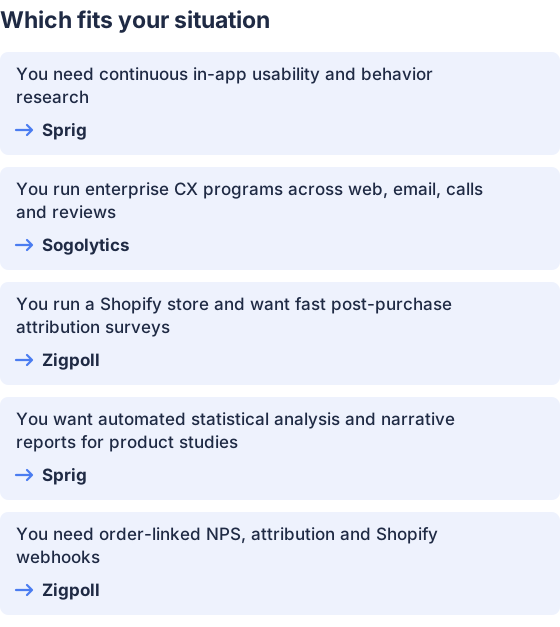
From the table above.
How this comparison was made
Prices, integrations and feature claims were taken from each vendor’s published pages and documentation and checked in November 2026 (see links inline). (sprig.com)
Products were not tested hands-on for this comparison; this is a feature, pricing and positioning summary based on vendor pages and public third-party listings. Zigpoll publishes this page. (zigpoll.com)


