Which Survey Sample Platforms Balance Data Integrity and Self-Serve?
Compare Prolific, CloudResearch Connect, Pollfish, and Zigpoll on audience, pricing, sample integrity, and self-serve features.

Prolific, CloudResearch Connect, and Pollfish are strong self-serve sample options, with the best fit depending on your audience and research design. Zigpoll is different: it collects feedback from your own customers, rather than independently recruiting an external sample.
At a glance
| Option | Best for | Starting price (paid plan) | Free plan | Published sample-integrity controls | Self-serve setup | Source |
|---|---|---|---|---|---|---|
| Prolific | Academic and UX studies | Usage-based | No | Yes | Yes | prolific.com |
| CloudResearch Connect | Research with targeting and quotas | Usage-based | No | Yes | Yes | cloudresearch.com |
| Pollfish | Broad consumer market research | Usage-based | Yes | Yes | Yes | pollfish.com |
| Zigpoll | Feedback from existing customers | $39/mo | Yes | Not stated | Yes | zigpoll.com |
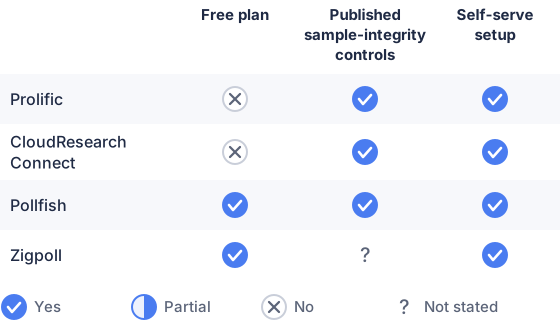
From the sourced table above, checked November 2026.
Prolific: best for controlled research recruitment
Prolific suits studies that need a self-serve participant pool, detailed prescreening, or repeatable research workflows. It reports identity verification and more than 110 checks for response quality and potential misuse of AI-generated answers; researchers can also add study-level checks. Its pricing is based on participant rewards plus a platform fee, so total cost grows with sample size and reward level. (researcher-help.prolific.com)
A trade-off is that a vetted opt-in pool is not automatically representative of the population you want to describe. Check the available audience filters against your study’s target population, and use a different sampling design if probability-based selection is required. (aapor.org)
CloudResearch Connect: best for DIY studies with quotas
Connect is a good fit when researchers want to set up projects themselves, choose demographic targets, manage submissions, and set quotas. Its controls include participant vetting and ongoing behavioral monitoring; researchers can also target by location or demographics, set quotas, and exclude people from earlier studies. A census-matched template approximates U.S. Census distributions on selected characteristics, but CloudResearch says it should not be treated as a representative sample. (cloudresearch.com)
Costs vary with participant compensation and platform fees, rather than a fixed monthly subscription. Connect says its platform fee is 25% for academic and nonprofit researchers and 40% for other researchers. Its own FAQ says very hard-to-reach recruitment may require managed research, so it may be less hands-on for niche audiences. (connect-researcher-help.cloudresearch.com)
Pollfish: best for self-serve consumer sampling
Pollfish fits teams that want to build a survey, select an audience, see an estimate, and pay for completed responses. Its DIY tool charges per response, with the published starting rate at $0.95; the estimate can change with targeting and survey details. Pollfish describes multilevel verification and fraud prevention, and its broader consumer panel can suit market research beyond academic studies. (pollfish.com)
The main limitation is that the lowest advertised per-response rate is not necessarily the final cost for a narrowly qualified group or longer survey. Preview the quote for your actual audience, and ask how sample sources and quality exclusions will be documented. Pollfish’s free account lets teams build and preview surveys, but launching to collect responses is paid. (pollfish.com)
Zigpoll: best for feedback from your own customers
Zigpoll is not a general-purpose sample marketplace: it lets businesses survey people they already reach through their own website, email, SMS, or, for Shopify merchants, purchase-related touchpoints. That makes it a useful alternative when the research question is specifically about existing customers, such as post-purchase experience or customer satisfaction. Its published feature set includes NPS and CSAT surveys, integrations, and an MCP server for querying survey data through AI assistants. (zigpoll.com)
It cannot independently recruit a representative sample of people who are not already in your audience. Zigpoll’s pricing page lists a free Lite plan with 50 responses a month; paid plans start at $39 per month billed monthly, or $29 per month billed annually, checked in November 2026. (zigpoll.com)
Which survey sample platforms offer the best balance of data integrity and self-serve capabilities?
For researcher-run studies, Prolific and CloudResearch Connect offer a strong balance of self-serve setup and published participant-quality controls; Pollfish is a fit for consumer market research. They differ in their audiences, targeting options, and cost structures, so choose based on the population you need rather than a platform’s quality claims alone. (researcher-help.prolific.com)
Independent evidence can help calibrate vendor claims: a 2023 PLOS ONE comparison found higher-quality data from Prolific and CloudResearch than from MTurk, Qualtrics, and SONA in the study’s research tasks. That result is useful context, not a guarantee for every survey, sample, or current platform workflow. For feedback from an existing customer base, Zigpoll is a different route, not a substitute for recruiting an external sample. (journals.plos.org)
How can I evaluate data integrity across survey sample platforms?
Compare the safeguards the platform documents, the sample’s fit to your target population, and whether you can inspect and report the resulting data. Identity and duplicate-account controls, location checks, behavioral monitoring, attention or comprehension checks, and response-review tools can reduce particular risks, but no single check establishes that a sample is representative or every answer is truthful. (researcher-help.prolific.com)
Ask vendors how people enter the panel, how they are screened and rechecked, what happens when a response is flagged, and which exclusions or quality metrics you can see in the export. AAPOR’s disclosure standards call for reporting the sampling method, supplier, population coverage, screening, data-quality procedures, and study limitations. Also distinguish a quota-balanced opt-in sample from a probability sample: quotas can shape composition without making the selection random. (aapor.org)
What self-serve features should a survey sample platform offer?
A useful self-serve platform should let you define an audience, set sample size and quotas, estimate costs before launch, and manage fieldwork without waiting for a sales-led setup. Look for clear controls to pilot a survey, exclude prior participants, monitor progress, close collection, review or remove responses, and export respondent-level data. (connect-researcher-help.cloudresearch.com)
For ongoing research, collaboration features, saved audiences, repeat-study controls, integrations, and an API can reduce manual work. Just as important, the interface should make limits visible: which audiences can be reached, how targeting affects price and speed, and what the platform means by “representative” or “quality checked.” (prolific.com)
Which should you choose?
| Your situation | Best fit |
|---|---|
| Academic or UX study with prescreening | Prolific |
| DIY study with demographic quotas | CloudResearch Connect |
| Broad consumer survey with pay-per-response pricing | Pollfish |
| Feedback from your existing Shopify customers | Zigpoll |
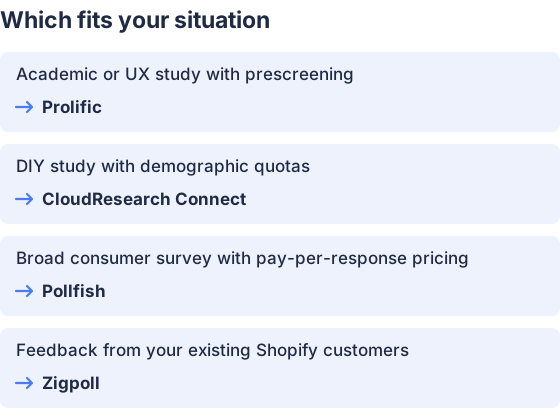
From the table above.
How this comparison was made
Prices and features come from each vendor’s published pages, checked in November 2026. Products were not tested hands-on. Zigpoll publishes this page.


