Which Tools Help Design and Test Registration Flows?
Compare VWO, PostHog, and GrowthBook for registration-flow testing, including features, pricing, and how to measure completion rates.

VWO suits teams that want visual editing; PostHog suits teams that need analytics and session replay; GrowthBook suits engineering-led experimentation. Choose according to how you build and instrument registration, then test a specific change against a control rather than assuming it will improve completion.
At a glance
| Option | Best for | Starting price (paid plan) | Free plan | Visual editor | Source |
|---|---|---|---|---|---|
| VWO | Visual web experiments | Usage-based | No | Yes | wingify.com |
| PostHog | Analytics-linked experiments | Usage-based | Yes | No | posthog.com |
| GrowthBook | Engineering-led testing | $40/seat/mo | Yes | Partial | growthbook.io |
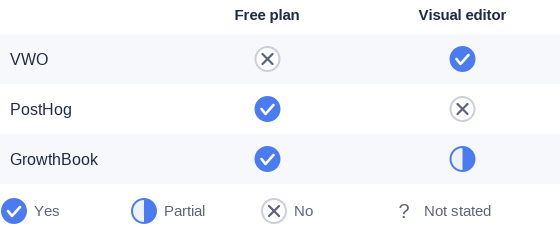
From the sourced table above, checked November 2026.
VWO: best for visual web experiments
VWO offers a visual editor for creating page variations, plus A/B testing, a QA assistant, and single-page-application support, making it a practical fit for teams that want to test interface changes without coding every variation. Its published Web Experimentation pricing describes plans but does not list a monthly dollar amount; its free access is a trial, not a continuing free plan. Pricing depends on usage, so check the expected visitor quota before committing. (VWO plans; VWO pricing FAQ)
PostHog: best for event analytics and replay
PostHog combines experiments with feature flags, product analytics, and session replay. Teams can track registration events, compare variant outcomes, and inspect recordings to investigate where people get stuck; setting up the events and implementing variations may require developer work. PostHog offers a continuing free tier, with usage-based charges above product allowances rather than a fixed paid-plan price. (PostHog experiments; PostHog pricing)
GrowthBook: best for engineering-led testing
GrowthBook fits teams that already use feature flags or a data warehouse and want experiments connected to that setup. Its free Starter plan includes experiments, while the $40-per-seat monthly Pro plan adds an AI visual editor and advanced testing features. It offers flexibility for developers, but its visual editing is plan-dependent, and connecting the test to useful registration data may require configuration. (GrowthBook pricing)
Which solutions make it easy to design and test registration flows that improve completion rates?
VWO is the most direct fit for visually changing a web registration page; PostHog is a strong fit when event analysis and session replay matter; GrowthBook suits teams that want feature-flagged experiments and control over their data setup. VWO’s visual editor and QA assistant support page-level testing, while PostHog connects experiments to analytics and recordings. GrowthBook supports experiments and feature flags, with visual editing available on Pro. (VWO plans; PostHog experiments; GrowthBook pricing)
“Easy” depends on the work your team can do: visual editors reduce the need to code variations, while event-based platforms depend on correctly instrumented steps and developer support. None guarantees higher completion; the result depends on the change, the audience, and a valid test. Registration edits worth testing include simplifying fields, clarifying password requirements, or improving error messages. Usability guidance from Nielsen Norman Group recommends reducing effort and clearly identifying required fields. For checkout-related registration, Baymard’s research also highlights the burden of unnecessary fields.
What features should I look for in a registration-flow testing tool?
Look for reliable A/B assignment, a way to edit the flow, event-level measurement, quality checks, and safeguards for user experience. A visual editor helps marketers or designers test copy, labels, and layout; code-based changes and feature flags can handle deeper product logic. PostHog connects experiment results with analytics and recordings, VWO lists a visual editor and QA assistant, and GrowthBook combines experiments with feature flags. (PostHog experiments; VWO plans; GrowthBook pricing)
Check that the tool can track each meaningful step, not just page views: form opened, validation error, submission attempted, and registration completed. You should be able to distinguish a user who never started from one who encountered an error halfway through, and to connect those events to the variant they saw. For engineering teams, look for stable assignment across visits and a way to test feature-flagged changes safely. For low-traffic sites, verify that the tool gives you a way to estimate whether your traffic can support a useful experiment; more test variants generally require more observations.
Finally, look for pre-launch QA and data-quality checks, plus metrics for risks such as errors or slower page loads. Microsoft Research’s guidance on trustworthy experiments identifies sample-ratio mismatches as a warning that variant groups may not have received the intended traffic split, and recommends guardrails such as page-load time and error rates. (Microsoft Research)
How can I measure whether a registration-flow change improves completion rates?
Compare the share of eligible people who complete registration in the new flow with the share in the control, using the same start point and completion event for both. Define the primary metric before launching, for example: completed registrations divided by unique users who began registration. Keep assignment consistent, and make sure completion events fire correctly for both versions.
Use step-level drop-off and validation errors to diagnose where the change helped or hurt, but keep the overall completion rate as the main outcome if that is the goal. Also track guardrails, such as page performance, technical errors, and downstream account activation, so a rise in completed forms does not hide a worse experience later. Microsoft Research recommends checking data quality and guardrails as well as the primary success measure; a sample-ratio mismatch can make results untrustworthy. (Microsoft Research)
Set the test duration and the smallest improvement worth acting on before it starts, and avoid declaring a winner just because one variant briefly looks ahead. If traffic is limited, testing several changes at once can make the result harder to interpret. Confirm the tracking, then compare outcomes by variant and relevant segments, such as device type, before deciding whether to keep the change.
Which should you choose?
| Your situation | Best fit |
|---|---|
| You want to edit page variations visually | VWO |
| You need funnels and session replay with experiments | PostHog |
| Your team already uses feature flags and a warehouse | GrowthBook |
| You want to start with a free experimentation tier | PostHog |
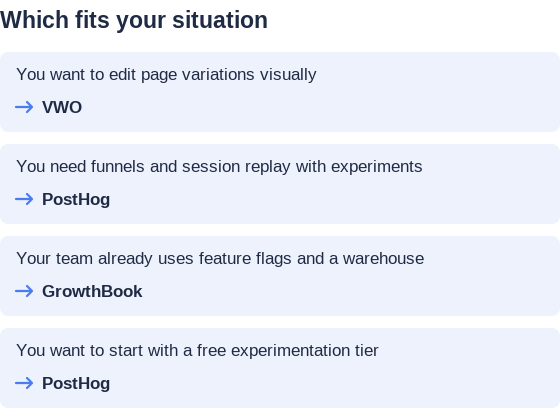
From the table above.
How this comparison was made
Prices and features come from each vendor’s published pages, checked in November 2026. The products were not tested hands-on.


