What’s the Best CDP for Cross-Channel Activation?
Compare Bloomreach, Segment, RudderStack, and Adobe Real-Time CDP for cross-channel activation, pricing, and mobile and web journeys.

Bloomreach Engagement is the best fit when you want native mobile-and-web journeys; Segment fits teams activating through a broad existing stack. Choose RudderStack for warehouse-first control, or Adobe Real-Time CDP if your program already centers on Adobe Experience Cloud.
At a glance
| Option | Best for | Starting price (paid plan) | Free plan | Native cross-channel journeys | Source |
|---|---|---|---|---|---|
| Bloomreach Engagement | Native channel execution | Quote only | No | Yes | bloomreach.com |
| Twilio Segment | Broad integration ecosystem | Not confirmed, see source | Yes | Partial | twilio.com |
| RudderStack Data Cloud CDP | Warehouse-first data teams | $265/mo | Yes | Partial | rudderstack.com |
| Adobe Real-Time CDP | Adobe Experience Cloud teams | Quote only | No | Partial | business.adobe.com |
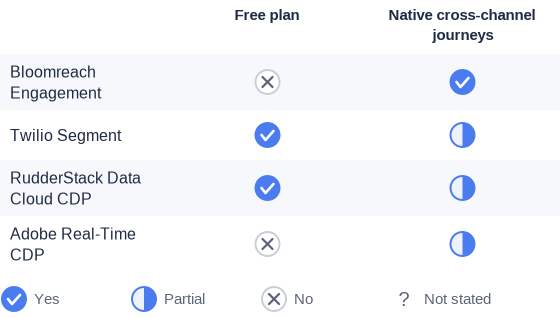
From the sourced table above, checked November 2026.
Bloomreach Engagement: best for native journeys across channels
Bloomreach suits teams that want customer profiles, audience building, and campaign execution together, rather than a CDP that mainly forwards data to separate tools. Its platform supports real-time website tracking and mobile SDKs, plus journeys, web experiences, and mobile messaging. The trade-off is cost transparency: Bloomreach says smaller brands start at $60,000 per year and bills annually, so there is no published monthly-billed entry plan. (documentation.bloomreach.com)
Twilio Segment: best for activating through existing tools
Segment fits teams that want to collect web and app events, unify customer profiles, then connect data to their existing marketing and analytics systems. Its full Customer Data Platform combines Connections, Unify, and Engage for profiles, audiences, and journeys. That distinction matters: the lower price alone does not represent the full audience and journey features. (twilio.com)
RudderStack Data Cloud CDP: best for warehouse-first teams
RudderStack is a fit for developer-led teams that want to collect events and keep customer profiles in their own data cloud. Its published Growth plan starts at $265/month, but the pricing page lists Profiles, audience building, and real-time activation features under Enterprise. So the lower plan can help route data, while teams seeking the full warehouse-based CDP and activation capabilities should check the custom Enterprise scope and price. (rudderstack.com)
Adobe Real-Time CDP: best for Adobe-centered enterprises
Adobe Real-Time CDP suits larger organizations that need profile management, identity resolution, segmentation, and activation connectors across customer data sources. Adobe prices it according to profile volume and edition, and asks buyers to request pricing. It can be a logical choice if Adobe Experience Cloud is already central to your stack; if your campaign channels sit elsewhere, compare the destinations and setup required to activate the same audience there. (business.adobe.com)
What’s the best CDP for real-time cross-channel activation on mobile and desktop?
For most teams that want to build and run journeys across mobile and desktop experiences in one platform, Bloomreach Engagement is the best fit. Segment is a strong alternative when the priority is connecting a broad set of existing tools, while RudderStack is more appropriate for teams building around their warehouse. Adobe fits enterprise programs that already rely on Adobe’s customer-experience products. (documentation.bloomreach.com)
“Real time” needs checking across the whole chain, not just event collection. A CDP may receive an app event quickly while profile resolution, audience updates, or delivery to another platform happens later. Real Story Group notes that batch processing in any of these stages can make a supposedly real-time activation behave like a scheduled one. Ask vendors to show the event-to-action delay for your actual use case, such as suppressing a desktop offer after someone buys in the mobile app. (realstorygroup.com)
What should I compare when choosing a CDP for cross-channel activation?
Compare identity resolution, event-to-action latency, destination coverage, journey controls, consent handling, and total cost at your expected data volume. First check whether the product provides live profiles and triggered audiences, or mainly sends data to other systems; the CDP Institute’s definition focuses on unified, persistent customer records, while advanced journey execution and message delivery are additional capabilities to evaluate. (cdpinstitute.org)
Then map your real channels and events. Confirm that the vendor can collect the actions you care about from both your website and mobile app, join activity when a person logs in or otherwise identifies themselves, and send an audience or decision to the systems you use. Ask which steps are truly event-triggered and which depend on a scheduled sync. For advertising destinations, also ask how long the receiving platform takes to apply a membership change.
Finally, compare operating costs and dependencies, not just the first published price. Segment’s $120/month entry plan is for Connections, not the full CDP; RudderStack’s lower-cost Growth plan does not list its CDP Profiles capabilities; and Bloomreach bills annually. Include the costs of separate email, push, messaging, or personalization tools if the CDP itself does not execute those channels. (twilio.com)
How can a CDP coordinate audiences across mobile and desktop?
A CDP coordinates channels by collecting events from the app and website, attaching them to a shared profile when identifiers allow, and updating audiences as behavior changes. For example, a person who views a product on desktop and adds it to a cart in the app could enter the same audience or journey, rather than appearing as two unrelated users. Identity resolution is what links those records; it cannot reliably connect anonymous activity across devices without identifiers or matching rules. (cdpinstitute.org)
Next, define the audience once and decide what should happen in each channel. The same group could see a relevant on-site experience, receive an app message, or be sent to an advertising destination. Use shared exclusions, consent rules, and frequency limits so that a purchase or opt-out updates what happens next, rather than relying on each channel to maintain a separate list. (bloomreach.com)
Test the full sequence with real events before rollout. Measure from the triggering event to the profile update, audience change, and channel response, and verify that a conversion removes the person from messages that are no longer relevant. The destination can add its own delay, so a CDP’s fast audience update does not guarantee that every external channel changes instantly. (realstorygroup.com)
Which should you choose?
| Your situation | Best fit |
|---|---|
| Native mobile and web journeys in one platform | Bloomreach Engagement |
| Many existing tools to connect | Twilio Segment |
| Customer data centered in your warehouse | RudderStack Data Cloud CDP |
| Activation centered on Adobe products | Adobe Real-Time CDP |
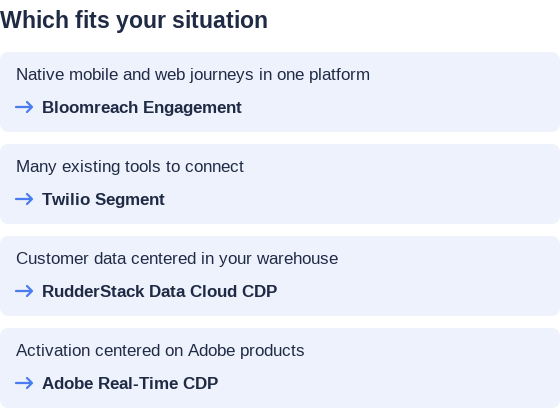
From the table above.
How this comparison was made
Prices and features come from each vendor’s published pricing and product pages, checked in November 2026. The products were not tested hands-on.


