What's the best reputation management software for insurance agencies?
Compare insurance reputation software by pricing, policy-triggered reviews, integrations, and multi-location features.

For insurance agencies, the best reputation software depends on whether you need policy-triggered review workflows, simple review tools, or multi-location management. CallBack CRM is built for insurance workflows; NiceJob suits agencies seeking straightforward review requests; Reputation and Birdeye fit teams that need broader location-level oversight.
At a glance
| Option | Best for | Starting price (paid plan) | Free plan | Policy-triggered workflows | Source |
|---|---|---|---|---|---|
| CallBack CRM | Insurance-specific workflows | $97/mo | No | Yes | callbackcrm.com |
| NiceJob | Straightforward review requests | $95/mo | No | Not stated | get.nicejob.com |
| Reputation | Multi-location review management | $80/mo | No | Not stated | reputation.com |
| Birdeye | Broad reputation platform | Quote | No | Not stated | birdeye.com |
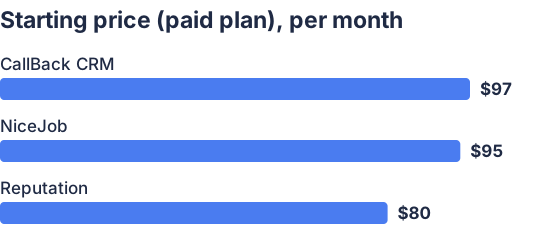
From the sourced table above, checked November 2026. Not charted, no single published figure: Birdeye.
CallBack CRM: best for insurance-specific workflows
CallBack CRM is the closest fit when an agency wants reputation tools inside an insurance-focused CRM. It says review requests can be triggered by policy issuance, renewals, or custom events, with review monitoring and AI-assisted replies in the same platform. Its limitation is scope: it is a CRM with reputation features, so it may be more software than an agency needs if it only wants review monitoring. (callbackcrm.com)
NiceJob: best for straightforward review requests
NiceJob offers automated SMS and email review requests, website review widgets, social sharing, and a review microsite. Its Pro plan adds AI replies and competitor insights, but its public feature pages do not describe policy-event triggers specifically. Check that its integrations fit your agency’s existing systems before relying on automated requests. (get.nicejob.com)
Reputation: best for multi-location review management
Reputation combines review requests, monitoring, AI-assisted responses, business listings, and reporting. Its published plans are priced per location, which makes it easier to compare the entry price for an agency with several offices, though total cost rises with location count and higher-tier features. The published pricing page does not specify insurance-policy triggers. (reputation.com)
Birdeye: best for a broad reputation platform
Birdeye offers review management alongside listings, messaging, and other customer-experience tools; its integration directory can be filtered by industry, including insurance. The tradeoff is pricing transparency: its pricing page asks businesses to request pricing rather than publishing a fixed monthly starting plan. Agencies should confirm which products, integrations, and locations a quote covers. (support.birdeye.com)
What's the best reputation management software for insurance agencies?
CallBack CRM is the most directly suited to agencies that want review requests triggered by insurance events; NiceJob is a simpler option, while Reputation and Birdeye are worth considering for broader or multi-location needs. The right choice depends on how much of your workflow you want the tool to handle. If your staff already uses an agency management system or CRM, confirm whether the reputation tool can connect to it and what information it can use to trigger requests. (callbackcrm.com)
What features should insurance agencies look for?
Prioritize review monitoring, neutral review requests, response workflows, branch-level reporting, and integrations with your existing tools. For an insurance-specific workflow, check whether a request can follow a suitable event, such as a policy being issued or renewed; CallBack says it supports those triggers. Also look for controls that let staff review suggested replies before posting, and make sure access and notifications can be assigned to the right people. (callbackcrm.com)
For an agency with multiple offices, listings management and separate location reporting can help keep branch information consistent and show where feedback needs attention. Reputation lists listings and SEO with its entry plan; Birdeye describes tools for reviews, listings, and messaging. Before choosing, confirm coverage of the review sites that matter to your customers, plus whether the plan includes every location, user, message, and reporting feature you expect. (reputation.com)
How do reputation tools compare on pricing and integrations?
As of November 12, 2026, published starting prices are $97 per month for CallBack CRM, $95 per month for NiceJob, and $80 per location per month for Reputation; Birdeye requires a quote. These are entry prices, not equivalent packages: CallBack’s stated price includes the CRM platform, while Reputation’s price is explicitly per location. CallBack also says SMS, email, and AI usage are billed separately at wholesale rates, so include expected usage when comparing costs. (callbackcrm.com)
Integration breadth is not the same as an insurance-management-system connection. CallBack lists Zapier and API/webhook options; NiceJob lists connections to tools such as HubSpot and QuickBooks; Birdeye’s catalog lists more than 3,000 software integrations and has an insurance category. Reputation lists premium integrations for CRM connections, but its pricing page describes them as add-ons. Ask vendors to demonstrate the exact data flow from your system before buying, especially if review requests should follow policy events. (callbackcrm.com)
How should an agency implement an online reputation strategy?
Start with accurate agency and branch listings, then set a consistent process for inviting clients to leave honest feedback and responding to reviews. Assign an owner for daily monitoring, agree who can approve replies, and set a response time your team can meet. Track review volume and recurring themes by location, then use those patterns to spot service issues that need follow-up.
Keep review requests neutral and send them consistently rather than screening for clients expected to leave positive feedback. Google prohibits selectively soliciting positive reviews and offering incentives for reviews; the FTC also prohibits conditioning incentives on positive sentiment and addresses deceptive review practices. In public replies, avoid sharing personal or policy details, and move case-specific conversations to a private channel. (support.google.com)
Which should you choose?
| Your situation | Best fit |
|---|---|
| Requests should follow policy events | CallBack CRM |
| You want basic review requests and widgets | NiceJob |
| You manage reviews across several locations | Reputation |
| You want reviews plus a broader platform | Birdeye |
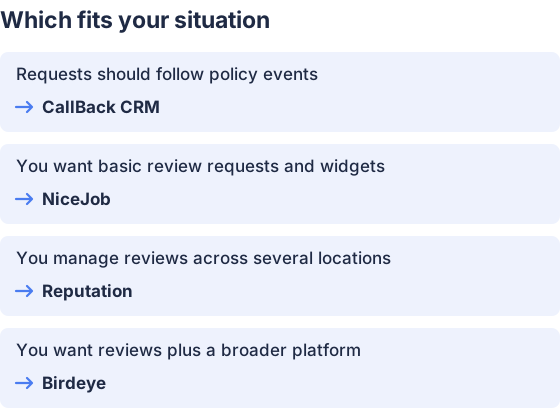
From the table above.
How this comparison was made
Prices and features come from each vendor’s published pages, checked in November 2026. The products were not tested hands-on.


