Which Analytics Platforms Track Custom Events Without Cookies?
Compare Plausible, Umami, and Fathom for cookie-free event tracking, ecommerce analytics, pricing, and the best fit for your goals.

Plausible, Umami, and Fathom support custom event tracking without cookies. Plausible suits straightforward website goals, Umami suits product analytics, and Fathom suits simple conversion and revenue reporting.
At a glance
| Option | Best for | Starting price (paid plan) | Free plan | Custom events without cookies | Ecommerce events | Source |
|---|---|---|---|---|---|---|
| Plausible | Website goals and marketing | $9/mo | No | Yes | Yes | plausible.io |
| Umami | Product analytics | $20/mo | Yes | Yes | Yes | umami.is |
| Fathom | Simple conversion reporting | $15/mo | No | Yes | Yes | usefathom.com |
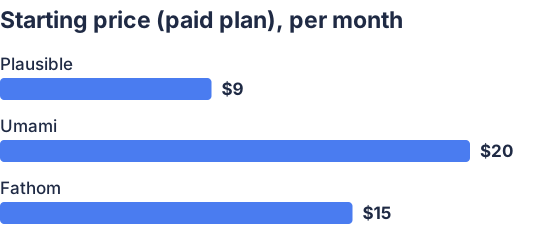
From the sourced table above, checked November 2026.
Prices are the lowest published monthly-billed paid plans checked on November 18, 2026. Feature availability and event limits can vary by plan, so check the linked vendor pages before choosing.
Plausible: best for website goals and marketing
Plausible records custom events such as signups and purchases without cookies, and can attach properties or revenue values to events. You can set up events with CSS classes, JavaScript, or a server-side request, then use them as goals and funnel steps. Its main trade-off is that ecommerce revenue attribution and custom properties are reserved for the Business plan, rather than the lowest-priced plan. (Custom event documentation; plan features)
Umami: best for product analytics
Umami’s web tracker does not use cookies, and its hosted product supports custom events, event properties, funnels, and retention analysis. Its free Hobby plan includes up to 100,000 events per month for one website; the lowest paid plan is $20 per month and includes one million events, with additional event charges above that limit. Umami is a fit when you want more product-analytics reporting than a simple goals dashboard, though its pricing depends on tracked usage. (Umami FAQ; pricing)
Fathom: best for simple conversion reporting
Fathom lets you send named events for actions such as form submissions, clicks, purchases, and checkout completions without cookies. You can attach a monetary value to an event and review conversions and revenue in its dashboard. It keeps setup simple, but its event model is less suited to detailed product analysis: the documented event call offers an event name and optional value, rather than the richer custom-property reporting available in some tools. Events also count toward the monthly pageview allowance. (Event tracking; pricing)
Which analytics platforms support custom event tracking without cookies?
Plausible, Umami, and Fathom all support custom events without cookies. Choose Plausible for website goals and marketing attribution, Umami for product-oriented reports, and Fathom for a simpler view of conversions and revenue. (Plausible; Umami; Fathom)
“Cookie-free” does not mean every analytics feature is identical across products. Compare how each handles event properties, unique visitors, attribution, and retention, and check which capabilities are included in the plan you would actually use. For example, Plausible lists revenue attribution and custom properties as Business-plan features, while Umami prices its hosted plans partly by event volume. (Plausible plans; Umami pricing)
What should I look for in a cookie-free product analytics tool?
Look for the event detail you need, the reports you will use, and a clear pricing limit. A tool that records a “purchase” event may be enough for basic conversion counts; product analysis may also require properties such as plan type, product category, or checkout step, plus funnels and retention reports. Confirm whether these are supported and whether your plan includes them. (Plausible event properties; Umami features and plans)
Check the usage unit before estimating cost. Plausible counts custom events toward its plan’s usage, Fathom counts them against its pageview allowance, and Umami counts pageviews and custom events toward its event limits. Also check whether you can send events from your website’s code, a tag manager, or a server, and whether you can export or query the resulting data. (Plausible plans; Fathom pricing; Umami pricing)
Finally, inspect how the service describes visitor identification and privacy. Cookie-free tracking can still use other information to group activity or attribute events; it does not, by itself, establish that a particular setup meets your legal obligations. (Umami metric definitions; Plausible data policy)
How do cookie-free analytics platforms track user events?
They send an analytics request when a chosen action happens, such as a button click, signup, or purchase, rather than saving a tracking cookie first. The request typically includes the event name and may include an event value, properties, or page context. For instance, Plausible supports JavaScript and CSS-based events, while Fathom provides a JavaScript event call and Umami supports custom event tracking. (Plausible setup; Fathom setup; Umami FAQ)
To connect events into sessions or count visitors, a platform may use approaches other than cookies. Umami, for example, documents generating an anonymous session identifier from the website ID, visitor IP address, browser information, and a rotating salt. These methods have limits: without persistent identifiers, recognizing returning visitors and attributing a later conversion to an earlier visit may be less complete. (Umami metric definitions)
Which platforms work well for ecommerce event tracking?
Plausible and Fathom are straightforward choices for purchase events and revenue values; Umami is worth considering when ecommerce events need to sit alongside product-analytics reports. Plausible can attach revenue and properties to events, while Fathom supports purchase events with values; Umami’s hosted plans include custom events and revenue reporting. (Plausible ecommerce tracking; Fathom events; Umami pricing and features)
Before implementing one, map out the events you need, such as checkout started, purchase completed, and refund recorded, and decide which details should accompany them. Confirm that the platform can accept those details and that your chosen plan includes the reporting you need. If you depend on cross-visit attribution, test how its cookie-free approach affects that analysis; cookie-free measurement may be less able to connect a purchase to an earlier visit. (Plausible event properties; Umami pricing; Fathom pricing)
Which should you choose?
| Your situation | Best fit |
|---|---|
| You want simple website goals and marketing reports | Plausible |
| You need product funnels and retention reports | Umami |
| You want basic purchase and conversion reporting | Fathom |
| You need a free hosted starting plan | Umami |
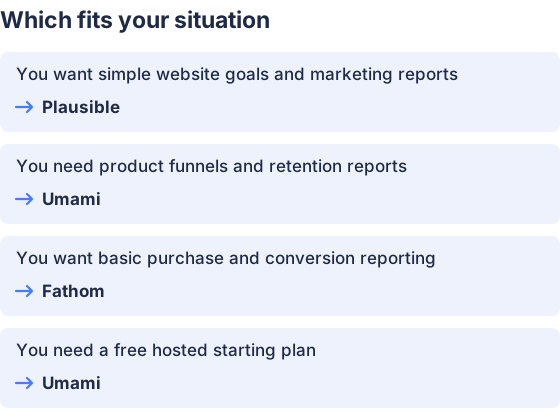
From the table above.
How this comparison was made
Prices and features come from each vendor’s published pages, checked in November 2026. The products were not tested hands-on.


