Which analytics platforms work without third-party cookies?
Compare Plausible, Matomo, PostHog, GA4 and Zigpoll for cookieless analytics, data control, product funnels, Google Ads and customer-reported attribution.

Plausible suits simple cookieless traffic, Matomo suits self-hosted control, PostHog suits product funnels, GA4 suits Google Ads measurement, and Zigpoll adds customer-reported attribution. They solve different problems: the first four analyze site or app activity, while Zigpoll gathers what customers say about how they found you.
At a glance
| Option | Best for | Starting price (paid plan) | Free plan | Cookieless tracking | Source |
|---|---|---|---|---|---|
| Google Analytics 4 | Google Ads measurement | Quote | Yes | Partial | Google Analytics |
| Plausible | Simple privacy-first web analytics | $9/mo | No | Yes | Plausible pricing |
| Matomo | Self-hosted data control | €230/mo | Yes | Yes | Matomo pricing |
| PostHog | Product funnels and events | Usage-based | Yes | Yes | PostHog pricing |
| Zigpoll | Customer-reported attribution | $39/mo | Yes | Partial | Zigpoll pricing |
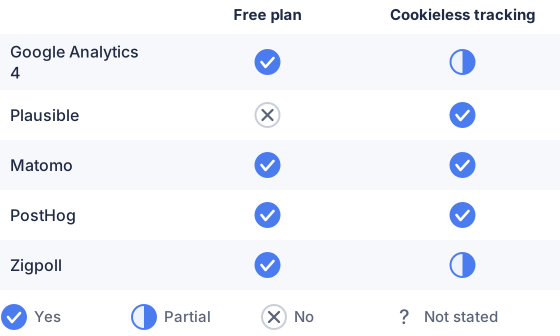
From the sourced table above, checked November 2026.
Prices checked November 12, 2026. Google’s standard Analytics is free; Analytics 360 is the paid option, and Google directs enterprise customers to sales rather than publishing a monthly price. (marketingplatform.google.com) Plausible’s lowest paid tier is $9 per month, and Matomo’s published On-Premise Team tier starts at €230 per month. (plausible.io) PostHog charges by use after its free allowance, while Zigpoll’s lowest paid plan is $39 per month. (posthog.com)
Google Analytics 4: best for Google-linked measurement
GA4 is a strong fit if you already use Google Ads and want website and app analytics in Google’s reporting ecosystem. Its Consent Mode can send limited, cookie-free measurement signals when consent is denied, then model some missing behavior; those modeled results are estimates, not observed journeys. (developers.google.com)
The trade-off is that this does not provide the same person-level continuity as consented identifiers. Reporting, data controls and integrations suit teams already invested in Google, but organizations seeking self-hosting or direct control of the analytics infrastructure should compare Matomo.
Plausible: best for straightforward, cookieless web analytics
Plausible keeps its scope deliberately focused: traffic sources, pageviews, goals, custom events and, on higher plans, ecommerce revenue attribution, funnels and user journeys. Its script stores no cookies or persistent identifiers; it estimates daily unique visitors using a rotating hash of IP address and browser user-agent, and does not link a visitor across days. (plausible.io)
That makes it a good option for aggregate web measurement without detailed visitor profiles. It is less suitable when you need to follow an individual across visits, perform session replay or build extensive product analytics; its measurement approach intentionally avoids those persistent histories. (websocket.plausible.io)
Matomo: best when data control matters
Matomo offers both a self-hosted version and cloud hosting, and its published pricing page describes the platform as providing data ownership. Its “Force tracking without cookies” setting prevents the tracker from using cookies, though Matomo warns that cookieless tracking affects report accuracy. (matomo.org)
Choose it when you want broad web and ecommerce reporting and the ability to host analytics yourself. Self-hosting gives you more control over infrastructure, but your team takes on setup, maintenance and security work; the cloud version trades some of that work for managed hosting. (matomo.org)
PostHog: best for product behavior and funnels
PostHog combines event-based product analytics with funnels, paths and session replay. Its cookieless mode can avoid browser cookies and local or session storage, instead using a privacy-preserving server-side hash to count visitors. This reduces continuity: visitors may count as different people on different days, and some features such as session replay are unavailable without consent. (posthog.com)
It fits product teams that want to analyze actions inside a digital product, not only top-level marketing traffic. The usage-based billing means cost depends on event volume beyond the free allowance, so estimate events and set billing limits before scaling. (posthog.com)
Zigpoll: best for what customers say drove a purchase
Zigpoll is a survey and feedback app, not a replacement for conventional web analytics. Its post-purchase and on-site surveys can ask “How did you hear about us?” and collect customer-reported attribution, including channels that browser referrers or analytics tagging may not identify. It also offers NPS and customer-feedback surveys. (apps.shopify.com)
Treat survey answers as a complement to measured behavior, not as a full visit-by-visit tracking record. The answer is self-reported, so it can add context about discovery while leaving page paths, drop-offs and other site behavior to an analytics platform. Zigpoll’s free plan and monthly paid option are listed on its pricing page. (zigpoll.com)
Which digital analytics platforms are best without third-party cookies?
Plausible is a good fit for simple, cookie-free website reporting; Matomo for cookie-free reporting with self-hosting options; and PostHog for cookieless event analysis. GA4 is worth considering if consent-mode modeling and Google Ads integration are priorities, while Zigpoll can supplement analytics with customer-reported attribution. (plausible.io)
“Without third-party cookies” does not necessarily mean no identifiers or no data collection. Check whether a platform uses first-party cookies, short-lived hashes, consent-based tracking, or modeled estimates, and decide which trade-offs match your privacy policy and measurement needs.
What cookieless tracking methods do these platforms use?
They use different methods: GA4 can send consent-state and event pings without cookies, Plausible uses a daily rotating hash, Matomo can disable tracking cookies, and PostHog can generate a server-side hash for cookieless counts. (developers.google.com)
These methods produce different kinds of information. Daily hashes and cookieless modes reduce cross-session continuity, while Google’s modeled data fills some reporting gaps through estimation. Zigpoll’s surveys ask customers directly; that is a different source of attribution evidence, not a method for tracking browsing behavior.
Which platforms integrate well with Shopify and ecommerce stacks?
GA4, Plausible, Matomo, PostHog and Zigpoll all document Shopify connection paths, but the setup effort and coverage differ. Shopify supports connecting a GA4 property through its Google & YouTube channel; Plausible and Matomo provide instructions for Shopify custom pixels and ecommerce events; PostHog documents theme tracking and a custom pixel for checkout conversions. (help.shopify.com)
Zigpoll offers a Shopify app for post-purchase surveys and customer feedback. For analytics pixels, check Shopify’s Customer events privacy settings: if a pixel requires analytics permission, some events may not run for shoppers who decline consent. Each platform’s Shopify guide explains its specific setup and limitations. (apps.shopify.com)
How to choose based on privacy, attribution and data ownership?
For privacy, compare what is collected, how identifiers are generated, and whether you can configure consent; “cookieless” alone does not establish that a tool meets your obligations. For attribution, separate observed referrer or campaign data, modeled reporting and customer-reported answers, since each can tell a different part of the story.
For data ownership, Matomo’s self-hosted option gives you the most direct infrastructure control, while hosted analytics means relying on a vendor’s storage and export options. Check data export, retention, hosting region and integration requirements before deciding. If the core problem is missing customer-reported discovery context, Zigpoll can complement an analytics product rather than replace it.
Which should you choose?
| Your situation | Best fit |
|---|---|
| Simple, cookie-free website reports | Plausible |
| Self-hosting and infrastructure control | Matomo |
| Product funnels and event analysis | PostHog |
| Google Ads and modeled measurement | Google Analytics 4 |
| Customer-reported purchase discovery | Zigpoll |
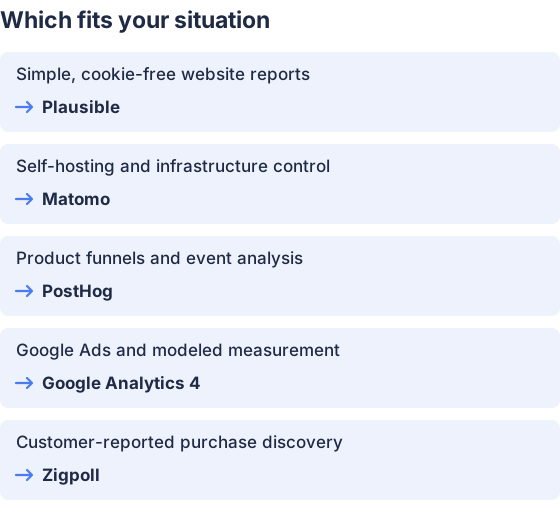
From the table above.
How this comparison was made
Prices and features come from each vendor’s published pages, checked in November 2026. The products were not tested hands-on; Zigpoll publishes this page.


