FullStory vs Contentsquare: Which is better for enterprise?
FullStory vs Contentsquare: Compare session diagnosis, visual journey analysis, enterprise features, pricing, integrations, and governance.

FullStory fits teams that want detailed interaction capture and session-level diagnosis; Contentsquare fits enterprises that prioritize visual journey analysis and impact measurement.
Both can support enterprise digital experience analytics, but neither is universally better. The deciding factors are the analyses your teams need, your governance requirements, and what each vendor includes in a custom-priced enterprise contract.
At a glance
| Option | Best for | Starting price (paid plan) | Free plan | Source |
|---|---|---|---|---|
| FullStory | Behavioral analysis and session diagnosis | Quote | Yes | fullstory.com |
| Contentsquare | Visual journey and impact analysis | $49/mo | Yes | contentsquare.com |
FullStory: best when teams need detailed behavioral evidence
FullStory combines session replay with behavioral analytics, including funnels, journey maps, dashboards, cohorts, mobile analytics, and heatmaps. Its vendor materials emphasize automatic interaction capture and sentiment signals that can help teams find friction, then inspect relevant sessions. Enterprise adds controls such as SSO and role-based permissions; some features, including multi-organization management, are optional or separately packaged. (fullstory.com)
It is a strong fit when product, support, and engineering teams need to move from an aggregate signal to what happened in a particular user session. FullStory’s paid-plan pricing is not published on its plans page, so organizations need a quote to compare enterprise costs. (fullstory.com)
Contentsquare: best when teams need visual analysis and quantified impact
Contentsquare combines replays, heatmaps, funnels, journey analysis, and impact quantification. Its Experience Analytics tiers publish some prices and limits, while its Experience Platform offers custom-priced Pro and Enterprise plans with broader cross-session and cross-device journey analysis, attribution, and enterprise features. (contentsquare.com)
It suits teams that want visual analysis of page or screen behavior and ways to quantify the conversion or revenue impact of issues. Its enterprise pricing is custom, and the Experience Platform’s plan details are separate from the self-serve Experience Analytics comparison, so buyers should confirm the exact package and limits in a proposal. (contentsquare.com)
Which is better for enterprise digital experience analytics: FullStory or Contentsquare?
FullStory is a better fit for teams centered on behavioral capture and investigating individual sessions; Contentsquare is a better fit for teams centered on visual analysis and quantified experience impact. Both offer enterprise plans, and the right choice depends on the analyses, controls, and integrations your organization needs.
FullStory’s emphasis is on capturing user interactions and connecting analytics findings to session replay. Its analytics offering includes funnels and journey maps, while its support materials describe investigating behaviors and friction in session context. (fullstory.com) Contentsquare’s emphasis includes zoning and impact analysis alongside replay and journey analysis, with enterprise packaging that adds cross-device and cross-session analysis and revenue or channel attribution. (contentsquare.com)
If your main question is “What did users do, and which sessions show the problem?”, FullStory merits a close look. If the main question is “Where on the experience is friction, and what is its business impact?”, Contentsquare merits a close look. Evaluate both with your own use cases rather than treating feature labels as proof that either will produce better outcomes.
How do their core features and analytics capabilities differ?
FullStory leans toward interaction-level behavioral evidence; Contentsquare leans toward visual experience analysis and impact measurement. Both provide replays, funnels, heatmaps, and journey-related analysis, but the capabilities and packaging differ.
FullStory describes metrics and dashboards, user journey maps, conversion funnels, segments and cohorts, mobile analytics, session replay, heatmaps, and sentiment signals. Its heatmaps can be used to inspect click and scroll behavior, while replay gives teams a way to examine sessions related to a pattern they have found. Journey analysis is plan-dependent: FullStory’s plan guide says Advanced includes journeys and conversions, with Enterprise adding further controls. (fullstory.com)
Contentsquare’s Experience Analytics page lists replays, heatmaps, funnels, and surveys across plans; Growth adds journey analysis and impact quantification. Higher tiers add capabilities such as form analysis, more advanced filtering, and deeper enterprise analytics, while the Experience Platform’s custom-priced Pro and Enterprise plans add event-based, cross-device and cross-session analysis. (contentsquare.com)
The practical distinction is not that one has replay and the other does not. It is whether teams primarily need to search behavioral data and diagnose specific sessions, or use visual and journey analytics to prioritize changes by estimated impact. Confirm which features are included in the specific enterprise plan being quoted.
How do they compare for enterprise scalability, security, and governance?
Both publish enterprise security and access-control capabilities, but the best fit depends on the controls your security and data-governance teams require. Ask each vendor to confirm the controls and terms included in the proposed plan, rather than relying on a general enterprise label.
FullStory lists Enterprise SSO, role-based permissions, and optional multi-organization management. Its help documentation also describes fine-grained access controls for analytics spaces, and its data-residency documentation says customers can designate a US or EU data center. FullStory states that privacy rules can be applied on users’ devices before data is sent. (help.fullstory.com)
Contentsquare’s plan comparison lists user permissions, SAML SSO for Pro and Enterprise, SOC 2 Type 2 reporting, data privacy controls, and ISO certifications. Its Enterprise Experience Analytics tier lists unlimited projects; its separate Experience Platform has custom packaging, so confirm how governance features and project limits apply to that product. (contentsquare.com)
For either vendor, compare the specific requirements that can affect approval: identity-provider support, role and group administration, data residency, privacy masking, retention settings, audit evidence, and data export or deletion procedures. FullStory documents EU hosting as an option; the available sources reviewed here do not establish that Contentsquare offers the same residency arrangement, so request its current documentation if location is a requirement.
Which offers better pricing, integrations, and ROI for enterprises?
Neither has a publicly listed enterprise price that allows a direct price comparison: FullStory directs buyers to request pricing, and Contentsquare’s enterprise tiers are custom-priced. Contentsquare does publish lower-tier pricing; its pricing page shows a $49 monthly-billed Growth price and a discounted annual price. (fullstory.com)
For integrations, Contentsquare lists more than 115 pre-built integrations for its Pro and Enterprise Experience Analytics tiers, and its documentation describes connectors for Google Analytics 360, Adobe Analytics, and A/B-testing tools such as Optimizely. FullStory lists integrations including Google Analytics, Adobe, Jira, Slack, Salesforce, Segment, and others, as well as APIs and warehouse-related options. Verify whether the integrations you need are included or require an add-on; FullStory, for example, identifies its Salesforce integration as a paid add-on. (contentsquare.com)
ROI depends on how a company uses the findings, not simply on the availability of a dashboard or replay. Contentsquare’s impact quantification is designed to help prioritize issues by conversion or revenue impact; FullStory’s replay and behavioral capture can help teams investigate user friction and connect it to sessions. Those are different routes to value, not a guarantee of a particular return. Compare proposed costs against your expected session volume, data retention, analyst and implementation effort, required add-ons, and the cost of connecting the product to your existing tools. (contentsquare.com)
Which should you choose?
| Your situation | Best fit |
|---|---|
| Teams need to investigate specific user sessions | FullStory |
| Teams prioritize visual page analysis and impact quantification | Contentsquare |
| You need published self-serve pricing to benchmark a starting tier | Contentsquare |
| You need Enterprise SSO and fine-grained access controls | Either |
| You need US or EU data-center choice documented | FullStory |
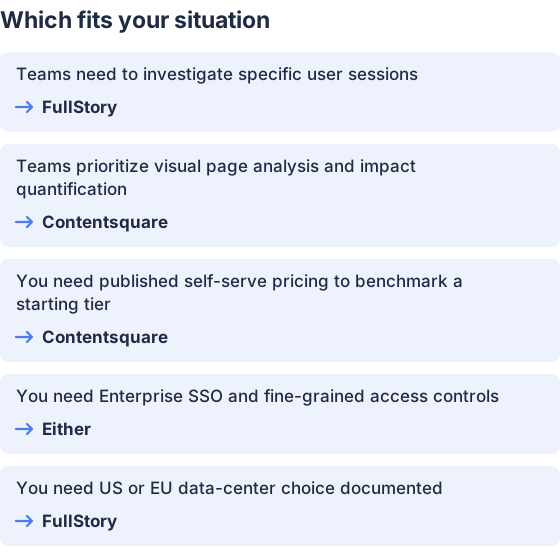
From the table above.
How this comparison was made
Prices and features come from each vendor’s published pages and help documentation, checked on November 12, 2026. The products were not tested hands-on.


