How can I auto-optimize influencer campaigns in real time?
Compare GRIN, Modash, and Influencer Hero for influencer campaign tracking, automation, pricing, and the workflows each suits.

GRIN fits teams wanting AI-assisted campaign workflows, Modash suits teams prioritizing automatic content tracking, and Influencer Hero suits teams automating outreach and affiliate reporting. These platforms automate data collection and support selected workflow steps; confirm whether any budget or creator-allocation action is truly rule-based before relying on unattended changes.
At a glance
| Option | Best for | Starting price (paid plan) | Free plan | Automatic tracking | Source |
|---|---|---|---|---|---|
| GRIN | AI-assisted campaign operations | $200/mo | Yes | Yes | grin.co |
| Modash | Cross-platform content tracking | $199/mo | No | Yes | modash.io |
| Influencer Hero | Outreach and affiliate reporting | $649/mo | No | Yes | influencer-hero.com |
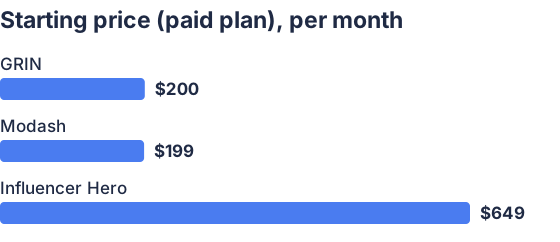
From the sourced table above, checked November 2026.
Prices and features in this comparison were checked in November 2026. “Automatic tracking” means the platform describes tracking content or campaign data automatically; it does not mean it automatically reallocates your budget.
GRIN: best for AI-assisted campaign operations
GRIN is a fit if you want campaign data and creator-program workflows in one system. Its platform describes real-time reporting on metrics including reach, impressions, engagement, clicks, conversions, and ROI, while its Gia AI agent can help with tasks such as finding creators and creating reports. The free plan is limited; the published Starter plan is $200 per month, with a management fee on wallet deposits, so check total costs against your creator-payment volume. (GRIN’s reporting features; plan details) (grin.co)
Modash: best for cross-platform content tracking
Modash suits teams that need a campaign-level view of creator posts and performance. It says it automatically collects campaign content and metrics, with post-level analytics, and can track measures such as CPM and ROAS; its Shopify sales-attribution tools are optional, so this is not limited to teams using that setup. The Essentials plan is $199 per month and includes tracking for up to 100 creators; Modash offers a free trial, not a free plan. (Modash tracking and plan features; campaign setup and tracking) (modash.io)
Influencer Hero: best for outreach and affiliate reporting
Influencer Hero is suited to teams that want campaign reporting alongside creator outreach and CRM workflows. Its platform describes automated outreach, post detection, affiliate links, discount codes, and analytics for campaign activity and sales; its reporting material also describes using campaign data to segment creators and trigger bulk actions. The published Standard plan costs $649 per month and has a three-month minimum term, making it a higher-cost fit than Modash for teams that mainly need tracking. (Influencer Hero plans; reporting and analytics) (influencer-hero.com)
What are the top options to auto-optimize influencer campaigns using real-time performance data?
For AI-assisted workflows, compare GRIN; for live post tracking, Modash; and for outreach automation connected to performance reporting, Influencer Hero. All three describe automatic tracking, but their strengths differ: GRIN emphasizes AI-assisted operations and reporting, Modash emphasizes content collection and campaign metrics, and Influencer Hero combines CRM and outreach automation with reporting. Treat them as ways to speed up measurement and decisions, not proof that the software will independently change creator fees or shift campaign budget. (GRIN; Modash; Influencer Hero) (grin.co)
Which tools and platforms enable real-time influencer optimization?
GRIN, Modash, and Influencer Hero all offer automatic tracking, but the best fit depends on what you need the data to trigger. GRIN is relevant when your team wants AI-assisted creator and reporting workflows; Modash when it wants automatic collection of campaign content and performance metrics; and Influencer Hero when outreach, creator records, and reporting should work together. Check the specific social networks, metrics, attribution methods, and automation rules included in the plan you would buy, rather than assuming every metric updates instantly or every action can be automated. (GRIN; Modash; Influencer Hero) (grin.co)
What KPIs and data should I track for automation?
Track metrics that match the campaign objective: reach and impressions for awareness; views, saves, shares, and engagement for content response; clicks and landing-page actions for consideration; and conversions, revenue, cost per acquisition, and return on ad spend for sales. Add campaign spend and creator fees so the system can calculate efficiency measures such as CPM, cost per engagement, and cost per click. GRIN lists reach, impressions, clicks, conversions, and ROI among its reporting measures; Modash describes CPM and ROAS tracking. (GRIN reporting; Modash plans) (grin.co)
For website traffic, use consistent campaign tags and a unique link or code for each creator where possible. Google Analytics documents campaign parameters such as utm_source, utm_medium, and utm_campaign, which help make traffic sources consistent enough to compare. Also define the conversion event, attribution window, and whether the report credits the last click or other touchpoints; changing those settings can change how conversions are counted. (Google Analytics campaign-tagging guidance; Google Ads attribution models) (support.google.com)
What are best practices for data-driven influencer optimization?
Set the objective, baseline, and decision thresholds before launch. For example, specify which result should prompt a human review, what counts as too little data to act on, and what change is permitted; this reduces the chance that automation reacts to a brief spike or a small sample. Review results by creator and content format as well as in aggregate, and check that links, codes, event tracking, and spend records are working before using the dashboard to make decisions.
Use attribution rules consistently across creators, and avoid treating platform-reported engagement or attributed sales as a complete view of incrementality. Keep a human approval step for consequential changes to spend, creator selection, or campaign terms unless you have tested and explicitly configured a safe rule. For U.S. campaigns, include disclosure checks in the workflow: the FTC says material connections such as payment or free products should be disclosed clearly with the endorsement, and brands should not assume a platform’s disclosure tool is enough. (FTC influencer disclosure guidance; FTC updated Endorsement Guides summary) (ftc.gov)
Which should you choose?
| Your situation | Best fit |
|---|---|
| You want AI-assisted creator and reporting workflows | GRIN |
| You mainly need automatic cross-platform content tracking | Modash |
| You want outreach automation alongside affiliate reporting | Influencer Hero |
| You need a free starting point for a small program | GRIN |
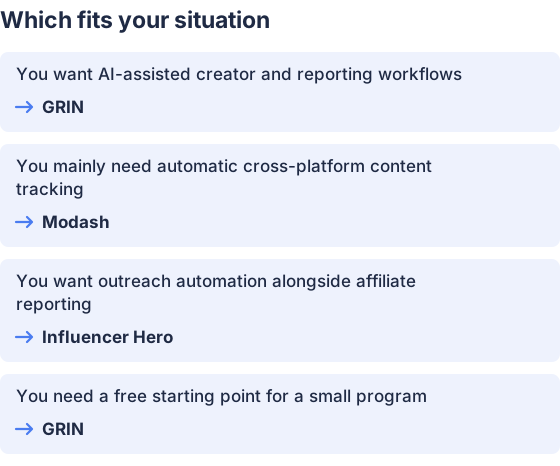
From the table above.
How this comparison was made
Prices and features come from each vendor’s published pages, checked in November 2026. The products were not tested hands-on.


