What Are the Best Alternatives to In-House UX Research?
Compare in-house UX research alternatives: agencies, freelancers, self-serve platforms, and managed services, with costs and guidance for choosing.

The best alternatives to in-house UX research are agencies for complex studies, independent researchers for flexible capacity, and platforms for repeatable testing. A self-serve tool suits teams that can run studies themselves; a managed service suits teams that need help with both research and execution.
At a glance
| Option | Best for | Starting price (paid plan) | Free plan | Researcher-led | Source |
|---|---|---|---|---|---|
| UX research agency (Marketade) | Complex, ongoing research | $20,000/mo | No | Yes | marketade.com |
| Independent UX researcher (Upwork) | Flexible specialist capacity | Usage-based | Yes | Yes | upwork.com |
| Self-serve research platform (Maze) | Repeatable usability testing | Not confirmed, see source | Yes | No | maze.co |
| Managed research platform (UserTesting) | Testing plus expert support | Quote | No | Partial | usertesting.com |
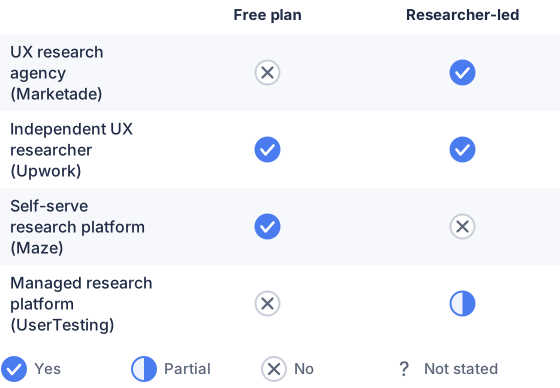
From the sourced table above, checked November 2026.
UX research agency: best for complex or ongoing work
An agency can plan and conduct research, recruit participants, analyze findings, and recommend next steps. Marketade lists usability testing, content testing, card sorts, interviews, and journey mapping among its services; its published starting prices are $30,000 for a one-time project and $20,000 per month for ongoing programs, as of November 2026. (marketade.com)
This suits a company that needs experienced researchers or several methods but does not want to build a team for a single project. The tradeoff is cost: an agency engagement may be excessive for a small, narrow usability question. A company should also set expectations for how the agency will share methods and findings so internal teams can use the work after the engagement ends.
Independent UX researcher: best for flexible specialist capacity
Hiring an independent researcher can add expertise for a defined project without a longer agency engagement or a permanent hire. A marketplace such as Upwork lets clients hire freelancers on hourly or fixed-price contracts; its client pricing describes a free Basic account with fees tied to payments, so the total depends on the contract and applicable charges. (support.upwork.com)
This route can fit a team that already knows what it needs and can manage scope, recruitment, and review. The company remains responsible for choosing a qualified researcher and coordinating the work. Check for experience with the specific research method and audience, and agree in advance on deliverables, timelines, and ownership of materials.
Self-serve research platform: best for repeatable usability testing
A self-serve platform gives a product or design team tools to create studies and review results without outsourcing every research task. The listed Starter tier is limited to one study per month and five seats, as of November 2026. (maze.co)
A platform can be useful when a team has staff who can write a sound research plan, run the study, and interpret what participants do. It can reduce the setup work for repeatable testing, but it does not replace research judgment: a tool cannot decide on its own whether the study asked the right question or whether a finding should change the product. More advanced recruitment and methods may require a higher tier or additional spending.
Managed research platform: best for research capacity plus support
A managed platform combines research software and participant access with optional professional services. UserTesting says its services can help define research objectives, choose a method, recruit participants, review tests, and prepare reports; its public plans page says pricing varies and directs buyers to request a quote, as of November 2026. (usertesting.com)
This can suit a team that needs a platform for repeated studies but also wants help with selected projects. It offers more support than a self-serve tool, but the quote-based price makes budgeting less direct, and the company still needs to decide when it wants vendor support versus internal ownership. Confirm what is included in the quote, including participant sourcing, analysis, and deliverables.
What are the best alternatives to in-house UX research?
The best fit depends on whether the company needs research expertise, execution capacity, or tools. Choose an agency for complex or continuing work, an independent researcher for a focused engagement, a self-serve platform when your team can run studies, or a managed service when you want both software and expert help. These options can also be combined: for example, a team may use a platform for routine prototype tests and bring in an outside researcher for a difficult audience or strategic question.
When should a company outsource UX research?
Outsource when the company lacks the right research skills or capacity for a particular project, needs specialist help, or wants an outside team to run a complex study. It can also make sense when research demand is occasional and does not justify building a permanent team. Keep research in-house when product knowledge, frequent iteration, and close collaboration with decision-makers matter most; even with an outside partner, the company should stay involved in defining the decision the research needs to inform.
What are the tradeoffs between research agencies and research platforms?
An agency brings people who can shape and conduct the study, while a platform provides tools that the company’s team operates. Agencies are better suited to projects that need method selection, recruiting, synthesis, or advice; they cost more and require coordination with an external team. Platforms can support repeated studies with more direct control, but their value depends on having someone inside the company who can design studies and interpret results. A managed platform sits between the two: it combines tooling with access to expert services, but the scope and price need to be checked with the vendor.
Which should you choose?
| Your situation | Best fit |
|---|---|
| Need a partner for complex, ongoing research | UX research agency |
| Need one specialist for a defined project | Independent UX researcher |
| Can run usability studies internally | Self-serve research platform |
| Need testing tools plus expert support | Managed research platform |
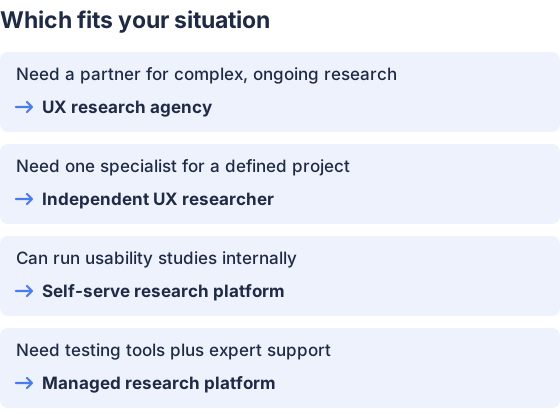
From the table above.
How this comparison was made
Prices and features come from each vendor’s published pages, checked in November 2026. The products were not tested hands-on.


