What Is the Best Attribution Model for Google Ads?
Compare Google Ads data-driven attribution and last click, and learn when customer surveys can add context beyond tracked ad interactions.

For most Google Ads advertisers, data-driven attribution is the best default; use last click when you need a simpler final-touch view. A customer survey can add context about channels Google Ads cannot fully observe, but it is not a Google Ads attribution model.
At a glance
| Option | Best for | Starting price (paid plan) | Free plan | Google Ads model? | Source |
|---|---|---|---|---|---|
| Data-driven attribution | Most conversion paths | Usage-based | No | Yes | support.google.com |
| Last click | Simple final-touch reporting | Usage-based | No | Yes | support.google.com |
| Customer-reported surveys (Zigpoll) | Missing-channel context | Not confirmed, see source | Yes | No | zigpoll.com |
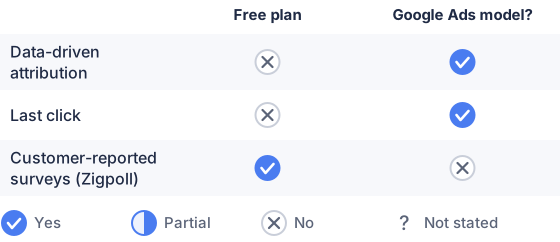
From the sourced table above, checked November 2026.
Google Ads has no monthly subscription; ad spend depends on your campaigns and billing model. Attribution is included rather than sold as a separate paid plan. Prices and features were checked in November 2026. (business.google.com)
Data-driven attribution: best for most advertisers
Data-driven attribution (DDA) suits advertisers who want to understand how Google ad interactions contribute across a conversion path, rather than awarding all credit to one interaction. Google’s model uses conversion data to estimate the contribution of ad interactions, and its reports can show whether keywords, campaigns, or devices appear undervalued under last click. It is Google’s default for most conversion actions. (support.google.com)
DDA is eligible even when a conversion action has little data, but Google says its performance improves with more: it recommends at least 200 conversions and 2,000 ad interactions in supported networks over a 30-day period. Treat that as a recommendation, not a requirement. With less data, DDA still runs, but you should be cautious about treating its credit allocation as precise. (support.google.com)
A key limitation: this is attribution across Google Ads interactions, not a complete measurement of every marketing influence. It cannot by itself tell you the full contribution of word of mouth, offline activity, or every other channel. For a wider picture, compare it with other measurement sources rather than treating any single model as ground truth.
Last click: best for a simple final-touch view
Last click gives all conversion credit to the last eligible ad interaction before the conversion. It is easy to understand and useful when your buying journey is short, when you need a consistent final-touch view, or when you are comparing results with a report that uses last-click attribution. (support.google.com)
Its trade-off is that it can overlook earlier ads that helped someone decide to convert. Google’s model comparison report is designed to help identify keywords and campaigns that may look less valuable under last click than under DDA. First-click, linear, time-decay, and position-based models are no longer available in Google Analytics, so don’t choose them expecting to find them as current alternatives there. (support.google.com)
Customer-reported surveys (Zigpoll): best for missing-channel context
A post-purchase or customer survey can ask how someone heard about a business, which can surface influences that click tracking does not show clearly. Zigpoll offers “how did you hear about us?” surveys alongside feedback tools; its Shopify App Store listing describes these as a way to compare reported channels with platform and analytics data. These answers can supplement Google Ads reporting, but they are self-reported and do not replace Google’s conversion tracking or its attribution model. (apps.shopify.com)
Zigpoll is a survey and feedback product, not an attribution model inside Google Ads. Its published pricing lists a free plan. It is relevant when you want to ask customers directly about discovery, but it won’t allocate credit among Google ad clicks in the way DDA does. (zigpoll.com)
What is the best attribution model for Google Ads?
For most advertisers, choose data-driven attribution for conversion actions that inform reporting or bidding. It can distribute credit across Google ad interactions instead of assigning everything to the final one, and Google makes it the default for most conversion actions. (support.google.com)
Use last click if you specifically need a final-touch view or want a straightforward baseline. Compare the two models in Google Ads before changing how you interpret performance: Google’s Model comparison report lets you compare them side by side, including cost per conversion and conversion value per cost. (support.google.com)
Remember that changing a conversion action’s attribution setting affects how its conversions are counted in the “Conversions” and “All conversions” columns going forward, and can affect automated bidding strategies that use those columns. Check your tracking setup and judge any change against the business decision you need to make, not simply a change in reported credit. (support.google.com)
How do I choose an attribution model for marketing?
Start with the decision you want the model to support. If you need Google Ads to value contributing interactions across a customer’s ad path, use DDA; if you need a simple report of the final eligible ad interaction, use last click. Google’s attribution setting applies to the conversion action it is configured for, so choose according to what that conversion represents. (support.google.com)
Then consider the journey length and the data behind it. A short, direct path may show little difference between DDA and last click; more interactions give DDA more information to work with. Google says the models can produce the same results in some situations and recommends at least 200 conversions and 2,000 ad interactions in supported networks in 30 days for better DDA performance. (support.google.com)
Finally, check whether your question extends beyond Google Ads. Google Ads attribution measures eligible Google ad interactions; a view of overall marketing may need other evidence too. For example, customer surveys can provide reported discovery context, while analytics and platform reports offer their own tracked views. Compare these as complementary signals, not as interchangeable versions of one definitive answer. (support.google.com)
When should I use data-driven attribution instead of last click?
Use data-driven attribution when customers may interact with multiple Google ads before converting and you want reporting or bidding to account for more than the final ad interaction. It is especially worth comparing when last-click reporting makes some campaigns or keywords appear less valuable despite their role earlier in a conversion path. (support.google.com)
You do not have to meet a minimum volume for DDA to run, but low conversion or interaction volume means less evidence for its estimates. Google recommends a specific data level to improve performance, so when your account is below it, treat DDA as a model that can still operate, not a guarantee of precise credit. (support.google.com)
Keep last click when a final-touch view best fits your reporting need, or when you need to align with another report’s last-click definition. If you switch, inspect the model comparison report and account for the fact that reported conversions can shift and that the selected model can affect conversion-based automated bidding. (support.google.com)
Which should you choose?
| Your situation | Best fit |
|---|---|
| You want a default for Google Ads conversion reporting | Data-driven attribution |
| You need a clear final-ad-interaction view | Last click |
| You want to compare credit across a Google ad path | Data-driven attribution |
| You want to ask customers how they discovered you | Customer-reported surveys (Zigpoll) |
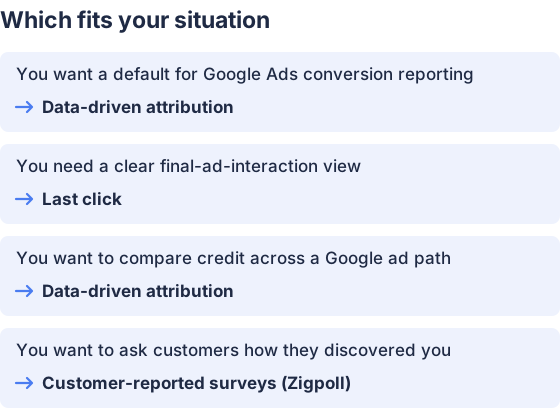
From the table above.
How this comparison was made
Prices and features come from each vendor’s published pages, checked in November 2026; the products were not tested hands-on. Zigpoll publishes this page.


