What Are the Best Micro-Feedback Tools for Retail Businesses?
Compare retail micro-feedback tools for Shopify, websites, QR surveys, and in-store kiosks, including features, pricing, and use cases.

The best micro-feedback tool depends on where shoppers encounter you: Zigpoll for Shopify ecommerce, Survicate for multi-channel surveys, Contentsquare for website behavior, and HappyOrNot for in-store kiosks. Each suits a different touchpoint, so compare how you’ll collect answers before choosing.
At a glance
| Option | Best for | Starting price (paid plan) | Free plan | Shopify-specific surveys | QR or kiosk feedback | Source |
|---|---|---|---|---|---|---|
| Zigpoll | Shopify ecommerce feedback | $39/mo | Yes | Yes | Yes | zigpoll.com |
| Survicate | Multichannel survey collection | $89/mo | Yes | Partial | Yes | survicate.com |
| Contentsquare | Website feedback and behavior | $79/mo | Yes | Partial | Not stated | contentsquare.com |
| HappyOrNot | In-store, in-the-moment feedback | Quote | No | Not stated | Yes | happy-or-not.com |
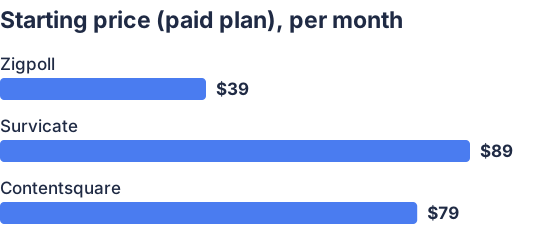
From the sourced table above, checked November 2026. Not charted, no single published figure: HappyOrNot.
Zigpoll: best for Shopify ecommerce feedback
Zigpoll is designed for Shopify and ecommerce brands. Retailers can ask short questions on Shopify’s thank-you or order-status pages, or follow up by email or SMS after fulfillment; its published features also include on-site surveys, NPS and CSAT, attribution questions, and QR codes. Its strengths are Shopify order context and multiple digital channels; it is less suited to retailers who mainly need dedicated physical feedback hardware. (zigpoll.com)
Zigpoll’s free Lite plan allows 50 responses a month. Its paid plans start at $39 per month when billed monthly, as of November 2026. Pricing and plan details. (zigpoll.com)
Survicate: best for multichannel survey collection
Survicate supports surveys by email and link, on websites and in products, and through QR codes and kiosk mode. It can suit a retailer who wants one survey platform for online prompts and printed QR codes in stores, without investing in a dedicated feedback terminal. (survicate.com)
For Shopify, Survicate’s documentation describes installing a tracking code to show surveys on store pages, but says its surveys are not supported on Shopify thank-you pages. The free plan allows 25 responses a month; the lowest paid plan with monthly billing starts at $89 per month, as of November 2026. (help.survicate.com)
Contentsquare: best for website feedback and behavior
Contentsquare combines website surveys and feedback widgets with tools such as session replays and heatmaps. That context can help a digital retail team investigate what shoppers were doing when they left feedback; it does not replace a physical kiosk for capturing reactions on a shop floor. (contentsquare.com)
Its free Voice of Customer plan includes up to 100 monthly responses and three surveys or feedback widgets. The paid Growth plan starts at $79 per month, as of November 2026. (contentsquare.com)
HappyOrNot: best for in-store, in-the-moment feedback
HappyOrNot offers physical feedback terminals, touchscreens, digital surveys, and QR-code surveys. Its simpler terminal can capture a quick rating at high-traffic points, while touchscreen and digital surveys can add an optional follow-up question and open comment. Shared analytics report trends by time and location. (happy-or-not.com)
This is a strong fit when shoppers should be able to respond without opening a survey on their own phone. Pricing depends on the equipment mix and service level; the vendor directs businesses to request a quote. (happy-or-not.com)
1. What are the best micro-feedback collection tools for retail businesses?
The best fit depends on whether feedback should come from an ecommerce order, a website visit, or an in-store moment. Zigpoll fits Shopify purchase and post-purchase questions; Survicate fits QR, kiosk-mode, and web surveys; Contentsquare fits feedback connected to website behavior; and HappyOrNot fits physical retail locations. (zigpoll.com)
For a retailer with stores and an ecommerce site, one product may not cover every touchpoint equally well. A QR survey can give customers in-store access to a web survey, while a physical terminal asks for an immediate tap; those are different collection experiences. Start with the moment you want to measure, then check whether answers need to connect to an order, customer profile, store, or staff team. (happy-or-not.com)
2. Which tools work best for collecting feedback in Shopify stores?
Zigpoll is the most directly Shopify-focused choice here, especially for feedback tied to an order or Shopify’s thank-you and order-status pages. Survicate can run website surveys on Shopify pages, but its documentation says thank-you pages are unsupported; Contentsquare may suit a retailer seeking site analytics alongside feedback, rather than Shopify-specific post-purchase surveys. (zigpoll.com)
A store that wants to ask about delivery, product fit, purchase motivation, or how customers heard about the brand can use Zigpoll’s Shopify-related survey options and email or SMS follow-ups. For questions about browsing or cart experience, a website survey can be more relevant; check the installation steps and page restrictions before choosing. (zigpoll.com)
3. What features should retail businesses compare in feedback tools?
Compare the touchpoints supported first: Shopify order pages, website pop-ups, email, SMS, QR codes, kiosk mode, or physical terminals. Then check whether a response can be tied to useful context, such as an order, customer, store location, or the webpage being rated. Zigpoll lists Shopify order-linked surveys, while HappyOrNot reports in-store feedback trends by time and location. (zigpoll.com)
Also compare the response allowance, paid-plan billing, question logic, exports and integrations, and ease of deployment across locations. For micro-feedback, it helps if the main question is brief and any open-text follow-up is optional, so a quick rating does not become a long questionnaire. Survicate offers QR and kiosk-mode surveys; HappyOrNot’s current flow supports a main question, optional follow-up, and optional open feedback. (survicate.com)
4. How can retailers collect brief feedback across customer touchpoints?
Ask at the moment that matches the experience: a website prompt while browsing, an order-page question after checkout, a short email or text after delivery, or a QR code or terminal near a store exit or service desk. Keep the first ask simple, such as a rating or one choice, and use a conditional follow-up only when an answer needs context. (zigpoll.com)
Use the channel customers can answer with least friction: a checkout-page prompt for ecommerce, a printed QR code for customers with a phone, or a physical terminal where a tap is easier than scanning. Avoid repeating the same question at every step; separate feedback about browsing, checkout, product use, and service so each answer is easier to interpret. For a physical checkout-counter comparison, see tools for collecting real-time feedback at checkout counters.
Which should you choose?
| Your situation | Best fit |
|---|---|
| Shopify order and post-purchase feedback | Zigpoll |
| QR and kiosk-mode surveys across channels | Survicate |
| Website feedback with behavior context | Contentsquare |
| Quick ratings at physical store locations | HappyOrNot |
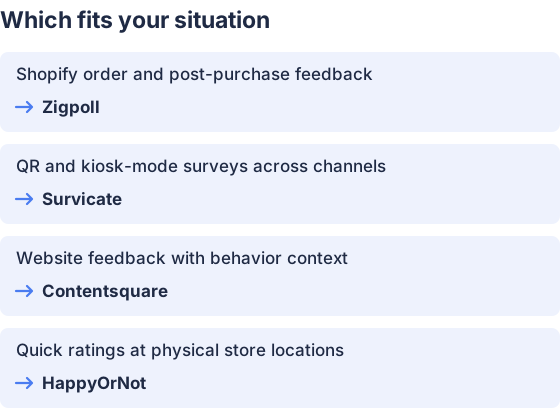
From the table above.
How this comparison was made
Prices and features come from each vendor’s published pages, checked in November 2026. The products were not tested hands-on; Zigpoll publishes this page.


