Which customer engagement platforms include predictive workforce forecasting?
Compare Genesys, NiCE, Talkdesk, and Five9 for predictive workforce forecasting, WFM features, pricing, and contact center use cases.

Genesys Cloud CX, NiCE CXone, Talkdesk, and Five9 offer predictive workforce forecasting for contact centers. Genesys and Talkdesk suit teams seeking integrated forecasting; NiCE and Five9 offer WFM options for teams that need more intraday or multichannel planning.
At a glance
| Option | Best for | Starting price (paid plan) | Free plan | Predictive WFM | Source |
|---|---|---|---|---|---|
| Genesys Cloud CX | Integrated omnichannel WFM | $75/mo | No | Yes | genesys.com |
| NiCE CXone | Complex, multichannel operations | $110/mo | No | Partial | nice.com |
| Talkdesk CX Cloud | Frequent intraday updates | $85/mo | No | Yes | talkdesk.com |
| Five9 | Flexible WEM choices | $119/mo | No | Partial | five9.com |
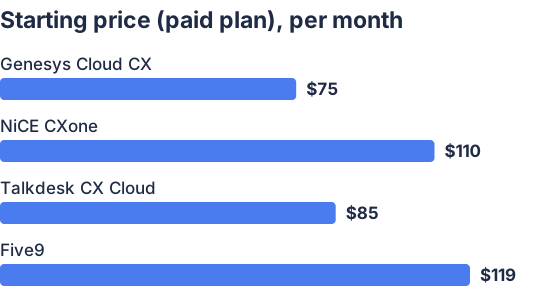
From the sourced table above, checked November 2026.
Prices are starting prices for each platform’s lowest paid plan, checked in November 2026. Those entry plans do not always include workforce management: check the product descriptions below for the tier or add-on that provides forecasting.
Genesys Cloud CX: best for integrated omnichannel WFM
Genesys Cloud CX offers AI-powered workforce forecasting alongside scheduling and other workforce-management capabilities. Its pricing page lists CX1 at $75 per user per month, billed annually, but workforce management and forecasting are included in CX3, listed at $155 per user per month, billed annually; CX1 and CX2 can get WFM through an add-on. (Genesys pricing and plan comparison) The trade-off is that the entry price is not the price of the plan with forecasting included, and Genesys says final costs depend on an organization’s needs.
NiCE CXone: best for complex, multichannel operations
NiCE describes CXone WFM as combining AI-powered forecasting, scheduling, and real-time intraday management across channels. Its published pricing starts at $110 per agent per month for Omnichannel Suite, and the pricing page presents Workforce Management as an add-on rather than a feature included in every suite. (NiCE WFM overview; NiCE pricing) That makes CXone worth assessing when you need its forecasting and intraday capabilities across a complex contact center, but the published starting price does not tell you the total cost with WFM added.
Talkdesk CX Cloud: best for frequent intraday updates
Talkdesk’s WFM predicts contact volume, average handle time, and required staffing for each 15-minute interval. Its documentation says intraday reforecasting can update forecasts as often as every 30 minutes and can trigger a new forecast when a queue has an unexpected volume surge or drop. (Talkdesk forecasting documentation) The published entry plan is Digital Essentials at $85 per user per month; WFM is listed in Elite at $165 per user per month. (Talkdesk pricing) The main limitation is that teams seeking workforce forecasting need to budget for the higher WFM tier, not the entry price.
Five9: best for flexible WEM choices
Five9 offers forecasting and WFM through its own Workforce Engagement Management (WEM) products and partner options. Its WFM materials describe multiskill, multichannel forecasting, intraday management, and automatic reforecasting; its pricing page says WEM is offered on a named basis and lets buyers choose Five9 or another WEM vendor. (Five9 WFM overview; Five9 pricing) Five9 publishes a $119-per-seat monthly starting price, but that entry bundle does not establish the cost of the WFM option you select; WEM is separately configured, and higher bundles may require a sales quote.
1. Which customer engagement platforms include predictive workforce forecasting?
Genesys Cloud CX, NiCE CXone, Talkdesk CX Cloud, and Five9 offer predictive forecasting for contact-center staffing. The important distinction is whether WFM is included in the plan you want: it is included in Genesys CX3 and Talkdesk Elite, while NiCE lists WFM as an add-on and Five9 offers WEM options that can be configured with its bundles. (Genesys; NiCE; Talkdesk; Five9)
“Predictive workforce forecasting” here means using historical and current contact-center data to estimate future demand and the staffing needed to handle it. It is different from predictive customer engagement or predictive routing, which anticipate customer behavior or help direct interactions. Compare the forecast inputs and update process, not just whether a vendor uses the word “predictive.”
2. How does predictive workforce forecasting work?
Predictive workforce forecasting uses past interaction patterns and staffing data to estimate future contact volume, handling time, and staffing needs. Talkdesk documents forecasts for contact volume and average handle time, then calculates required staffing for each interval; Genesys describes forecasts based on projected volumes and handle times. (Talkdesk; Genesys WFM overview)
A WFM system typically organizes those estimates by channel, queue, skill, and time interval, then uses them to help build schedules. During the day, managers can compare actual activity with the plan and adjust staffing when demand changes. The usefulness of the result depends on the quality and relevance of the historical data, how well the system handles changes in channel mix, and whether managers can review unusual events such as campaigns or outages.
3. Which vendors offer real-time forecasting?
NiCE, Talkdesk, and Five9 publish details about intraday forecasting or adjustment; Genesys provides intraday comparisons and rescheduling. “Real-time” does not mean the same thing across these platforms: it can refer to live visibility into actual activity, automatic forecast updates, or schedule changes prompted by those updates.
Talkdesk documents intraday reforecasting as often as every 30 minutes, with automatic reforecasting when it detects an unexpected volume change. (Talkdesk documentation) NiCE describes automated intraday reforecasting, while Five9 lists automatic reforecasting and intraday management among its WFM capabilities. (NiCE intraday management; Five9 WFM)
Genesys documents real-time tracking of intraday differences between forecast and actual values and an option to run intraday rescheduling after a forecast change. (Genesys WFM overview; Genesys intraday rescheduling) Ask vendors to demonstrate how often forecasts refresh, whether a manager must initiate a reforecast, and whether changes automatically flow into schedules.
4. How to choose a platform for my contact center?
Start by matching the WFM capability to your planning needs, then compare the total cost of the relevant plan and add-ons. A low entry price may not include forecasting, and a platform’s advertised live dashboards may not mean it automatically rebuilds forecasts or schedules.
Check whether forecasts cover your channels, queues, skills, and planning intervals; how historical data is imported; and how the system handles sudden demand changes. Ask to see both a normal planning cycle and an intraday scenario, such as an unexpected spike in one queue. Also verify what requires a manager’s approval and what updates automatically.
Finally, assess the platform in the context of your existing contact-center setup. Confirm integrations, implementation effort, agent scheduling needs, and the specific WFM license or bundle required. Compare like with like: use the price for the plan that actually includes your required forecasting features, rather than comparing entry tiers alone.
Which should you choose?
| Your situation | Best fit |
|---|---|
| Forecasting and WFM in an integrated omnichannel plan | Genesys Cloud CX |
| Intraday forecasting with updates as often as every 30 minutes | Talkdesk CX Cloud |
| Complex, multichannel workforce planning | NiCE CXone |
| Choice of native or partner WEM | Five9 |
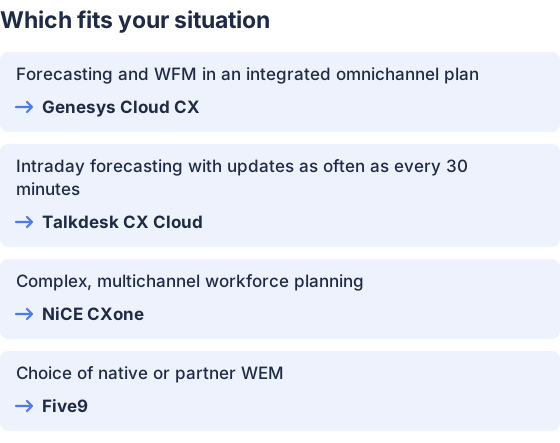
From the table above.
How this comparison was made
Prices and features come from each vendor’s published pages, checked in November 2026. The products were not tested hands-on.


