Which email marketing tool is best for growing a student newsletter?
Compare MailerLite, Kit, beehiiv, and Brevo for student newsletters, including free plans, pricing, automation, and audience growth.

MailerLite fits most student newsletters; Kit suits creator-led growth, beehiiv publication-first projects, and Brevo large contact lists with low send volume. Choose based on how you plan to attract readers, how often you’ll email them, and whether you need automated welcome messages or audience-specific content.
At a glance
| Option | Best for | Starting price (paid plan) | Free plan | Free automation | Source |
|---|---|---|---|---|---|
| MailerLite | General student newsletters | $12/mo | Yes | Partial | mailerlite.com |
| Kit | Creator-led audience growth | Not confirmed, see source | Yes | Partial | kit.com |
| beehiiv | Publication-style newsletters | $59/mo | Yes | No | beehiiv.com |
| Brevo | Large lists, fewer sends | $9/mo | Yes | Partial | brevo.com |
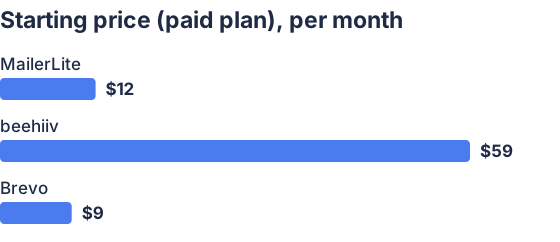
From the sourced table above, checked November 2026. Not charted, no single published figure: Kit.
Prices and plan details were checked in November 2026. Beehiiv’s entry paid price is for its 1,000-subscriber tier; its paid prices increase with list size. Free-plan limits and features differ, so check the linked vendor page before signing up.
MailerLite: best for a general student newsletter
MailerLite is a practical starting point for a campus club, class project, or student publication that needs signup forms, email campaigns, landing pages, and basic automations in one place. Its free plan supports up to 250 active subscribers and 2,500 emails per month; it includes up to three automations, so a small welcome series may be possible without paying. MailerLite’s pricing page lists its Comfort plan from $12 per month and describes additional tools such as dynamic emails and a preference center. The main catch is the low free subscriber limit: a newsletter that grows past 250 active readers will need to upgrade or move platforms.
Kit: best for a writer building an audience
Kit suits a student writing a personal newsletter or trying to grow through other creators’ recommendations. Its free plan allows up to 10,000 subscribers and includes forms, landing pages, broadcasts, tagging, segmentation, and recommendations through its Creator Network.
beehiiv: best for an independent publication
beehiiv is a good fit if the newsletter is itself the main publication, with a public web edition and a goal of growing beyond an email list. Its free plan includes a newsletter website, landing pages, a recommendation network, and unlimited email sends for up to 2,500 subscribers. Paid plans add automations and sending to segments; the lowest paid plan is listed at $59 per month for the 1,000-subscriber tier with monthly billing. beehiiv’s pricing page shows that price depends on subscriber tier, so the cost can rise as the audience grows. Its newsletter-focused publishing tools are appealing, but its paid entry point is higher than the other options here.
Brevo: best for a large contact list with modest sending needs
Brevo can work well when a campus group has many contacts but sends infrequently, such as a monthly update to students, alumni, and staff. Its free plan stores up to 100,000 contacts, but limits sending to 300 emails per day; it also includes automation for up to 2,000 contacts. Brevo’s plan details list the Starter plan from $9 per month, with paid tiers based on email volume and stored contacts. Brevo also supports saved segments for campaign targeting, according to its help documentation. Its contact limit can be useful, but the daily free sending cap may not suit a large newsletter sent all at once.
Which email marketing tool is best to grow a newsletter for students?
For most student clubs and campus groups, MailerLite is a strong starting choice because it combines signup forms, campaigns, and small-scale automation. If your priority is reaching new readers through a network of newsletter writers, Kit offers a larger free subscriber allowance and creator recommendations. Choose beehiiv if you want the newsletter to function as a standalone publication, and Brevo if you have a large contact database but expect to send less often.
These are different kinds of “growth.” A signup form can collect addresses from an event or club page; a recommendation network can help readers discover the newsletter through other publications. MailerLite describes its forms and landing pages, while Kit’s free plan includes Creator Network recommendations and beehiiv’s free plan includes its recommendation network. For a campus newsletter with a known audience, straightforward collection and consistent sending may matter more than creator-network features.
What features matter for student-focused newsletters?
Prioritize easy signup, reliable recurring sends, and simple ways to manage different reader interests. A form that asks only for an email address is easy to share; optional interests such as “events,” “career news,” or “club updates” can help tailor later messages. MailerLite offers signup forms, groups, and segments, while Kit supports subscriber tags and segmentation. Their feature pages show how those tools can organize readers by signup source, interests, or engagement.
A welcome email is useful when people join at different points in the semester, because it can introduce the newsletter without waiting for the next issue. More complex automations may not be necessary if you send one regular digest. Consider the number of people who need access to the account, too: a student editor may graduate or hand over the role, so a shared club account and clear permissions can make continuity easier. Check whether a free plan’s subscriber cap, sending allowance, and included seats fit your team before importing a list.
Which tools are best free or low-cost for student lists?
For the lowest-cost start, compare the free-plan limits rather than just the headline price. Kit allows up to 10,000 subscribers on its free plan, while MailerLite’s free allowance is up to 250 active subscribers and 2,500 emails a month. Kit’s plan page and MailerLite’s plan page also show which audience-growth and campaign features are included.
Brevo may suit a list with many stored contacts but relatively few messages, because its free plan supports up to 100,000 contacts and 300 daily sends. beehiiv’s free option supports up to 2,500 subscribers with unlimited sends, but its paid plans start at $59 monthly for the 1,000-subscriber tier. Check current plan terms when your list approaches a limit: free tiers can have different restrictions on sends, forms, or automations, and a paid plan may cost more as your audience expands.
How to choose between deliverability, automation, and segmentation?
Start with deliverability basics: use a reputable sending platform, send to people who signed up, and remove addresses that bounce or no longer engage. No vendor feature list can guarantee that every message lands in the inbox. beehiiv lists optimized deliverability among its plan features, and MailerLite offers deliverability-related tools on paid plans, but your list quality and sending habits still matter. See beehiiv’s plan comparison and MailerLite’s plan information.
Choose automation when you need a repeatable welcome or onboarding sequence; it saves manual work but may require a paid tier or have free-plan limits. Choose segmentation when readers have distinct interests or audiences, such as separate student organizations, year groups, or event updates. Segmentation is most useful when you have a clear reason to send different content; otherwise, a single relevant newsletter is simpler. If you are unsure, start with basic campaigns and signup tracking, then add automations or segments when a real workflow calls for them.
Which should you choose?
| Your situation | Best fit |
|---|---|
| One regular newsletter for a club or class | MailerLite |
| Growing a writer-led newsletter for free | Kit |
| Publishing a newsletter with a web edition | beehiiv |
| Many contacts, but fewer email sends | Brevo |
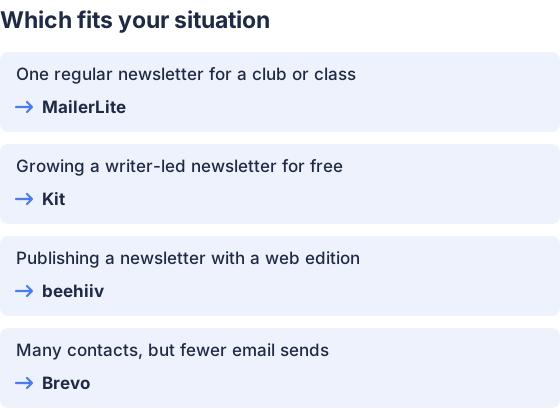
From the table above.
How this comparison was made
Prices and features come from each vendor’s published pages, checked in November 2026. The products were not tested hands-on.


