Feefo vs Trustpilot: Which Should a UK Business Choose?
Feefo vs Trustpilot: compare pricing, purchase-linked reviews, public feedback and Google Seller Ratings to find the right fit for your UK business.

Feefo suits UK businesses prioritising purchase-linked reviews; Trustpilot suits those seeking an open public profile and feedback from more kinds of customer experience. Both can contribute eligible reviews to Google Seller Ratings, but Google may still decide not to display a rating.
At a glance
| Option | Best for | Starting price (paid plan) | Free plan | Google Seller Ratings | Transaction verification | Source |
|---|---|---|---|---|---|---|
| Feefo | Purchase-linked reviews | £149/mo | No | Yes | Yes | feefo.com |
| Trustpilot | Open public reviews | Not stated | Yes | Yes | Partial | trustpilot.com |
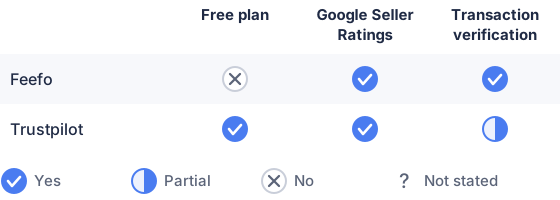
From the sourced table above, checked November 2026.
Feefo: best for purchase-linked customer feedback
Feefo is built around review invitations connected to customer transactions, with product and service reviews, display tools and feedback insights in its paid plans. Its Essentials plan lists Google Seller Ratings and Google Shopping support, while its published plan starts at £149 per month plus VAT. The trade-off is that a business generally needs to send sales data to Feefo so it can invite customers, and the public price is higher than Trustpilot’s lowest advertised monthly equivalent. (business.feefo.com)
Trustpilot: best for an open public review profile
Trustpilot allows people with a genuine recent experience to leave a review, including people who were not invited by the business. That can give potential customers a broader public record of feedback, but not every review is tied to a specific transaction. The free plan offers up to 50 invitations a month; paid plans add more invitations and business tools, with prices shown per domain. (business.trustpilot.com)
Feefo vs Trustpilot: which should a UK business choose?
Choose Feefo if you want reviews tied closely to purchases and a platform that lists Google Seller Ratings in its entry paid plan. Choose Trustpilot if an open, searchable public profile and feedback from a wider range of genuine interactions matter more. The right fit depends on the kind of feedback you want and how you collect it, not simply which platform has the larger public presence.
Feefo’s invitation-led approach is useful when you need to connect customer reviews to transactions and products. Trustpilot’s open model can capture experiences beyond a completed sale, such as a customer’s interaction with staff or a visit to a business. Those models produce different kinds of evidence: a purchase-linked review is easier to trace to an order, while open reviews can reflect more kinds of customer experience. (business.feefo.com)
Consider the operational side, too. Feefo says its review invitations use customer and order data, so a business needs a way to provide that information and automate invitations. Trustpilot can start with a free account, though its free plan has a monthly invitation limit. If you compare paid options, check invitation limits, domain pricing and contract terms alongside the headline price. (business.feefo.com)
Is Feefo more trustworthy than Trustpilot?
Not automatically. Feefo is a stronger fit if “trustworthy” means reviews linked to verified purchases; Trustpilot’s open model accepts reviews from people with a genuine experience, even when they were not invited or their review is not verified against a transaction. (business.feefo.com)
Feefo’s transaction-based approach can make it easier for readers to understand what a review refers to. Trustpilot’s broader intake can give businesses feedback from people who did not complete a purchase, but readers need to distinguish invited, verified reviews from unprompted ones. Trustpilot labels review types, and its guidance identifies which collection methods count towards Google store ratings. (help.trustpilot.com)
Neither approach alone proves that every review is accurate or representative. Feefo describes automated and human checks for reviews, while Trustpilot says it uses automated detection and human review when content is challenged. A business should also consider whether its invitation process reaches customers consistently, and how each platform handles disputes and review visibility. (help.feefo.com)
Is Feefo cheaper than Trustpilot?
No, not on the lowest published headline price: Feefo starts at £149 per month plus VAT, while Trustpilot lists Starter from £119 per month per domain when billed annually. That makes Trustpilot’s advertised monthly equivalent lower, but it is not a like-for-like monthly payment comparison. (business.feefo.com)
Feefo’s pricing page publishes a monthly plan price and describes fees as depending on review-request volume and features. Trustpilot’s pricing page says its contracts are 12-month commitments, shows Starter’s price as billed annually, and says monthly or annual billing cycles may be selected; it does not publish a separate monthly-billed Starter price on that page. Its plans are priced per domain, while Feefo’s listed starting price is plus VAT. So compare written quotes and payment terms before deciding which will cost less for your business. (business.feefo.com)
The plans also include different allowances. Feefo Essentials lists 200 email requests, plus 50 each for WhatsApp and SMS. Trustpilot Starter lists 100 invitations a month, while its free plan offers 50. Your likely invitation volume and preferred channels may matter more than the headline price. (business.feefo.com)
Which platform is better for Google Seller Ratings?
Neither is universally better: both can supply eligible reviews, and neither can guarantee that Google will show your Seller Rating. Feefo lists Google Seller Ratings in Essentials; Trustpilot says its automated invitations can count towards Google Seller Ratings. (business.feefo.com)
Google says store ratings can be based on reviews from third-party review partners, and that the number needed varies; most merchants can obtain a rating after collecting 100 or more eligible reviews in a country within 24 months. For Search text ads, Google also requires an average composite rating of at least 3.5 stars, and the ad’s visible URL domain must match the domain for the ratings. Google may still decide not to display a rating. (support.google.com)
For Google Shopping product ratings, the requirements and feed setup are separate from Seller Ratings. Google’s product review guidance says merchants need at least 50 product reviews in the feed, and lists Feefo as an aggregator; it notes that Trustpilot automatically submits product reviews after sufficient collection and setup. If your priority is Seller Ratings, compare how each service will collect enough eligible reviews for your domain and country, rather than choosing solely on partner status. (support.google.com)
Which should you choose?
| Your situation | Best fit |
|---|---|
| You want reviews connected to customer transactions | Feefo |
| You want a public profile that accepts unprompted reviews | Trustpilot |
| You want a free starting plan for invitations | Trustpilot |
| Google Seller Ratings are a priority and you want them listed in the entry paid plan | Feefo |
| You need feedback about non-purchase interactions too | Trustpilot |
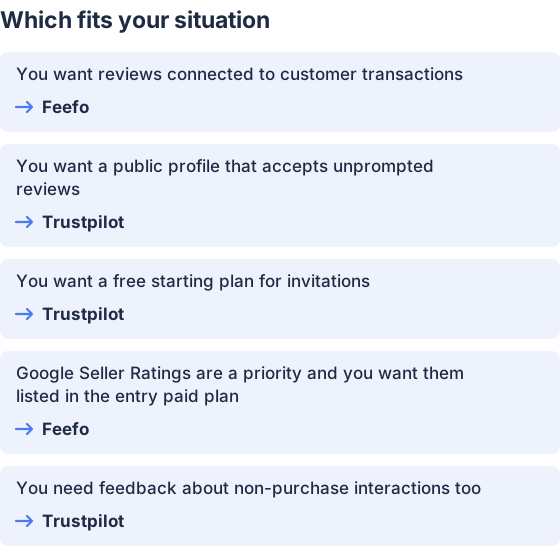
From the table above.
How this comparison was made
Prices and features come from Feefo’s and Trustpilot’s published pages, checked in November 2026; Google requirements come from Google’s published help pages. The products were not tested hands-on.


