Which platforms automate user-generated content for ecommerce products?
Judge.me vs Loox vs Yotpo vs Okendo: Compare pricing, review automation, UGC features, and ecommerce platform support to find the right fit.

Judge.me, Loox, Yotpo, and Okendo automate customer reviews and product UGC for ecommerce stores. Judge.me and Loox suit Shopify-focused stores; Okendo adds broader customer-marketing tools, while Yotpo supports several ecommerce platforms.
At a glance
| Option | Best for | Starting price (paid plan) | Free plan | Photo/video UGC | Other ecommerce platforms | Source |
|---|---|---|---|---|---|---|
| Judge.me | Low-cost Shopify reviews | Not confirmed, see source | Yes | Yes | No | judge.me |
| Loox | Visual reviews on Shopify | Not confirmed, see source | Yes | Yes | No | loox.io |
| Yotpo | Multi-platform review programs | $15/mo | Yes | Yes | Yes | yotpo.com |
| Okendo | Reviews plus customer tools | $19/mo | Yes | Yes | No | apps.shopify.com |
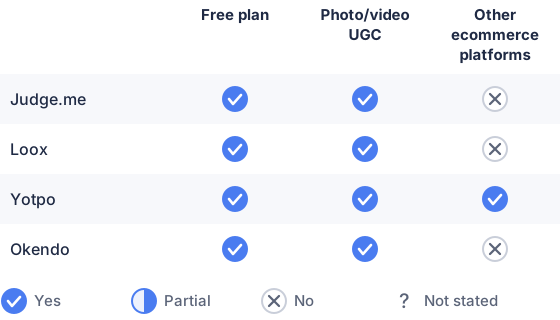
From the sourced table above, checked November 2026.
Judge.me: best for affordable Shopify reviews
Judge.me automates review requests and offers widgets for showing ratings and customer reviews; customers can submit photo and video reviews, too. Its free plan includes unlimited review requests, and the paid plan adds features such as Google Shopping integration and expanded customization. It is now focused on Shopify, so stores on other ecommerce platforms should look elsewhere. (judge.me)
Loox: best for visual reviews on Shopify
Loox focuses on photo and video reviews, review widgets, and referral features. Its free plan is limited by store order volume, while the paid Convert plan adds features including video reviews, AI review summaries, and review syndication to Google, Meta, and TikTok. Loox is built for Shopify; displaying widgets on an external domain is supported on Convert and above, but that is not the same as supporting another ecommerce platform. (help.loox.io)
Yotpo: best for multi-platform ecommerce
Yotpo automates review requests and supports text, photo, and video reviews. Its higher plans add tools such as AI review summaries, review sorting, Q&A, and syndication; the available features depend on plan and order volume. Yotpo’s published support list includes Shopify, Adobe Commerce, BigCommerce, Salesforce Commerce Cloud, and WooCommerce, making it the clearest fit here for a store that may change platforms or use a non-Shopify storefront. (yotpo.com)
Okendo: best for reviews alongside customer-marketing tools
Okendo combines review collection and display with other customer-marketing products, including loyalty, referrals, and quizzes. Its review features include automated requests, photo and video reviews, review displays, moderation, and integrations with tools such as Klaviyo and Gorgias. It is Shopify-focused, so its extra tools are most relevant to merchants already working in that ecosystem. (apps.shopify.com)
Which platforms automate user-generated content for ecommerce products?
Judge.me, Loox, Yotpo, and Okendo automate customer review collection and display; Yotpo is the option here that supports multiple ecommerce platforms. These tools typically send post-purchase requests, collect written feedback and, depending on plan, customer photos or videos. They focus on customer-submitted product reviews and visual content, not on managing influencer campaigns. (judge.me)
The best fit depends on what you mean by “automate.” A review app can send requests and reminders, display submitted reviews on product pages, and pass review data to marketing or support tools. If you need to find creators, manage contracts, or track paid influencer campaigns, compare creator-marketing software rather than treating a review platform as a full influencer solution.
What features should I compare when choosing a UGC platform?
Compare collection automation, supported content types, moderation, display controls, integrations, and limits that affect your cost. Check whether requests are triggered from order or delivery events, whether reminders can be scheduled, and whether the platform collects only text or also photos, video, product attributes, and Q&A. For example, Yotpo lists automatic review requests on its free plan and photo and video reviews on Starter; Loox’s free plan has order limits. (yotpo.com)
Also review how the product handles incentives, spam or inappropriate submissions, and customer consent for using submitted images elsewhere. For storefront display, check available widgets, styling, mobile presentation, and review filtering. If you already have reviews, verify that the platform can import your data, including media, and check which marketing, loyalty, social, analytics, and helpdesk tools connect on the plan you would actually buy. Integration availability can vary by plan. (support.okendo.io)
Which platforms integrate with Shopify and other ecommerce platforms?
All four options in this comparison support Shopify, while Yotpo also lists several other ecommerce platforms. Its published list includes Shopify, BigCommerce, WooCommerce, Adobe Commerce, and Salesforce Commerce Cloud; Yotpo notes that non-Shopify implementations may involve additional fees. (yotpo.com)
Judge.me, Loox, and Okendo are Shopify-focused. Judge.me says it has ended support on non-Shopify platforms, and Loox’s documentation describes its storefront integration as Shopify-based. Okendo connects to services such as Klaviyo and Gorgias, but those app integrations do not mean it supports other storefront platforms. Check that the integration you need is supported on your plan and region before migrating or signing up. (judge.me)
How do UGC platform pricing models typically work?
Pricing often starts with a free plan or a fixed monthly subscription, then rises with order volume or access to advanced features. Those are entry prices, not necessarily the price a store will pay at its current order volume. (judge.me)
Check each plan’s order allowance, feature gates, and overage rules. Yotpo’s prices scale with monthly order volume, and its documentation describes extra charges when a store exceeds some plan limits. Loox’s Convert plan charges more as monthly orders exceed its included amount. Okendo’s listing gives a free plan up to 50 monthly orders and a $19-per-month plan up to 200 orders. Compare annual versus monthly billing, trial terms, and any extra implementation or usage fees before estimating the total cost. (yotpo.com)
Which should you choose?
| Your situation | Best fit |
|---|---|
| You want a free Shopify review app | Judge.me |
| Visual photo reviews matter most | Loox |
| You need support for multiple ecommerce platforms | Yotpo |
| You want reviews alongside loyalty and referrals | Okendo |
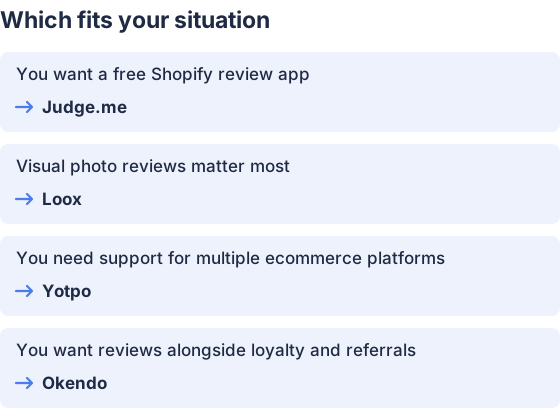
From the table above.
How this comparison was made
Prices and features come from each vendor’s published pages, checked in November 2026. The products were not tested hands-on.


