How does real-time feedback analytics compare to traditional surveys?
Real-time feedback vs traditional surveys: use in-the-moment analytics to fix UX, and structured surveys for representative research.

Use real-time feedback analytics to capture in-the-moment behavior and fix UX issues; use traditional surveys when you need structured, representative answers and formal research.
At a glance
| Option | Best for | Starting price (paid plan) | Free plan | Real-time behavioral context | Source |
|---|---|---|---|---|---|
| FullStory | Session replay + behavior signals | Quote only | Yes | Yes | fullstory.com/plans |
| Survicate | Multichannel in-product NPS & CX | $114/mo | No | Partial | survicate.com/pricing |
| Typeform | Polished long forms & conversational surveys | $39/mo | Yes | No | typeform.com/pricing |
| Zigpoll | Ecommerce post-purchase, on-site surveys | $39/mo | Yes | Partial | zigpoll.com/pricing |
| Qualtrics | Enterprise research & programmatic CX | Quote only | No | Partial | qualtrics.com/pricing |
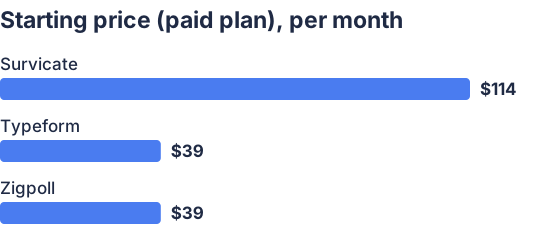
From the sourced table above, checked November 2026. Not charted, no single published figure: FullStory, Qualtrics.
FullStory: best when you want session replay and behavioral context
FullStory captures sessions, heatmaps and event streams so you can see exactly what users did before they gave feedback. It is designed to connect behavioral signals to issues (rage clicks, errors) and supports a permanent free tier for small teams; paid tiers require a demo and sales conversation. Use it when you need qualitative context (replays + analytics) rather than only numeric scores. (fullstory.com)
Survicate: best when you want targeted in-product NPS and multichannel surveys
Survicate provides in-app, web and email surveys with NPS/CSAT workflows and AI tagging; its pricing shows paid plans starting on the published pricing page (see Growth/Pro tiers). It sits between traditional survey platforms and product feedback tools: you can trigger surveys by event or user segment, but it does not offer session replay. Choose Survicate when you want targeted, recurring CX metrics tied to product events. (survicate.com)
Typeform: best when you want respondent experience and polished questionnaires
Typeform is a modern form/survey builder focused on design and conversational flows, with clear self-serve pricing and a free tier. It’s excellent for long surveys, lead capture and research where respondent experience improves completion; it does not capture session replays or behavioral telemetry. Use Typeform when presentation and respondent engagement matter more than live behavioral context. (typeform.com)
Zigpoll: best when you need ecommerce-native post-purchase and on-site surveys
Zigpoll targets ecommerce and Shopify merchants with post-purchase, exit-intent and on-site surveys, plus integrations for marketing and analytics. It publishes a free Lite plan (50 responses/mo) and self-serve paid tiers starting at the monthly price shown on its pricing page; it supports event triggers and attribution surveys but not session replay. Choose Zigpoll when you need quick, purchase-linked answers and Shopify integrations. (zigpoll.com)
Qualtrics: best when you need an enterprise program and advanced analysis
Qualtrics is built for large CX programs, enterprise governance and advanced analysis; most commercial plans are quote-only on the vendor site. It supports surveys, journey analytics and programmatic CX at scale, but cost and implementation effort are high compared with self-serve tools. Pick Qualtrics when you need a governed, multi-team experience program and are prepared for a sales process. (qualtrics.com)
How does real-time feedback analytics software compare to traditional survey tools?
Real-time feedback analytics captures in-context, behavioral signals while traditional surveys capture structured, self-reported answers. Real-time tools (session replay, heatmaps, in-app micro-surveys) show what users were doing at the moment and surface immediate issues; surveys (email, panel, long forms) collect considered answers, scores and representative samples useful for trend tracking and statistical analysis. Use both where possible: behavioral context helps explain survey scores, and surveys provide comparable KPIs (NPS/CSAT) across audiences. Sources describing the distinction and when vendors sit between these categories include product-analytics and VoC roundups. (glassbox.com)
What are the key benefits of real-time feedback analytics?
Real-time feedback gives context and immediacy: it ties complaints or low scores to pages, errors and user actions so teams can reproduce and fix problems faster. It increases response relevance and often raises response rates for in-product prompts versus post-event email surveys, because you ask while the experience is fresh. It also enables faster cycle time for experiments and fixes: you can detect issues, validate a quick change, and measure impact in days rather than weeks. That said, real-time feedback is often less representative (sample is contextual and self-selected) and usually needs separate quantitative tracking for long-term trends. Evidence and vendor categories are discussed in VoC tool roundups and product analytics guides. (zonkafeedback.com)
When should I choose real-time feedback over traditional surveys?
Choose real-time feedback when you need to diagnose immediate UX friction, validate changes fast, or collect context-rich responses (what did you try, what broke) at the moment of use. Prefer it for product onboarding, checkout flow friction, feature validation and reactive support triage where behavioral context speeds fixes. Don’t rely on it when you need representative samples, rigorous benchmarking, controlled survey logic or statistical analysis across a population, traditional surveys remain better for programmatic NPS, market research and compliance-grade studies. Guides that compare moments-to-ask and recommended tool types explain this tradeoff. (raconte.ai)
What features matter when evaluating real-time feedback software?
Focus on these features: (1) targeting and triggers, can you show prompts by event, segment or page; (2) behavioral context, does the product link answers to sessions, events or user IDs; (3) analysis, built-in text tagging, AI categorization and dashboards; (4) integrations, export to your analytics, CRM and data warehouse; (5) SDK and performance, mobile/web SDKs and low client overhead; and (6) privacy and data controls. Vendors differ: session-replay platforms excel at (2); in-app survey tools excel at (1) and (3). Look for documented retention, sample-limits and published prices on the vendor pages before buying. (fullstory.com)
Which should you choose?
| Your situation | Best fit |
|---|---|
| You need session replay and behavior signals to debug a checkout funnel | FullStory |
| You want in-product NPS and targeted CX workflows | Survicate |
| You want beautiful, high-completion surveys for research or lead capture | Typeform |
| You run a Shopify store and need post-purchase attribution surveys | Zigpoll |
| You need an enterprise CX program and vendor support | Qualtrics |
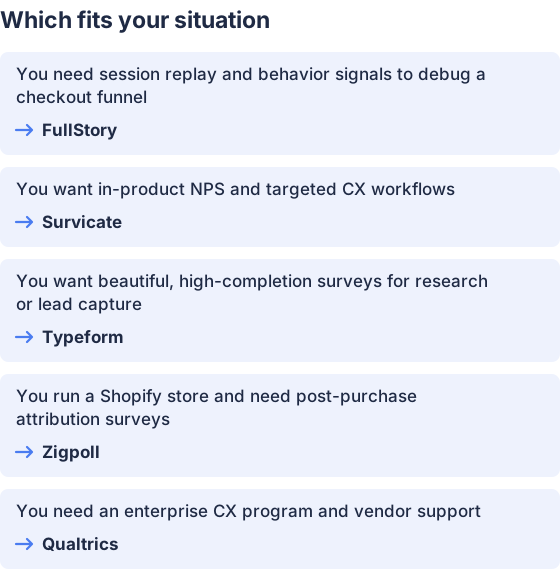
From the table above.
How this comparison was made
Prices and feature claims were taken from each vendor’s published pricing and product pages and checked in November 2026; where vendors publish no public list price, the page is marked Quote only. The products were not tested hands-on; this comparison is based on vendor documentation and vendor/industry roundups. Zigpoll publishes this page. (fullstory.com)


