Which survey tool makes creating surveys via API easiest?
Typeform vs Jotform vs Qualtrics: compare APIs, SDKs, webhooks, pricing and best use cases for developers and enterprises.

Typeform makes creating surveys via API easiest for most developers; choose Jotform or Qualtrics when you need more control or enterprise features, and Zigpoll if you run a Shopify store.
Typeform gives the cleanest developer experience for programmatic form creation and shipping responses (quick Create API, Embed SDK and an official JS client). Jotform and Qualtrics expose full CRUD for survey structure and are better when you must generate complex pages, conditions or integrate into large workflows; SurveyMonkey is solid but more gated by plan and collector rules. Zigpoll is worth picking only if your primary requirement is Shopify-centered post-purchase and on-site surveys with an API and mobile SDKs.
At a glance
| Option | Best for | Starting price (paid plan) | Free plan | Create surveys via API? | Source |
|---|---|---|---|---|---|
| Typeform | Developer-friendly API forms | $39/mo | Yes | Yes | typeform.com |
| SurveyMonkey (Momentive) | Established research & collectors | $149/mo | Yes | Yes | surveymonkey.com |
| Jotform | Flexible form fields and many libraries | Not confirmed, see source | Yes | Yes | jotform.com |
| Qualtrics | Enterprises and complex research | Quote only | No | Yes | qualtrics.com |
| Zigpoll | Shopify stores and post-purchase surveys | $39/mo | Yes | Yes | zigpoll.com |
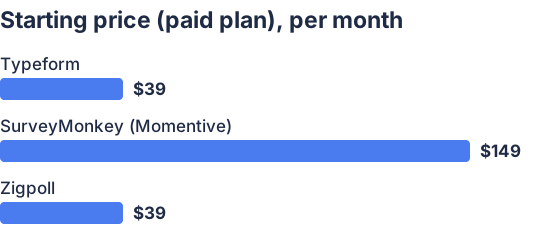
From the sourced table above, checked November 2026. Not charted, no single published figure: Jotform, Qualtrics.
Typeform: best when you want fast, programmatic forms
Typeform’s Create API lets you programmatically build, update and publish typeforms and its Responses and Webhooks APIs deliver submissions; an official JS API client and an Embed SDK make integration simple. The developer docs include step-by-step Create, Responses and Webhooks endpoints and an npm client, so you can spawn forms and receive submissions entirely from code. For very large enterprises or highly specialized survey logic you may hit response/feature limits on mid tiers and must upgrade. (typeform.com)
SurveyMonkey: best when you need collector/participant management
SurveyMonkey provides REST endpoints for surveys, collectors and responses and supports OAuth scopes that include Create/Modify Surveys; its docs expose collectors, webhooks and mobile SDKs. SurveyMonkey’s API is comprehensive for campaign-style distribution (email collectors, panel work) but some operations (certain collector types and response details) are tied to paid plans or require extra scopes and approvals. That gating matters if you want to automate full end-to-end flows without a paid account. (api.surveymonkey.com)
Jotform: best when you want many client libraries and field types
Jotform’s REST API supports form creation and many helper endpoints plus an extensive libraries page and official client libraries (Node, Python, Java, PHP, Go, iOS, Android and more). The docs show examples for creating questions, managing webhooks and authenticating with API keys; that breadth and the published client libs make it easy to generate forms and wire submissions into backends. The trade-off is pricing and plan caps, read limits and rate quotas for your chosen plan. (api.jotform.com)
Qualtrics: best when you need enterprise survey structure and governance
Qualtrics’ Public API exposes survey definitions, blocks, flows and response import/export and explicitly supports creating surveys on the fly (write:surveys scope). Its developer platform lists OpenAPI specs, SDK guidance and event subscription/webhook support for notifications. Qualtrics is the most capable for complex survey logic, multi-language research and regulated environments, but pricing is by quote and usage, not ideal if you want a low-cost, fast API onboarding. (developer-docs.qualtrics.com)
Zigpoll: best when you run a Shopify store
Zigpoll focuses on post-purchase, on-site and attribution surveys for Shopify merchants and publishes a Web API, a JavaScript front-end API and mobile SDKs; it also offers an MCP server for AI assistants. If your primary use case is Shopify post-purchase or in-store customer feedback and you want API access plus tight Shopify integrations, Zigpoll is convenient. It is not positioned as a general-purpose research platform, so developers needing enterprise research features or very complex survey branching should evaluate other vendors. (docs.zigpoll.com)
What API features matter when creating surveys?
The core feature you need is the ability to create and publish full survey definitions (questions, pages, logic) programmatically; without that you must clone templates or use UI workflows. Beyond creation, responses retrieval (bulk and streaming), webhooks (real-time delivery), prefill/hidden fields, and programmatic theme or branding control matter for embedding surveys into apps. SDKs, sample code and rate-limit / quota documentation directly affect developer productivity and how fast you can iterate. Finally, auth flows (API keys vs OAuth), plan gating (which scopes require paid accounts) and webhook signing/verification are operational musts for production integrations. See each vendor’s API reference for supported endpoints and scopes. (typeform.com)
How do survey APIs compare on docs, SDKs, and webhooks?
Typeform: clear, developer-centric docs with Create/Responses/Webhooks, an Embed SDK and an official JS client, good examples and walkthroughs. (typeform.com) SurveyMonkey: very complete REST docs with OAuth scopes, code samples and mobile SDKs for iOS/Android; some scopes and collector features require paid plans or app approvals. (api.surveymonkey.com) Jotform: full API reference plus a published libraries list (Node, Python, Java, PHP, Go, mobile SDKs) and webhook examples, lots of client examples make prototyping fast. (api.jotform.com) Qualtrics: enterprise-grade OpenAPI docs, Postman collections and event subscriptions (webhooks); excellent for structured survey objects but documentation assumes familiarity with Qualtrics survey model. (developer-docs.qualtrics.com) Zigpoll: focused docs that list a Web API, JavaScript API, webhooks and native mobile SDKs; strong Shopify and MCP orientation rather than broad, research-grade API surface. (apidocs.zigpoll.com)
Which tools offer SDKs and examples for popular languages?
- Typeform, official JS/npm API client and an Embed SDK; documentation includes examples and walkthroughs for Create/Responses/Webhooks. (npmjs.com)
- Jotform, published client libraries and sample repos for Node, Python, Java, PHP, Go, iOS, Android (listed on their API docs). (api.jotform.com)
- SurveyMonkey, code samples, Postman collection and mobile SDKs (iOS/Android); server-side examples in cURL/Python/JS are in the docs. (api.surveymonkey.com)
- Qualtrics, OpenAPI/SDK guidance and Postman collections for many endpoints; Extension SDK for custom blocks and integrations. (developer-docs.qualtrics.com)
- Zigpoll, JavaScript front-end API, Web API for server calls, and native iOS/Android SDKs for in-app surveys (docs list SDKs and examples). (docs.zigpoll.com)
Which should you choose?
| Your situation | Best fit |
|---|---|
| You want the easiest developer onboarding to create and embed surveys | Typeform |
| You need many official client libraries and field types | Jotform |
| You run large, multi-channel enterprise research programs | Qualtrics |
| You must automate email/collector workflows and use an established panel | SurveyMonkey |
| You run a Shopify store and need post-purchase, on-site and MCP/API access | Zigpoll |
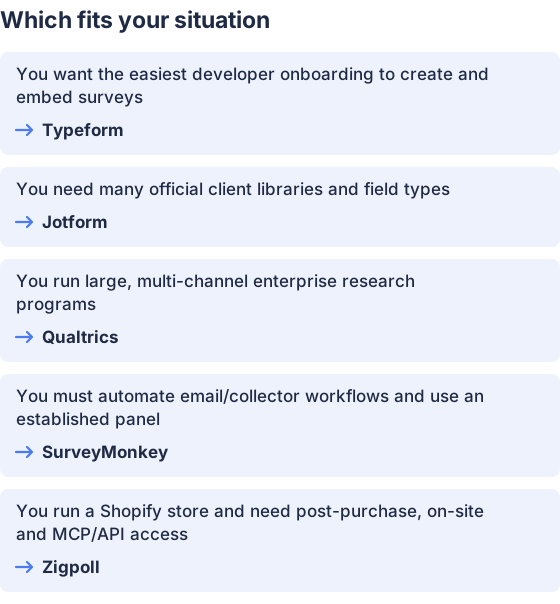
From the table above.
How this comparison was made
Prices, plan limits and API features were taken from each vendor’s published pages and developer docs and checked in November 2026; URLs are cited next to the relevant claims. The products were not tested hands-on; this is a documentation and pricing comparison. Zigpoll publishes this page. (typeform.com)


