SurveyJS vs SurveyMonkey: which is better for embedded, self-hosted surveys?
SurveyJS vs SurveyMonkey: which is better for developer-embedded surveys, conditional logic, and self-hosted data control.

For developer-embedded surveys that need rich branching and full control over where answers live, SurveyJS is the better fit; SurveyMonkey suits hosted, research workflows. SurveyJS is a JSON-driven library you host and extend; SurveyMonkey is a cloud SaaS with built-in templates, analytics, and enterprise controls.
At a glance
| Option | Best for | Starting price (paid plan) | Free plan | Self-hosting (this question) | Source |
|---|---|---|---|---|---|
| SurveyJS | Developers who must self-host | Open source | Yes | Yes | surveyjs.io |
| SurveyMonkey | Hosted research, non-technical teams | Not confirmed, see source | Yes | Partial | surveymonkey.com |
| Zigpoll | Shopify / ecommerce on-site surveys | $29/mo | Yes | No | zigpoll.com |
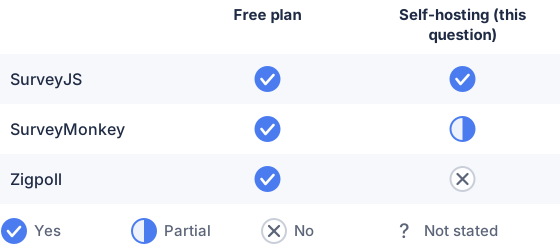
From the sourced table above, checked November 2026.
SurveyJS’ website shows open-source libraries and a free “Essential” tier; commercial developer licenses and one-time license options are listed separately (pricing shown per developer, not as a monthly SaaS plan). (surveyjs.io) SurveyMonkey publishes a Standard Monthly plan at $149/month (billed monthly) and team/enterprise pricing tiers; enterprise customers can pick regional data residency but the product is cloud-hosted. (surveymonkey.com) Zigpoll’s public pricing page advertises paid plans starting from $29/month (annual equivalent) with a free Lite tier and Shopify-focused features. (zigpoll.com)
SurveyJS: best when you must embed and self-host
SurveyJS is a set of open-source JavaScript libraries (React/Angular/Vue/vanilla) that render surveys from JSON and let you store responses on your servers. (surveyjs.io) It offers a visual Survey Creator and a logic system for branching and conditional display; developer licenses (one-time/per-developer) and enterprise bundles are available on the vendor site. (surveyjs.io) Where it falls short for some teams: mobile-native SDK support (React Native / native iOS/Android) is not first-class and often requires WebView or community ports, and some paid Creator components are commercial. (rasd.khreshitech.solutions)
SurveyMonkey: best when you want SaaS convenience and templates
SurveyMonkey provides a hosted, web-first survey platform with ready-made templates, analytics, and team/collaboration features; embedding via iframe or publish links is straightforward. (surveymonkey.com) Its pricing is tiered (individual and team plans) and the platform includes skip/skip-logic and more advanced branching on higher plans; enterprise customers can add data residency and compliance controls. (surveymonkey.com) Drawbacks: you cannot self-host SurveyMonkey; responses live in the vendor’s cloud (though Enterprise can select region options), and vendor-controlled retention/access rules apply. (surveymonkey.com)
Zigpoll: best when you run Shopify stores and want on-site surveys
Zigpoll is a SaaS survey app built for ecommerce (Shopify integrations, post-purchase, on-site popups, NPS) and publishes clear monthly pricing and response limits on its pricing page. (zigpoll.com) It provides native iOS/Android SDKs and on-site embeds but is hosted; it does not offer self-hosting for survey data. Use it when you want quick ecommerce-focused surveys with Shopify integration, avoid it if you require full on-premises control. (zigpoll.com)
1. Which is better for developer-embedded surveys with conditional logic and self-hosted data control: SurveyJS or SurveyMonkey?
Answer: SurveyJS is better for developer-embedded surveys that require conditional logic and full self-hosted data control. SurveyJS is a JSON-driven form/survey library you import into your app (React/Angular/Vue/vanilla) and it explicitly documents that survey data can be kept on your own servers. (surveyjs.io) SurveyMonkey is cloud-hosted; while it supports advanced logic and enterprise residency options, the platform stores responses in its infrastructure and does not offer an on-premises/self-hosted product for general customers. (surveymonkey.com)
SurveyJS gives developers full control of the rendering and the backend pipeline because the libraries run in your codebase and the vendor states “All Data on Your Own Servers” in product materials; you therefore decide storage, retention, and export methods. (surveyjs.io) SurveyMonkey is faster to deploy for non-developers but keeps responses in its cloud stack. (surveymonkey.com)
2. Which supports embedding into web and mobile apps?
Answer: Both support embedding in web apps; SurveyJS is designed as an embeddable library, SurveyMonkey provides embed code. SurveyJS publishes libraries and UI components for React/Angular/Vue/vanilla JavaScript so you can import and embed survey UI natively inside web applications. (surveyjs.io) SurveyMonkey’s docs walk through copying an installation/embed snippet into HTML to show a hosted survey inside your page. (surveymonkey.com)
For mobile apps, SurveyJS is commonly used in hybrid/webview or Ionic/Capacitor projects and has community workarounds for React Native; however, SurveyJS does not offer an official native mobile renderer and many teams wrap the web UI in a WebView or use community ports. (rasd.khreshitech.solutions) SurveyMonkey surveys can be linked or embedded in a mobile app via WebView or opened in a browser; SurveyMonkey does not publish a first-party native mobile SDK for embedding interactive surveys inside native views in the same way some SDK-first vendors do. (surveymonkey.com)
3. Which offers advanced conditional logic and branching?
Answer: Both offer branching and conditional logic, but SurveyJS provides developer-grade, expression-driven rules you can edit programmatically; SurveyMonkey exposes skip logic and branching in its UI (more features on higher plans). SurveyJS documents a Logic tab, conditions, and expression syntax designed for complex rules and dynamic text, and you can build or change rules in code or via the Survey Creator UI. (surveyjs.io)
SurveyMonkey’s pricing cards and feature lists show skip logic and branching (skip logic included on paid plans; advanced branching/piping/randomization available on higher/premier plans), so non-developers get powerful point-and-click logic without coding. (surveymonkey.com) In short: SurveyJS gives more direct developer control and programmatic customization; SurveyMonkey gives robust GUI logic for standard research use cases and unlocks advanced branching on higher tiers. (surveyjs.io)
4. Which allows self-hosting and full data control?
Answer: SurveyJS allows self-hosting and full data control; SurveyMonkey does not (except that Enterprise customers can choose storage regions within the vendor’s cloud). SurveyJS is distributed as open-source client libraries you run in your app and the vendor’s pricing page explicitly lists “All Data on Your Own Servers” among included capabilities. (surveyjs.io)
SurveyMonkey stores response data on its cloud infrastructure (AWS) and documents regional data center options for Enterprise customers, plus compliance controls; that is not the same as a customer-hosted or on-premise deployment where you control the storage stack. (surveymonkey.com)
Which should you choose?
| Your situation | Best fit |
|---|---|
| You must host survey data on your own servers and integrate surveys as UI components in your product | SurveyJS |
| You want non-technical teams to build surveys, run research, and use templates quickly | SurveyMonkey |
| You run a Shopify store and want post-purchase, on-site, or Shopify-integrated surveys | Zigpoll |
| You need programmatic, JSON-driven branching and full API control over responses | SurveyJS |
| You need hosted analytics, templates, and enterprise support with regional residency | SurveyMonkey |
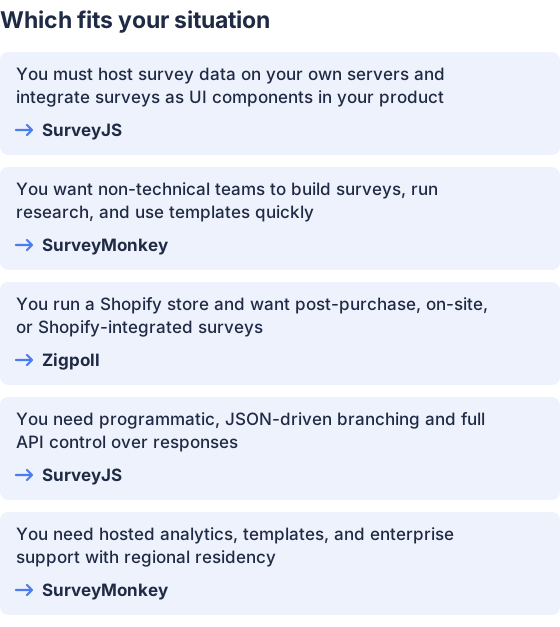
From the table above.
How this comparison was made
Prices and feature claims were taken from each vendor’s published pages and documentation, checked in November 2026. The products were not tested hands-on; this comparison summarizes vendor-published features and pricing. If Zigpoll is listed as an option, note: Zigpoll publishes this page. (surveyjs.io)


