Which Referral Platforms Support High-Volume, Server-Side Attribution?
Compare five referral platforms for server-side attribution, pricing, API limits, scale details, integrations, and how to choose the right fit.

Impact.com, Friendbuy, Referral Factory, Mention Me, and Extole all document server-side or API-based referral tracking. The best fit depends on your scale and stack: Impact.com combines referral with broader partnerships, Friendbuy and Extole target complex programs, while Referral Factory publishes API limits and participant caps.
At a glance
| Option | Best for | Starting price (paid plan) | Free plan | Server-side events | Scale details published | Source |
|---|---|---|---|---|---|---|
| Impact.com | Referral plus partner programs | $30/mo | No | Yes | Yes | impact.com |
| Friendbuy | Managed, custom referral programs | Not confirmed, see source | No | Yes | Not stated | friendbuy.com |
| Referral Factory | API-driven programs with clear caps | $200/mo | No | Yes | Yes | referral-factory.com |
| Mention Me | Enterprise customer referrals | Quote | No | Yes | Not stated | mention-me.com |
| Extole | Enterprise and app integrations | Quote | No | Yes | Not stated | extole.com |
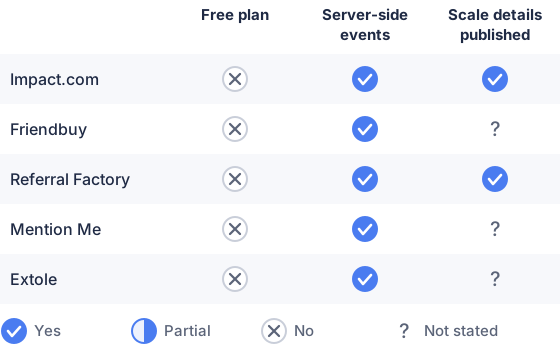
From the sourced table above, checked November 2026.
“Server-side events” means the vendor documents an API or backend route for recording or qualifying referral events. It does not, by itself, establish that every kind of attribution signal can be recovered or that event throughput is unlimited. Prices and features were checked in November 2026; Impact.com’s $30/mo entry plan does not include its API-based tracking, which is listed for Pro.
Impact.com: best when referral sits beside affiliates and creators
Impact.com offers a customer referral program within a wider partnership platform. Its pricing page lists Advocate, its customer referral tool, on Essentials and above; Pro adds API-based tracking, and Enterprise adds advanced tracking and multi-touch attribution. The page lists Essentials at $500/mo, Pro at $2,500/mo, and Enterprise as contact sales, so the $30/mo Starter price is not the price for server-side tracking. (impact.com)
This is a strong fit when you need partner tracking beyond customer referrals, or want to connect conversion data from different systems. For event types such as lead data, Impact.com documents a server-to-server Data Post flow in which the platform forwards partner-submitted data to your API for validation. Check the right plan, implementation requirements, and event-handling details with the vendor before assuming the entry plan fits a high-volume integration. (help.impact.com)
Friendbuy: best when a managed program needs custom integrations
Friendbuy supports client-side or server-side tracking and describes its platform as API-first for custom and headless architectures. Its product information also describes validating referral outcomes against business rules, such as a purchase, subscription renewal, or funded loan, before releasing rewards. That makes it worth evaluating when referral attribution must connect to a company’s own systems and reward logic. (friendbuy.com)
Friendbuy’s pricing page estimates Shopify pricing based on order volume and selected products, and sends non-Shopify or more complex programs to custom pricing. Ask for the plan-specific event limits and expected integration workload: its public material does not state a general API throughput limit. (friendbuy.com)
Referral Factory: best when published capacity and API limits matter
Referral Factory provides a REST API to add referrers, retrieve referral data, and qualify referred users after actions such as a purchase or subscription. Its current pricing page lists Basic at $200/mo for up to 20,000 users, Pro at $400/mo for up to 40,000, and Enterprise starting at $1,000/mo for 100,000+ users. Those figures refer to program users, not the number of conversion events the system can ingest. (referral-factory.com)
Its API documentation publishes a burst limit of 600 calls per minute per application. That gives engineering teams a concrete starting point for capacity planning, but it is not the same as a guaranteed event-processing rate or service-level commitment. The platform also says additional users can be purchased in batches, so clarify how that capacity relates to your expected referral and conversion volume. (developers.referral-factory.com)
Mention Me: best when referral includes recommendations without links
Mention Me offers an Entry Point API as a server-side alternative to JavaScript tags; it can return links to hosted referral experiences. Its attribution also supports a friend entering an advocate’s name or referral code at checkout, so the program can credit some recommendations that did not arrive through a tracked click. (mention-me.com)
The API page says cancellations can be sent in batches of up to 100 customers per request. That is useful evidence of batch support, not a published overall rate limit. Mention Me does not publish a fixed plan price on its pricing page; it asks prospective customers to request custom pricing. Ask for current API limits, bulk-processing options, and any constraints on event timing before choosing it for high-volume ingestion. (mention-me.com)
Extole: best for enterprise programs built into web and mobile products
Extole documents REST APIs, SDKs, and webhooks for integrating referral experiences into websites and apps. Its referral product page shows sending purchase and signup events from a backend, and describes sending share, conversion, and reward events back to a company’s systems. That makes it a candidate for enterprise teams that want referral functionality embedded in their own product rather than relying only on a standard widget. (extole.com)
Extole directs prospective customers to request a demo and does not publish a standard price on its website. Its public product information supports backend event integration, but does not state a general event-rate ceiling or volume guarantee. Get those figures, along with implementation scope and plan costs, in writing for your expected traffic. (extole.com)
Which referral platforms support high-volume, server-side attribution?
All five options document a backend API, server-side tracking method, or both, but only Referral Factory publishes an API burst limit in the sources reviewed. Impact.com, Friendbuy, Mention Me, and Extole document server-side capabilities; their public pages reviewed here do not state comparable universal throughput limits.
That distinction matters: “server-side” describes how an event is sent, not whether the vendor can accept your peak volume, process retries, or guarantee delivery. For Impact.com, API-based tracking is listed on Pro, not its $30/mo Starter tier. For Referral Factory, the published 600-calls-per-minute limit and user caps are useful reference points, but neither should be mistaken for a guaranteed number of conversion events processed per minute. (impact.com)
How do referral platforms handle high-volume attribution events?
Typically, your backend sends qualifying events, such as a paid order or signup, to the referral platform through an API or server-to-server connection. Depending on the product, the platform can match the event to a referral, apply eligibility rules, and trigger a reward; some vendors also send webhook notifications back to your systems. Referral Factory documents qualifying a referred user through its API, while Extole documents backend event submission and outbound webhooks. (help.referral-factory.com)
At high volume, the mechanics matter as much as the integration label. A burst limit can require request throttling; an API may return errors when you exceed limits; and batch endpoints can reduce the number of calls needed for some operations. GrowSurf, for example, is not included in the comparison table, but its documentation illustrates why to check details: it warns of rate limits, 429 responses, and a three-connection-per-IP cap. These vendor-specific rules should not be assumed to apply to the five listed platforms. (docs.growsurf.com)
Also distinguish event submission from attribution capture. A server can reliably submit a purchase, but it still needs an identifier or referral context that connects that purchase to an advocate. Confirm how the platform captures and persists that referral identity, and how it handles duplicate events, retries, cancellations, refunds, and delayed conversions. Do not assume the server-side method alone reconstructs a referral that was never recorded.
What should you compare when evaluating server-side attribution?
Compare the full event path: how a referral identifier reaches your systems, which conversion events the API accepts, what data fields are required, and whether the vendor supports batch imports or only individual requests. Ask for published rate limits, peak-volume guidance, retry behavior, idempotency or duplicate handling, and any service-level commitments. If limits are not published, request a written answer for your expected event volume.
Then check the operational details. Does the platform support your business model and systems? Can you record delayed conversions, cancellations, refunds, or subscription milestones? Can your team reconcile vendor events with its own order or customer records? And does the price you compared include the plan needed for API access, implementation, data retention, and support? The lowest paid plan may not include server-side tracking, as Impact.com’s plan details show. (impact.com)
Which should you choose?
| Your situation | Best fit |
|---|---|
| Referral alongside affiliate and creator partnerships | Impact.com |
| Managed referral program with a custom commerce stack | Friendbuy |
| Published API rate limit and user-cap information | Referral Factory |
| Recommendations that may be credited by name or code | Mention Me |
| Referral built into web or mobile apps | Extole |
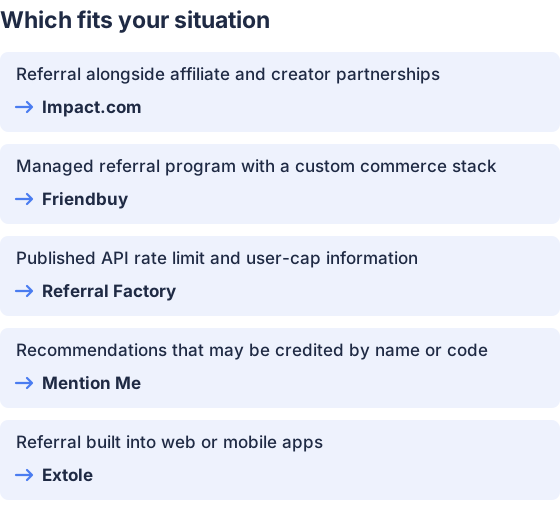
From the table above.
How this comparison was made
Prices and features come from each vendor’s published pages, checked in November 2026. The products were not tested hands-on.


