Which survey platforms integrate with market research panels?
Survey tools for recruited samples compare enterprise platforms, DIY panels and programmatic marketplaces to guide tool selection.

Survey tools that target recruited samples include enterprise research platforms (Qualtrics, Alchemer, QuestionPro), DIY panels (SurveyMonkey Audience, Pollfish) and programmatic marketplaces (Cint, Dynata).
At a glance
| Option | Best for | Starting price (paid plan) | Free plan | Supports panel/sample integration | Source |
|---|---|---|---|---|---|
| SurveyMonkey (Audience) | Fast DIY market research | $30/user/mo | Yes | Yes | surveymonkey.com/pricing |
| QuestionPro (Research Suite) | Research teams, academic use | $83/user/mo | Yes | Yes | questionpro.com/pricing |
| Alchemer (Panel Services) | Panel-managed projects, mid-market | Not confirmed, see source | No (trial) | Yes | alchemer.com/plans-pricing |
| Dynata+ (panel / sample API) | High-quality first-party sample, enterprise | Usage-based | No | Yes | dynata.com/dynata-plus/sample |
| Cint Exchange (Lucid marketplace) | Programmatic multi-panel sourcing | Quote only / Usage-based | No | Yes | cint.com/products |
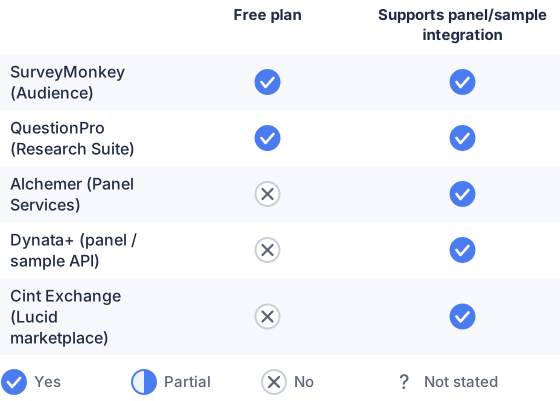
From the sourced table above, checked November 2026.
SurveyMonkey (Audience): best when you need quick DIY sample
SurveyMonkey combines its core survey builder with SurveyMonkey Audience so you can buy respondent completes inside the platform and run fast studies; Audience advertises starts from about $1/response and native distribution controls. SurveyMonkey is easy for marketers or small research teams but its response and seat model can become expensive at scale and complex quota work often needs careful setup. (surveymonkey.com)
QuestionPro: best when you want a research-focused platform with panel features
QuestionPro offers both a self-serve survey product and panel-management features (custom redirects, panel lists and third-party sample wiring). It publishes per-seat prices for standard paid plans and supports redirect- and token-based panel returns, which suits academic and in-house research groups that need more control than a pure DIY panel. It can still require configuration for server-to-server workflows. (questionpro.com)
Alchemer: best when you want a panel-services team on top of a survey tool
Alchemer sells survey software plus managed Panel Services (they contract or broker sample from multiple suppliers and offer fulfillment/quality guarantees). That makes it convenient when you want an agency-like fielding service without leaving the survey environment; prices are self-published for software seats and panel buys are quoted. The trade-off is higher project minimums and extra fees for tailored audiences. (alchemer.com)
Dynata+ Sample: best when you need first-party, programmatic sample at scale
Dynata is a major panel owner that exposes first-party sample and a Sample API (Dynata+). Use Dynata when you need large, verifiable respondent pools and programmatic control over feasibility, quotas and fielding. It is usage-priced and aimed at research teams or platforms that can run server-to-server integrations; it is not a low-cost DIY route. (dynata.com)
Cint Exchange (Lucid): best when you want programmatic marketplace sourcing
Cint (which consolidated Lucid) operates a programmatic marketplace that routes your survey to many panel suppliers. It is ideal when you must combine multiple panel sources quickly or buy hard-to-reach audiences via a single API/portal; outcome codes, security and supplier selection are the implementation details to verify. Pricing and terms are handled per project or via the exchange UI. (cint.com)
Which survey platforms and tools integrate with market research panels?
Short answer: enterprise survey platforms (Qualtrics, Alchemer, QuestionPro, Forsta/Decipher), DIY survey products that sell sample (SurveyMonkey Audience, Pollfish), and programmatic marketplaces (Cint/Lucid, Dynata) all support panel/sample integrations. These vendors either embed panel buying inside the survey product or document APIs/redirects so external panels can deliver respondents into the questionnaire. (alchemer.com)
Why: some providers own and sell sample (Dynata), others provide a native “audience” product (SurveyMonkey Audience, Pollfish) while traditional survey engines offer integration points so third-party panels can push respondents via a tracked survey URL and receive completion dispositions back (QuestionPro, Alchemer). Programmatic marketplaces sit between buyers and many panel suppliers to route sample automatically. (dynata.com)
How do survey, panel integrations work?
Short answer: by passing the participant into the survey through a tracked entry URL and returning an outcome either via a browser redirect or a server-to-server callback; many marketplaces also offer a full API for feasibility, purchase and fielding. (ongraph.com)
Reasoning: common patterns are (a) redirect-based flow, the panel sends a respondent to your survey URL with a tracking id and receives a redirect on complete/screenout/overquota, (b) S2S callbacks, the panel or marketplace posts the outcome back to your server (preferred for reliability), and (c) demand/supply APIs, marketplaces like Dynata+ and Cint expose endpoints to request feasibility, launch projects, and monitor quotas. Each supplier uses its own outcome codes and security (signed URLs, HMAC, API keys), so integrations require mapping dispositions and testing. (ongraph.com)
What panel providers are commonly supported?
Short answer: Dynata, Cint (Lucid), Toluna, PureSpectrum, Pollfish, Prolific and specialist B2B sources (Wynter, Respondent, User Interviews) are commonly used; many survey platforms explicitly list integrations or work with these suppliers. (dynata.com)
Reasoning: marketplaces (Cint/Lucid) aggregate many supply partners; large owners such as Dynata operate their own first-party sample and offer APIs; Pollfish and PureSpectrum supply mobile/web panel access with pay-per-response pricing; B2B specialist panels and recruiting sites are used for professional audiences. Each supplier differs on verification, recontact rights and pricing, so platform support is a practical indicator of interoperability. (cint.com)
How to choose the right integration for my market research?
Short answer: pick the option that matches your target audience, budget, timeline and technical resources, use panel marketplaces for scale, first-party panels for quality, and platform-embedded audience products for speed. (dynata.com)
Reasoning:
- Audience fit first: consumer vs B2B vs healthcare/specialist. B2B and healthcare often cost more and need verified credentials. (wynter.com)
- Budget and pricing model: pay-per-complete marketplaces (Dynata, Cint, Pollfish) are predictable for one-off projects; enterprise licenses (Qualtrics/Alchemer/QuestionPro) suit ongoing programs. (dynata.com)
- Speed and control: embedded panels (SurveyMonkey Audience, Pollfish) get fast answers; APIs (Dynata+, Cint Exchange) give programmatic control and in-field adjustments. (surveymonkey.com)
- Data quality and security: prefer S2S callbacks, signed tokens, and vendors that publish disposition mappings and fraud-protection practices. Ask for sandbox testing. (ongraph.com)
Which should you choose?
| Your situation | Best fit |
|---|---|
| Need results within 24-48 hours and low setup effort | SurveyMonkey (Audience) |
| Research team that needs programmatic control and enterprise features | Dynata+ |
| Want a mix of survey software plus managed panel support | Alchemer |
| Academic or campus research with mixed DIY and panel needs | QuestionPro |
| Need blended supply from many panel sources quickly | Cint Exchange |
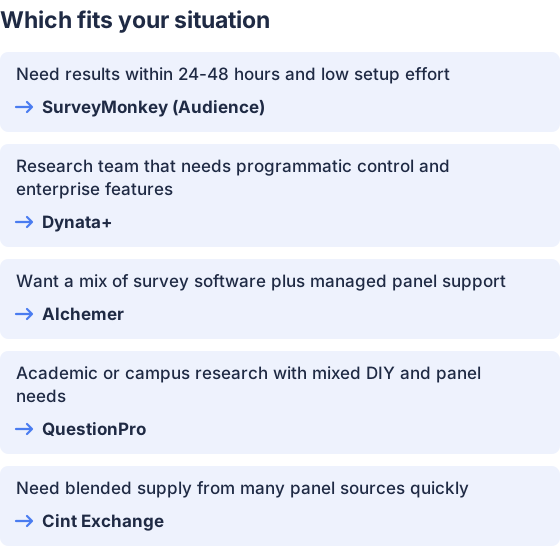
From the table above.
How this comparison was made
Prices and feature claims were taken from each vendor’s published pages and documentation and checked in November 2026. Products were not tested hands-on; descriptions are synthesis of vendor docs and industry developer guides. (surveymonkey.com)


