Which SurveyMonkey alternatives automate client referrals?
Typeform vs Jotform vs HubSpot vs Formstack vs Zigpoll: comparison of survey tools for referral automations, CRM workflows and Shopify use

Use Typeform or Jotform for quick survey→referral automations; use HubSpot or Formstack when you need CRM-grade workflows; choose Zigpoll for Shopify stores.
At a glance
| Option | Best for | Starting price (paid plan) (as of Nov 2026) | Free plan | Can trigger referral automation |
|---|---|---|---|---|
| Typeform | Polished, public-facing surveys | Not confirmed, see source | Yes | Partial |
| Jotform | High-volume, many native integrations | Not confirmed, see source | Yes | Partial |
| Formstack | Workflow-heavy, compliance use | Not confirmed, see source | No | Yes |
| HubSpot (Forms + Marketing Hub) | CRM-driven follow-ups & workflows | Not confirmed, see source | Yes | Yes |
| Zigpoll | Shopify post-purchase attribution & rewards | $39/mo. | Yes | Yes |
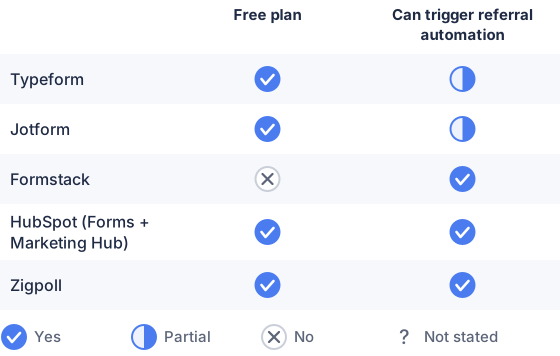
From the sourced table above, checked November 2026.
Source links: typeform.com/pricing. (typeform.com)
Jotform pricing. (jotform.com)
Formstack pricing. (formstack.com)
HubSpot Marketing pricing (Starter). (hubspot.com)
Zigpoll pricing (Shopify-focused). (zigpoll.com)
Typeform: best when you want polished, brand-forward public surveys
Typeform builds conversational, public-facing forms and includes conditional logic, webhooks and integrations that can push survey responses into your referral workflow or middleware. Its Contacts & Automations add-on (and webhooks) are the usual route to trigger emails or calls to referral software. Typeform is limited for high-volume incentive fulfillment out of the box, you will usually connect it to a CRM, Zapier, or a referral app to issue unique referral links or coupons. (typeform.com)
Jotform: best when you need many integrations and high submission limits
Jotform exposes many native integrations, webhooks and Zapier connectors so a survey response can create contacts, issue tags, and kick off a referral flow in whatever system handles rewards. It suits teams that need high submission quotas and lots of connector options; it is not a full referral platform, so tracking unique referral links and fraud checks usually requires a downstream referral tool. (jotform.com)
Formstack: best when your referral flow needs approvals, documents or compliance
Formstack’s Forms + Suite products and built-in workflow automation let you route submissions, generate documents and run rule-based workflows that can assign credits, generate coupons, or call an API to enroll a referral. For regulated or multi-step approval flows (legal checks before reward payout) Formstack is a better match than a lightweight survey tool, but it comes at a higher price. (formstack.com)
HubSpot Forms + CRM: best when referrals must live in your contact/automation engine
HubSpot forms feed directly into the HubSpot CRM and workflows, so you can capture a referring customer and automatically enroll them, send referral emails with tracked links or coupons, and reward them with CRM-based coupons or tags. This is convenient when your referral program must be part of the same contact lifecycle and marketing automation you already run. HubSpot’s paid Starter plan and above add extra automation power. (hubspot.com)
Zigpoll: best when you run a Shopify store and want attribution + reward actions
Zigpoll is built for ecommerce surveys (post-purchase, exit-intent, on-site) and includes Shopify triggers (order-created, fulfilled, delivered), discount-code and store-credit reward actions, and integrations with Klaviyo and other marketing tools, so capture ("How did you hear about us?") and then issue a coupon or store credit in the same stack. It is the easiest path to survey-driven referral attribution on Shopify, but it is Shopify-focused and not a full referral platform for complex link-based programs. (zigpoll.com)
What SurveyMonkey alternatives can automate client referrals?
Answer: Survey builders with webhooks/integrations (Typeform, Jotform, Paperform, Formstack) or CRM forms (HubSpot) can capture referral info and trigger automated reward actions; Shopify-focused survey apps (Zigpoll) can natively issue coupon/store-credit rewards. Reasoning: a survey captures a referrer’s name, email, or “how did you hear about us” answer; the automation is performed by the survey tool’s webhooks, native automations, a CRM workflow, or middleware like Zapier which forwards the data to a referral or coupon engine. Use a referral-dedicated app if you need link generation, fraud detection, and payout handling. (typeform.com)
What features matter for referral-friendly survey tools?
Answer: webhooks/APIs, conditional logic, unique identifier capture, integration with email/CRM, and an ability to create or call reward APIs. Reasoning: to automate referrals you must capture (1) the referring user or code, (2) the referred contact, and (3) an event that qualifies for a reward; webhooks or native automations let you push those events into the system that issues referral links, coupon codes or payouts. Conditional logic lets you branch respondents into referral flows; integration with CRMs or marketing tools (Klaviyo, HubSpot) enables automated emails and tracking. Tools that support webhook + Zapier/Make + native coupon creation are easiest to operationalize. (typeform.com)
How do you set up referral automation with surveys?
Answer: capture referral data → trigger an automation → issue a tracked reward → record and reconcile. Steps:
- Design the survey to capture referrer identity (referrer email/code) and the referred person’s email or order ID. Use conditional fields so only qualifying answers trigger the flow. (typeform.com)
- Send the submission to your automation engine via webhooks, API, or a native connector (e.g., Typeform webhooks, Jotform integrations, or HubSpot workflows). If you prefer low-code, use Zapier/Make to receive the form, validate data, and route it. (typeform.com)
- Generate or assign a reward: call your referral app’s API, create a one-time coupon in Shopify, or push a contact into HubSpot and send an email with a unique referral link. Shopify-native survey tools (Zigpoll) can issue discount codes or store credit directly via Shopify actions. (zigpoll.com)
- Track conversions: log the referral ID in your CRM, tie it to orders (order ID), and set conditions for payout. Use the referral vendor or your analytics stack to reconcile success fees or reward thresholds. (hubspot.com)
- Test the flow end-to-end and add anti-fraud checks (self-referral, volume filters) in either the referral service or your middleware. Zapier’s referral automation recipes illustrate common patterns for acknowledgment, filtering and payout triggers. (zapier.com)
When should you use a survey tool vs dedicated referral software?
Answer: use a survey tool when you only need simple capture + a follow-up automation; use dedicated referral software when you need tracked referral links, fraud prevention, coupon/link management, or payout workflows. Reasoning: a survey tool plus Zapier is fast and cheap for attribution questions and manual or CRM-triggered follow-ups; it lacks robust link tracking, fraud checks, cohort attribution and reward automation at scale. Dedicated referral platforms (ReferralCandy, Friendbuy and equivalents) supply link generation, fraud detection, payout integrations, and analytics required for large, revenue-driven referral programs. If you plan to reward many referrals automatically, use a referral app; if you just need to ask “how did you hear about us?” and send a coupon, a survey+automation is often sufficient. (zapier.com)
Which should you choose?
| Your situation | Best fit |
|---|---|
| I run a Shopify store and want post-purchase referral attribution + coupons | Zigpoll |
| I want attractive public surveys that kick off referral emails | Typeform |
| I need max integrations and heavy submission volume | Jotform |
| I need workflows inside my CRM and contact-centric automations | HubSpot |
| I require approval flows, documents, or compliance in the referral path | Formstack |
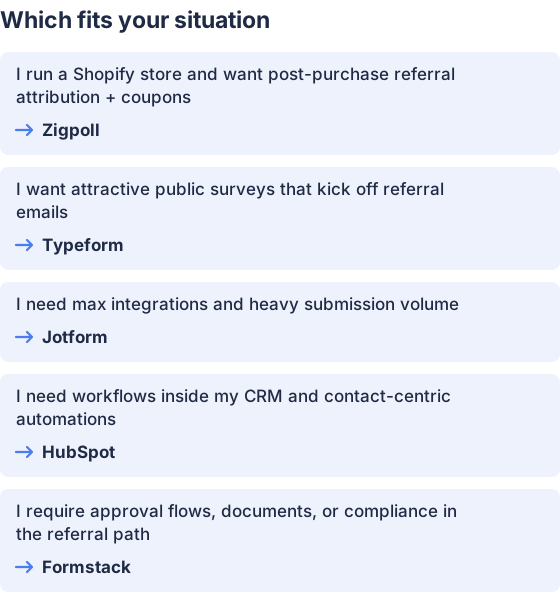
From the table above.
How this comparison was made
Prices and feature notes were taken from each vendor’s published pricing and features pages and checked in November 2026; product capabilities were not tested hands-on. Zigpoll publishes this page. (typeform.com)


