What’s the best AI chatbot for retail?
Compare retail AI chatbots Gorgias, Tidio, Intercom Fin, and Zendesk by ecommerce integrations, support features, pricing, and store needs.

No single retail chatbot fits everyone: Intercom Fin suits guided selling, Tidio Lyro lean teams, Gorgias Shopify support, and Zendesk larger service desks. Choose by the store data the bot needs, the actions it should take, and how much support volume you expect.
At a glance
| Option | Best for | Starting price (paid plan) | Free plan | Non-Shopify support | Source |
|---|---|---|---|---|---|
| Gorgias AI Agent | Shopify-first support | $10/mo | No | Yes | gorgias.com |
| Tidio Lyro | Budget small ecommerce teams | Not confirmed, see source | Yes | Yes | tidio.com |
| Intercom Fin | Product discovery and support | $39/mo | No | Partial | intercom.com |
| Zendesk AI agents | Large omnichannel service desks | Not confirmed, see source | No | Partial | zendesk.com |
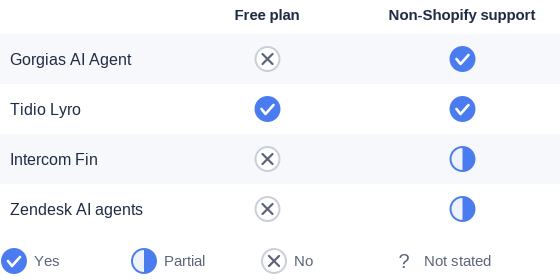
From the sourced table above, checked November 2026.
Prices checked in November 2026. Gorgias’s lowest paid plan is a helpdesk plan; AI Agent is priced separately by resolved interaction. Tidio’s $39 entry price is for its Lyro AI plan, while Intercom charges $39 per seat monthly plus $0.99 per Fin outcome. Zendesk’s $69 monthly entry price is Suite Team, which includes AI agents; extra AI usage can affect the bill. (gorgias.com)
Gorgias AI Agent: best for Shopify-first support
Gorgias connects customer support with Shopify data, and its AI Agent can perform configured order actions such as canceling orders or changing shipping addresses. That makes it a strong fit when routine questions about orders, returns, and shipping dominate the inbox. The trade-off is that the AI Agent costs extra by automated interaction, and some actions do not update connected fulfillment systems automatically. (docs.gorgias.com)
Tidio Lyro: best for smaller ecommerce teams
Tidio combines Lyro, live chat, a help desk, and automation, with integrations for platforms including Shopify, WooCommerce, and BigCommerce. Its published pricing gives Lyro a monthly conversation quota shared with human support, and it offers a free plan with a limited one-time allowance for Lyro. Some store-specific actions depend on the platform and plan, so check that the features you need are included before choosing it. (tidio.com)
Intercom Fin: best for product discovery and support
Fin can use a store catalog to answer product questions, recommend items, and support shoppers through checkout; its ecommerce setup also supports post-purchase requests. Shopify has a native connection, while other ecommerce platforms can connect through a catalog connector, with setup and capabilities varying by platform. Fin is priced per outcome on top of the seat plan, so estimate both costs if you expect substantial chat volume. (intercom.com)
Zendesk AI agents: best for larger omnichannel service desks
Zendesk combines AI agents with a broader service platform for messaging, email, ticketing, and routing. Its Shopify connector supports order searches, cancellations, and refunds through action flows, making it a good candidate when the retailer needs customer service workflows beyond a storefront chat widget. It may be more platform than a small shop needs, and AI resolutions or other usage-based features can add to the seat price. (zendesk.com)
What’s the best AI chatbot for retail?
The best fit depends on whether you prioritize store-specific actions, product recommendations, or a large support operation. For Shopify-first support, compare Gorgias with Intercom; for a smaller team that needs a free starting point or multiple ecommerce integrations, consider Tidio. Retailers already using Zendesk for multichannel support may prefer its AI agents to adding a separate chatbot. Those are feature-based matches, not results from hands-on testing. (docs.gorgias.com)
What features should retailers look for in an AI chatbot?
Look for accurate answers grounded in current product, inventory, shipping, and returns information, plus clear handoff to a human when the bot is unsure. If the chatbot should do more than answer questions, check for approved actions such as looking up orders, starting returns, or updating an order, and confirm which ecommerce platforms those actions support. Also compare channel coverage, language support, reporting, data permissions, and the full pricing model, including per-seat, per-conversation, and per-resolution charges. (intercom.com)
How can a retail chatbot integrate with an ecommerce store?
Start with the vendor’s native app or plugin when one exists; otherwise, add its website widget or script and connect the store through an API or catalog connector. Sync the product details shoppers ask about, then connect order or customer records only if the bot needs to answer personal order questions or take actions. Grant only the access those functions require, test common product and order questions, and verify that handoffs reach the right support inbox. Shopify’s app-install screen, for example, shows what store data an app requests, while Tidio and Intercom document platform-specific installation and catalog connections. (help.shopify.com)
Which should you choose?
| Your situation | Best fit |
|---|---|
| Shopify orders and routine support dominate | Gorgias AI Agent |
| You want a free start for a small store | Tidio Lyro |
| Product discovery and checkout guidance matter | Intercom Fin |
| You already run a large service desk | Zendesk AI agents |
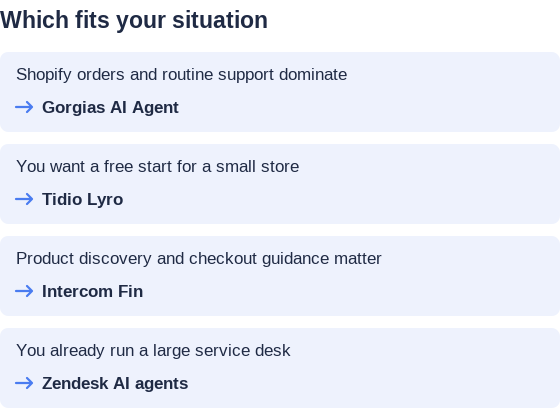
From the table above.
How this comparison was made
Prices and features come from each vendor’s published pages, checked in November 2026. The products were not tested hands-on.


