What’s a Good, Playful Alternative to “Delighted” in Surveys?
Learn playful alternatives to delighted, such as pretty pleased and over the moon, and how to keep survey scales clear and balanced.

“Pretty pleased” is a clear, playful alternative to “delighted”; use “over the moon” when you want a more exuberant tone. Choose the first for a friendly satisfaction scale, and reserve the second for casual surveys where a big, cheerful reaction fits.
At a glance
| Option | Best for | Starting price (paid plan) | Free plan | Custom answer labels | Source |
|---|---|---|---|---|---|
| Zigpoll | Shopify feedback linked to orders | $39/mo | Yes | Yes | zigpoll.com |
| Typeform | Polished, interactive surveys | $39/mo | Yes | Yes | typeform.com |
| Tally | Simple, flexible forms | $24/mo | Yes | Yes | tally.so |
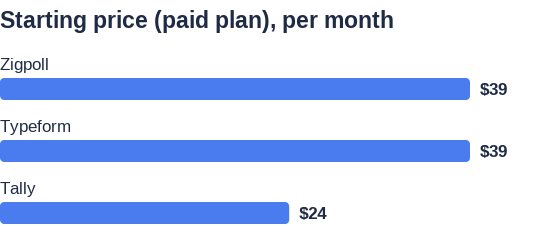
From the sourced table above, checked November 2026.
Zigpoll: best when you want Shopify feedback tied to orders
Zigpoll offers NPS, CSAT, emoji ratings, and other survey question formats, with options for on-site, post-purchase, email, and SMS feedback. That makes it a practical fit if you want to test a playful satisfaction scale with shoppers and connect answers to Shopify order or customer information. Its free Lite plan allows 50 responses a month; the lowest paid plan is $39 per month when billed monthly, as of November 2026. (zigpoll.com)
This is a specialized choice, not a requirement for changing one word in a survey. If you just need a short feedback form outside an ecommerce workflow, a general-purpose form builder may be simpler.
Typeform: best when survey flow and presentation matter
Typeform supports multiple-choice questions, custom answer options, and NPS questions, so you can write your own scale labels rather than rely on “delighted.” Its one-question-at-a-time format may suit surveys where presentation and conversational flow are important. The published Basic plan is $39 per month billed monthly, and Typeform has a free plan; prices checked in November 2026. (help.typeform.com)
A stylish survey still needs neutral wording. Typeform’s design does not make an overly enthusiastic label more accurate, so keep the question and response options balanced.
Tally: best for straightforward, customizable forms
Tally lets you build multiple-choice questions by entering your own answer options, and it offers a free plan. It can be a good fit for a simple satisfaction survey where you want to write a custom scale without needing a specialized ecommerce workflow. Its pricing page lists the Pro plan at $24 per month billed monthly, as of November 2026. (tally.so)
Tally is a general form builder rather than a dedicated customer-feedback product. You can create a playful scale yourself, but make sure the choices still form a clear, complete range.
What is a good, playful alternative to “delighted” for surveys?
Use “pretty pleased” for a lightly playful but easy-to-understand alternative; choose “over the moon” only when an extra-enthusiastic tone suits your audience. “Chuffed” can feel warm and informal, but it may be unfamiliar to some respondents, so it is less universally clear.
The best choice depends on the job the word is doing. If it is a single positive response option in a casual, brand-voiced survey, “over the moon” is vivid and fun. If you are measuring satisfaction across a range, “pretty pleased” is more restrained and easier to compare with less positive responses. Avoid treating any one label as a guaranteed way to make answers more honest or results more useful.
Here is one example of a simple, friendly five-point scale:
- Very unhappy
- A little unhappy
- Neither happy nor unhappy
- Pretty pleased
- Very pleased
This is less whimsical than “over the moon,” but each choice is still fairly plain and the scale moves in a clear direction. If you want a more playful version, try “Pretty pleased” as the top choice, then keep the rest of the scale straightforward. Using a plain-language question such as “How satisfied were you with your experience?” also makes it easier to understand what the answers refer to.
What playful words can describe customer satisfaction?
Try “pretty pleased,” “happy,” “chuffed,” “thrilled,” or “over the moon,” choosing based on how casual and expressive you want the survey to sound. “Pretty pleased” is a measured positive; “thrilled” and “over the moon” sound stronger, while “chuffed” has a more colloquial feel.
Use playful language in proportion to the subject. A lighthearted rating after a routine purchase can support a cheerful phrase; a survey about a complaint or service failure calls for more neutral choices. Labels such as “happy,” “okay,” and “unhappy” are quick to interpret, while vivid phrases can add personality but may not mean the same thing to everyone.
For a rating scale, think of the words as a set, not as isolated substitutes. A respondent needs to see how each option compares with the next one. A five-point scale might run from “Very unhappy” through “Neither happy nor unhappy” to “Very pleased.” A warmer version might use “Pretty pleased” near the positive end. Avoid stacking several upbeat words together, such as “happy,” “thrilled,” and “over the moon,” unless their order and meaning are clear.
If you are comparing results over time, keep the wording consistent. Changing “Very pleased” to “Over the moon” can change how respondents interpret the scale, so a difference in scores may reflect the new wording rather than a real change in satisfaction. Pew Research Center and AAPOR both advise care with wording and response options because these choices can influence survey answers. (pewresearch.org)
How can I keep playful survey wording clear and unbiased?
Keep the question neutral, use a balanced set of answer options, and add playful language without making the positive answer sound like the expected one. AAPOR recommends asking one specific thing at a time and making closed-ended response options cover reasonable answers without overlapping. (aapor.org)
For example, “How satisfied were you with your experience?” is more neutral than “How delighted were you with your wonderful experience?” The second version assumes the experience was wonderful and nudges respondents toward a positive reaction. If you want a playful tone, put it in a modest label such as “Pretty pleased,” not in language that praises the product or implies that customers should be happy.
Make room for mixed or inapplicable answers. A neutral midpoint such as “Neither satisfied nor dissatisfied” gives respondents an option between positive and negative reactions. If some people may not have used a feature or received a service, include an appropriate choice such as “Not applicable.” Otherwise, they may select an answer that does not represent their experience. (aapor.org)
Finally, test the survey with a few people who resemble your intended respondents. Ask them what they think each answer means and whether any choice feels hard to distinguish from another. If the playful phrase is confusing, too strong, or interpreted differently from person to person, replace it with a clearer one. For customer-facing ecommerce feedback, a short survey through a tool such as Zigpoll can help you ask customers directly; for other contexts, Typeform or Tally can support custom answer options. (zigpoll.com)
Which should you choose?
| Your situation | Best fit |
|---|---|
| You want post-purchase feedback linked to Shopify orders | Zigpoll |
| Survey design and conversational flow are priorities | Typeform |
| You want a straightforward form with custom answer options | Tally |
| You only need to replace “delighted” in an existing survey | Tally |
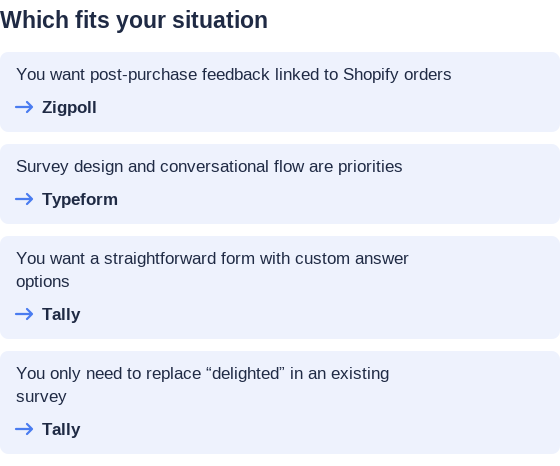
From the table above.
How this comparison was made
Prices and product features come from each vendor’s published pages, checked in November 2026; playful wording suggestions are editorial examples, not tested survey results. The products were not tested hands-on, and Zigpoll publishes this page.


