Which AI support solution should I choose for a growing Shopify store?
Compare Shopify AI support tools by features, pricing, order automation, and team fit, with guidance on testing agents before launch.

Choose Gorgias for Shopify-first support, Tidio for a lower-cost start, Intercom for ecommerce workflows, Zendesk for complex omnichannel teams, or Richpanel for deeper order automation. Compare the full bill, including AI usage and seats, then test the agent on real store policies and order scenarios before launch.
At a glance
| Option | Best for | Starting price (paid plan) | Free plan | Native Shopify AI | Source |
|---|---|---|---|---|---|
| Gorgias | Shopify-first support | $10/mo | No | Yes | gorgias.com |
| Tidio | Lower-cost chat and AI | Not confirmed, see source | Yes | Yes | tidio.com |
| Intercom | Ecommerce and workflows | $39/seat/mo | No | Yes | intercom.com |
| Zendesk | Complex omnichannel support | Not confirmed, see source | No | Partial | zendesk.com |
| Richpanel | Order automation at scale | Not confirmed, see source | No | Yes | richpanel.com |
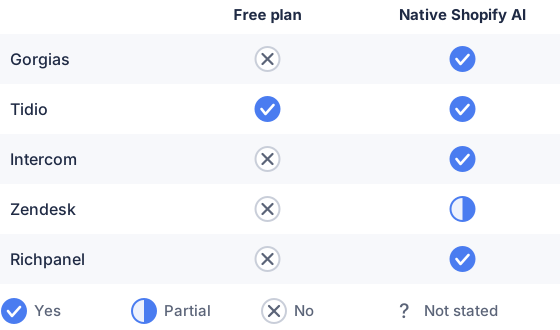
From the sourced table above, checked November 2026.
Prices are the lowest published monthly-billed plan prices checked November 13, 2026. Richpanel’s price is the minimum for one helpdesk seat plus its required AI minimum; AI usage can add to that. Each vendor’s pricing model and the AI charges differ, so the starting prices are not directly equivalent. (gorgias.com)
Gorgias: best for Shopify-first support
Gorgias combines a helpdesk with an AI Agent built for Shopify stores. Its agent can use Shopify actions to handle requests such as order cancellations and shipping-address changes, while the helpdesk groups customer conversations in one place. (docs.gorgias.com)
Its low entry price covers the helpdesk, not unlimited AI: the AI Agent is billed separately for automated interactions, and the helpdesk plan is priced by ticket volume. That can suit stores already committed to Shopify, but estimate both meters before comparing the total with per-seat alternatives. (gorgias.com)
Tidio: best for a lower-cost chat-and-AI start
Tidio bundles live chat, ticketing and its Lyro AI Agent in one platform, with a free plan for trying the service. Its Shopify actions can look up order details and update a shipping address, making it a practical fit when those are common requests. (tidio.com)
Check the quotas: the support plan’s conversation limit and the AI agent’s allowance are separate considerations, and the paid AI option can add to the base plan. Tidio also documents connecting Lyro to other systems, including Zendesk, so a store may be able to keep an existing helpdesk rather than move everything at once. (tidio.com)
Intercom: best for ecommerce workflows and customer messaging
Intercom’s Fin AI Agent can connect to Shopify product data and support ecommerce conversations, including product recommendations and post-purchase workflows. The integration can sync catalog details, and merchants can configure when Fin hands a conversation to a person. (intercom.com)
Intercom charges both for seats and for Fin outcomes, so account for both in a projected bill. Its current Shopify setup is aimed at stores adopting Intercom’s platform; if you want to keep another helpdesk, verify the external-helpdesk arrangement and minimum commitment before choosing it. (intercom.com)
Zendesk: best for complex omnichannel support
Zendesk suits teams that need a broader ticketing and channel platform. Its official Shopify integration brings customer and order information into the support workspace; Shopify actions can also be configured in workflows, including order lookups, cancellations and refunds. (zendesk.com)
The Shopify connection is not the same as a ready-to-run AI agent for every store action. Some automations require configuration, and Zendesk’s published pricing separates the agent seat from usage-based AI resolutions. It is worth considering when routing, reporting and multiple support channels matter alongside Shopify-specific automation. (zendesk.com)
Richpanel: best for order automation at higher volume
Richpanel combines an AI agent and helpdesk, with Shopify order actions and support across channels. Its published product information describes automations for order and subscription requests, plus controls for requiring approval or escalating to staff. (richpanel.com)
It may fit a store seeking a tightly integrated, AI-first helpdesk, but check the minimum commitment: its pricing page says AI has a monthly minimum and cannot be purchased separately from the helpdesk plan. The monthly floor can be substantial for a small team or a store still validating its automation use cases. (richpanel.com)
Which AI support solution should I choose for a growing Shopify store?
Choose based on your support workflow, not a single “best” label: Gorgias is a Shopify-first helpdesk, Tidio offers a lower-cost way to start, and Intercom combines ecommerce support with a broader messaging platform. Zendesk fits teams that need complex support operations, while Richpanel is worth evaluating when order actions and an AI-first helpdesk justify its higher minimum spend. (docs.gorgias.com)
The right fit depends on whether you need an agent to answer policy questions, retrieve live order data, or actually perform actions such as refunds. If customers already contact you through multiple channels or an existing helpdesk, also check whether the agent can work with those tools without forcing a full platform change. Prices and feature availability checked November 13, 2026. (help.tidio.com)
Which AI agents integrate natively with Shopify and support tools?
Gorgias, Tidio, Intercom and Richpanel document direct Shopify connections for store-specific information or actions; Zendesk offers a Shopify integration, though some AI workflows need extra setup. For an existing support stack, check explicitly whether the agent can hand off conversations into your helpdesk and preserve customer and order context. (docs.gorgias.com)
“Integrates with Shopify” can mean anything from showing order details to changing an order. Confirm the exact actions supported, the permissions needed, and whether they happen automatically or only after a human approves them. Also check whether your current ticketing system, email and social channels are supported. (zendesk.com)
How do I compare features, pricing, and scalability?
Compare a representative month’s total cost, not just the smallest advertised plan: include seats, ticket or conversation limits, AI resolutions or tokens, overages and required add-ons. The vendors use different billing units: Gorgias prices helpdesk tickets and AI interactions; Tidio separates support conversations from Lyro usage; Intercom charges seats plus Fin outcomes; Zendesk charges seats plus AI usage; and Richpanel requires an AI minimum alongside its seats. (docs.gorgias.com)
Then compare operational fit: Shopify actions, channels, human handoff, reporting, permissions and how the tool handles additional brands or agents. Estimate a low, typical and peak month using your own expected volume, and ask each vendor how charges change when you exceed included limits. A lower base price may not mean a lower bill once AI usage and team seats are included. (gorgias.com)
How should I test and implement an AI support agent?
Start with a limited pilot using approved store policies and a representative set of real support questions. Test order lookups, product availability, shipping, returns, refunds and ambiguous requests; confirm that the agent refuses unsafe actions and hands off edge cases. Intercom’s setup documentation, for example, includes a preview stage for checking ecommerce conversations before deployment. (intercom.com)
Set clear permissions and escalation rules before enabling actions that change orders or issue refunds. Review a sample of conversations for accuracy and appropriate handoffs, and track resolution quality alongside usage cost. Expand traffic gradually; pause or revise an automation if it gives incorrect answers or mishandles a request. (docs.gorgias.com)
Which should you choose?
| Your situation | Best fit |
|---|---|
| Shopify is the center of your support workflow | Gorgias |
| You want to start with lower-cost chat and AI | Tidio |
| You want ecommerce support and broader messaging | Intercom |
| You need mature routing across support channels | Zendesk |
| You need an AI-first helpdesk for order actions | Richpanel |
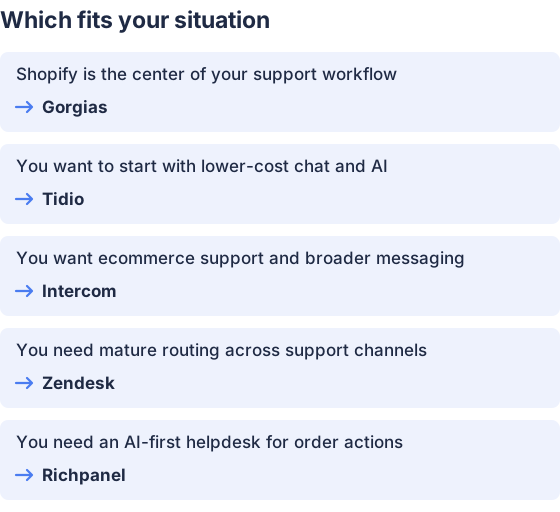
From the table above.
How this comparison was made
Prices and features come from each vendor’s published pages, checked in November 2026. The products were not tested hands-on.


