Which platforms best automate and manage service escalations?
Compare PagerDuty, incident.io, Rootly, Jira Service Management, and Zendesk by pricing, on-call paging, incident workflows, and ticket routing.

PagerDuty fits alert-driven on-call paging; incident.io suits chat-centered incident response; Rootly suits configurable incident workflows; Jira Service Management suits ticket-led IT operations; Zendesk suits customer-support escalations. The best fit depends on whether your team needs to page responders, coordinate technical incidents, or route customer tickets.
At a glance
| Option | Best for | Starting price (paid plan) | Free plan | On-call paging | Source |
|---|---|---|---|---|---|
| PagerDuty | Alert routing and paging | $25/mo | Yes | Yes | pagerduty.com |
| incident.io | Chat-based incident response | $19/mo | Yes | Yes | incident.io |
| Rootly | Custom incident workflows | $20/mo | No | Yes | rootly.com |
| Jira Service Management | IT service desk and incidents | $21.50/mo | Yes | Yes | atlassian.com |
| Zendesk | Customer-support ticket routing | Not confirmed, see source | No | No | zendesk.com |
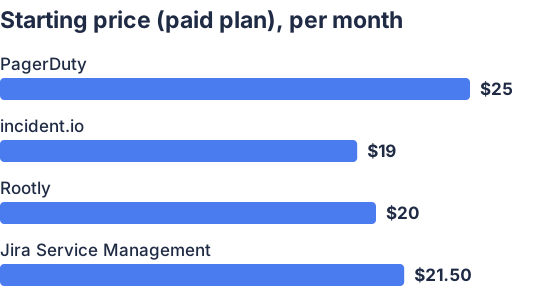
From the sourced table above, checked November 2026. Not charted, no single published figure: Zendesk.
PagerDuty: best for alert-driven on-call teams
PagerDuty is built to turn incoming alerts into routed notifications, on-call schedules, and escalation policies; its free plan includes up to five users and one schedule and policy. It’s a strong fit when missed alerts or clear responder handoffs are the main concern, though some capabilities, such as AIOps and status pages, are add-ons. The lowest paid Incident Management plan is $25 per user per month with monthly billing, as checked in November 2026. (pagerduty.com)
incident.io: best for teams that respond in chat
incident.io centers incident response in Slack or Microsoft Teams, with workflows, on-call schedules, and alerting available across its plans. Its free Basic plan includes one team’s on-call; the Team plan adds multi-team on-call and alerting, with a published monthly price of $19 per user as of November 2026. Integrations connect incidents to Datadog alerts and Jira follow-up tickets, and can link customer-support tickets from Zendesk. (incident.io)
Rootly: best for configurable incident workflows
Rootly combines on-call paging and incident coordination, with workflows and integrations for tools such as Datadog, Jira, and Slack. Its Incident Response and On-Call products are separate: each starts at $20 per user per month, so teams needing both should account for the additional cost. Rootly’s pricing page lists a trial, but not a free plan. (rootly.com)
Jira Service Management: best for ticket-led IT operations
Jira Service Management brings service requests, incident records, routing rules, escalation policies, and on-call schedules into an IT service-management workflow. Its free plan covers up to three agents; the Standard plan is listed at $21.50 per agent per month, as of November 2026. Premium adds advanced incident and problem management features, so teams should check which plan includes the incident controls they need. (atlassian.com)
Zendesk: best for customer-support escalations
Zendesk Support Team focuses on customer tickets: its listed features include ticket routing, triggers, and automations. That makes it suitable for routing a support request to the right team or applying rules as a ticket changes, but it is not an on-call paging tool for technical incidents.
Which platforms and tools are best for automating and managing service/incident escalations?
Choose PagerDuty or Rootly when the core requirement is to page an on-call responder from an alert; choose incident.io for incident coordination with on-call and chat workflows. Jira Service Management suits teams managing incidents alongside IT requests, while Zendesk fits customer-service ticket escalations rather than technical on-call paging.
The useful distinction is the unit each platform manages. PagerDuty focuses on alerts, responders, schedules, and escalation policies; incident.io and Rootly add incident coordination and workflow automation; Jira Service Management and Zendesk make service tickets central. Product pages confirm these different capabilities, including PagerDuty’s escalation policies, incident.io’s multi-team on-call, and Jira Service Management’s service request and incident features. (pagerduty.com)
How do escalation workflows and features differ between platforms?
PagerDuty routes alerts through on-call schedules and escalation policies, while incident.io and Rootly combine paging with incident workflows and chat-based coordination. Jira Service Management connects alerts and on-call schedules to IT service processes; Zendesk automates ticket assignment and handling rather than paging a technical responder.
That distinction affects how work moves after an alert or request arrives. A support ticket might be routed according to ticket rules, while an operational alert may need to notify a primary responder and then escalate if it is not acknowledged. Compare how each tool handles ownership changes, repeated alerts, incident records, stakeholder updates, and follow-up tasks; check plan limits for any feature your process depends on. (pagerduty.com)
How to choose the right escalation platform for my team?
Start with the event that begins an escalation: a monitoring alert, an employee service request, or a customer-support ticket. Then choose a platform that can route that event to the right owner, provide the notification channel and fallback path your team needs, and record the outcome where your team already tracks work.
Also compare the cost at your actual team size, the paid-plan features required for on-call and automation, and the effort of introducing another tool. A tool that adds a new escalation layer may suit a dedicated incident-response team, while teams already working in an ITSM or customer-support queue may prefer to keep routine escalations there. Run a sample workflow during evaluation, including a handoff and a ticket or incident update.
Which escalation tools integrate best with monitoring and ticketing?
PagerDuty, incident.io, Rootly, and Jira Service Management are natural candidates when alerts need to reach responders and connect to issue tracking; Zendesk is more appropriate when the source and destination are customer-service tickets. Check the exact integration and required plan for your monitoring and ticketing products before choosing.
Integration behavior differs: it may create an incident from a monitor, link a ticket, or sync status between systems. For example, Datadog documents integrations for paging through PagerDuty and for creating or syncing Jira work items; incident.io and Rootly list monitoring and ticketing integrations in their own directories. These vendor-specific links make a better shortlist than a generic claim of compatibility: test whether the integration carries the fields, ownership, and status updates your workflow needs. (docs.datadoghq.com)
Which should you choose?
| Your situation | Best fit |
|---|---|
| Monitoring alerts must page on-call responders | PagerDuty |
| Responders coordinate incidents in Slack or Teams | incident.io |
| You need configurable incident workflows and paging | Rootly |
| Incidents belong in an IT service desk workflow | Jira Service Management |
| Customer requests need automated ticket routing | Zendesk |
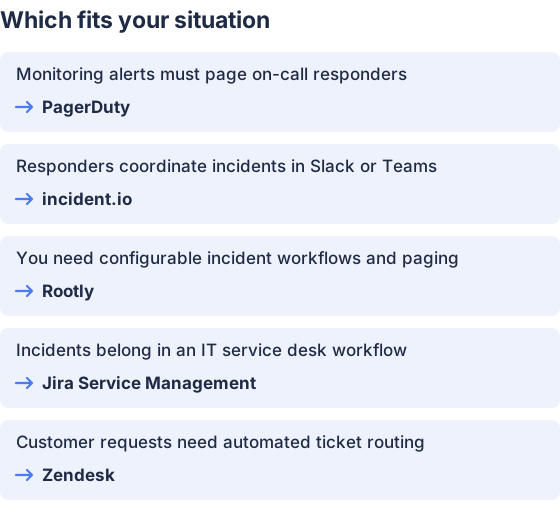
From the table above.
How this comparison was made
Prices and features come from each vendor’s published pages, checked in November 2026. The products were not tested hands-on.


