What Are Alternatives to Traditional Survey Platforms?
Compare survey alternatives for deeper consumer insights, including usability tests, interviews, research repositories, and ecommerce feedback.

Traditional surveys are not the only way to understand consumers: use usability tests to see behavior, interviews to hear context, and customer-feedback tools to ask questions in context. Maze suits unmoderated product tests, UserTesting suits moderated research with recruited participants, Dovetail suits organizing research findings, and Zigpoll suits ecommerce teams collecting feedback across the customer journey.
At a glance
| Option | Best for | Starting price (paid plan) | Free plan | Behavioral evidence | Source |
|---|---|---|---|---|---|
| Maze | Unmoderated product testing | Not confirmed, see source | Yes | Yes | maze.co |
| UserTesting | Moderated customer research | Quote only | No | Yes | usertesting.com |
| Dovetail | Organizing qualitative research | Quote only | Yes | Partial | dovetail.com |
| Zigpoll | Ecommerce customer feedback | $39/mo | Yes | No | zigpoll.com |
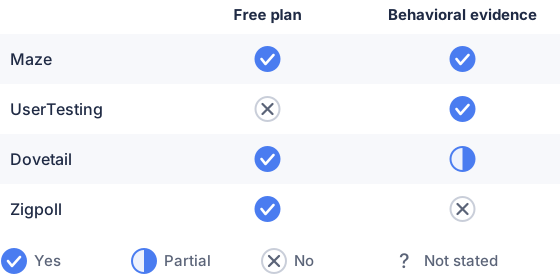
From the sourced table above, checked November 2026.
Prices checked in November 2026. “Behavioral evidence” indicates whether the option can help you observe people using a product or website, rather than only collect what they say.
Maze: best when you need to test a product or website
Maze lets teams run unmoderated studies, including prototype tests, website tests, and surveys. Participants can try a task while the team reviews how they move through the experience, where they hesitate, or whether they complete it; that can expose friction a rating question alone may miss. Its free plan is limited, and panel recruitment costs extra on paid plans, so check the study and participant limits against your research needs.
UserTesting: best when you need people to explain their experience
UserTesting supports moderated live conversations and unmoderated tests, and offers access to a participant panel. It can help teams hear people think aloud as they try a task, combining observed behavior with explanations in their own words. The trade-off is that prices are quote-based, and the feature set depends on the plan; it is a better fit for structured research programs than for a quick, low-cost feedback prompt. (usertesting.com)
Dovetail: best when research is spread across many sources
Dovetail helps teams organize and analyze research materials such as recordings, documents, and surveys, then search for recurring themes. That can be useful when insights are scattered across interviews, support conversations, and feedback rather than sitting in one survey dashboard. It is primarily a place to synthesize existing evidence, not a participant-recruitment or website-testing method. Its free plan is limited to one project and one channel; Enterprise pricing is custom. (dovetail.com)
Zigpoll: best when you want feedback tied to ecommerce activity
Zigpoll is a survey and feedback tool for ecommerce, including post-purchase, on-site, exit-intent, email, and SMS surveys. Its Shopify workflows can attach responses to customer or order information, which helps teams compare feedback with purchase context; its integrations include Klaviyo, Slack, and Triple Whale. It remains a direct-question method, so it can reveal stated reasons and preferences but does not show, by itself, what shoppers actually do on a site. Zigpoll’s free Lite plan includes 50 responses a month, and paid plans start at $39 per month billed monthly, as of November 2026. (zigpoll.com)
What are alternatives to traditional survey platforms for deeper consumer insights?
The main alternatives are customer interviews, usability testing, behavioral analytics, and analysis of customer conversations and reviews. Choose interviews when you need to understand motives, usability tests when you need to see where people struggle, and behavior analytics when you need patterns from real site visits. A research repository such as Dovetail can help synthesize findings across those sources, while a focused survey tool can still capture specific feedback in the right moment. (media.nngroup.com)
What methods can reveal deeper consumer insights than standard surveys?
Use interviews or moderated usability sessions to ask follow-up questions, and unmoderated tests or behavioral analytics to observe actions rather than rely only on recall. Open-ended questions can surface reasons you did not anticipate, but they take more effort to answer and can be harder to compare consistently. Keep questions clear and neutral: Pew Research Center notes that wording and answer choices can change responses. Pair qualitative findings with sales, support, or usage data to see whether people’s explanations line up with what they do. (pewresearch.org)
How do I choose a customer research tool for ecommerce?
Start with the decision you need to make, not the tool category: improving checkout, understanding returns, testing a new product page, or learning what brings customers back calls for different evidence. Check whether the tool supports your ecommerce platform, reaches the audience you need, and connects findings to useful customer or order context. For site friction, favor behavioral testing or analytics; for motivations and opinions, use interviews or feedback prompts; for recurring patterns across sources, use a research repository. If you do not use Shopify, verify integrations and order-event support before selecting a Shopify-focused app.
Can post-purchase surveys provide deeper consumer insights?
Yes, especially when a short, well-timed question asks about a specific purchase, but a survey alone will not explain every behavior. Ask about purchase motivation soon after checkout, or about fit, delivery, or product experience after the customer has had time to use or receive the item. Keep questions concise, include an optional open-text follow-up, and compare answers across relevant groups such as first-time and repeat buyers. Treat responses as one source of evidence, since those who choose to answer may not represent every customer; combine the results with interviews, site behavior, or customer-service feedback. (docs.zigpoll.com)
Which should you choose?
| Your situation | Best fit |
|---|---|
| Test whether shoppers can complete a website task | Maze |
| Hear customers explain what they think while testing | UserTesting |
| Bring interview notes, recordings, and feedback together | Dovetail |
| Collect order-linked feedback across an ecommerce journey | Zigpoll |
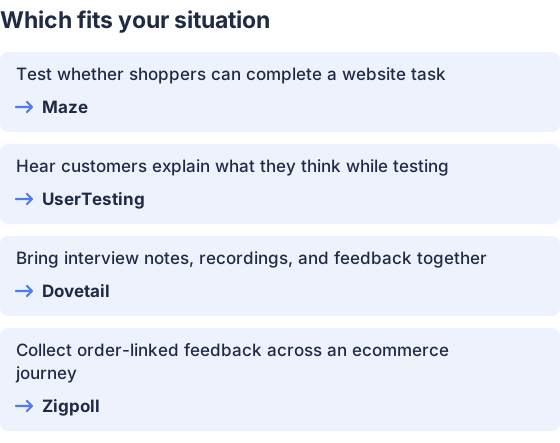
From the table above.
How this comparison was made
Prices and features come from each vendor’s published pages, checked in November 2026; the products were not tested hands-on. Zigpoll publishes this page.


