What are the best tools for automating feedback categorization?
Compare Survicate vs SurveyMonkey vs Zigpoll to find the right fit for feedback categorization, cross-source analysis, survey features, and pricing.

Survicate fits teams that need to group feedback from multiple sources, while SurveyMonkey and Zigpoll suit teams analyzing survey responses. The right choice depends on where your feedback lives and whether you need automatic themes, cross-channel analysis, or a way to collect customer input.
At a glance
| Option | Best for | Starting price (paid plan) | Free plan | Automatic theme grouping | Cross-source analysis | Source |
|---|---|---|---|---|---|---|
| Survicate | Multi-source feedback analysis | $89/mo | Yes | Yes | Yes | survicate.com |
| SurveyMonkey | Survey comment analysis | $149/mo | Yes | Yes | No | surveymonkey.com |
| Zigpoll | Ecommerce surveys and insights | $39/mo | Yes | Partial | No | zigpoll.com |
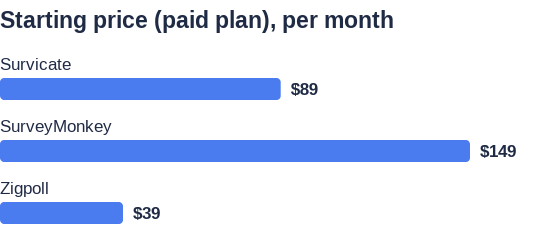
From the sourced table above, checked November 2026.
Prices checked in November 2026. Survicate’s monthly Starter plan begins at $89; its Growth plan is listed at $56 per month with annual billing. SurveyMonkey’s $149 Standard plan is billed monthly, while its Thematic Analysis feature is listed on the annual Advantage plan. Zigpoll’s paid plans begin at $39 per month billed monthly, or $29 per month with annual billing. (Survicate pricing details, SurveyMonkey plans, Zigpoll pricing)
Survicate: best for bringing feedback sources together
Survicate’s Research Hub combines survey responses with feedback from connected sources, and its AI can group text answers into categories and topics. That makes it a strong fit when a team wants to analyze more than surveys alone, such as app reviews or support conversations. Its trade-off is that plan limits and access to particular analysis features vary, so check the feature list for the plan you intend to buy. (Survicate AI analysis, Survicate plan details)
SurveyMonkey: best for categorizing survey comments
SurveyMonkey’s Thematic Analysis groups open-ended survey answers into themes, summarizes them, and lets teams filter responses by those themes. It is a focused choice if comments are already collected in SurveyMonkey and the job is to make those answers easier to scan. Its analysis has limits: it works with English text answers, supports surveys with up to 10,000 responses, and may need to be refreshed after new responses arrive. (SurveyMonkey Thematic Analysis)
The published monthly Standard plan starts at $149, but SurveyMonkey lists Thematic Analysis on its Advantage Annual plan, not Standard Monthly. Check that distinction before comparing the entry price with the cost of the categorization feature you need. (SurveyMonkey pricing)
Zigpoll: best for ecommerce teams collecting survey feedback
Zigpoll pairs customer surveys with AI-generated insights from responses. It is particularly relevant when a business wants to collect feedback through post-purchase, on-site, email, or SMS surveys, then review emerging themes and summaries. It is less suited to teams seeking one hub that automatically categorizes feedback already held in support tickets, reviews, and other external sources; its documented analysis is centered on Zigpoll survey data. (Zigpoll features and analysis, Zigpoll analytics documentation)
Zigpoll’s Lite plan is free for up to 50 responses a month; paid plans start at $39 per month billed monthly, or $29 per month billed annually. The response limit and AI analysis credits are worth checking against your expected survey volume. (Zigpoll pricing)
What are the best tools for automating feedback categorization?
Survicate is a good fit for teams categorizing feedback across connected sources; SurveyMonkey suits survey-only comment analysis; Zigpoll suits teams that want to collect and analyze ecommerce survey responses. The main difference is scope: Survicate is designed to bring multiple feedback sources into analysis, while SurveyMonkey and Zigpoll focus on feedback collected through their surveys. (Survicate AI analysis, SurveyMonkey Thematic Analysis, Zigpoll analytics documentation)
Choose based on your existing data and the categorization you need. If customer comments are scattered across support, review, and survey tools, prioritize a platform that connects those inputs; if they are already in a survey platform, built-in analysis may be enough. Also check whether the feature is included at the plan price you are comparing: a vendor’s lowest paid tier may not include its broader AI analysis. (Survicate plan details, SurveyMonkey pricing)
How do these tools categorize customer feedback automatically?
They use AI to find related words and ideas in open-ended responses, then present those patterns as themes, categories, or summaries. SurveyMonkey describes grouping and summarizing survey text into themes; Survicate offers AI categorization and topic analysis; Zigpoll’s documented approach includes summaries and trend extraction from its survey responses. (SurveyMonkey Thematic Analysis, Survicate AI analysis, Zigpoll analytics documentation)
The underlying workflow differs. Some tools analyze only answers submitted to their own surveys; a feedback hub can also ingest data from other connected sources. Results may need human review: vague comments can be difficult to classify, categories may not match a team’s vocabulary, and patterns are more useful when people can inspect the original feedback. Check whether categories are editable, whether new responses are processed automatically, and whether a tool lets you trace each theme back to the comments that support it. (Survicate AI analysis, SurveyMonkey Thematic Analysis)
What should ecommerce teams look for in a feedback categorization tool?
Look for a tool that handles the feedback sources your business actually uses, supports useful categories, and makes it easy to act on what it finds. Ecommerce teams may need to compare feedback from surveys, reviews, support tickets, or post-purchase interactions, but a survey-focused tool will not automatically categorize sources it cannot ingest. (Survicate AI analysis, Zigpoll features)
Check how the tool handles volume, languages, and plan limits; whether teams can revise categories; and whether each theme links back to its source response. For ecommerce specifically, consider whether you can connect responses to relevant context, such as the product or order, and send insights into tools your team already uses. Finally, confirm which paid tier includes the categorization features you need, how often results refresh, and what happens when you reach a response or data limit. (SurveyMonkey Thematic Analysis, Zigpoll pricing and features)
Which should you choose?
| Your situation | Best fit |
|---|---|
| You need to analyze feedback from several connected sources | Survicate |
| Your comments are already in SurveyMonkey surveys | SurveyMonkey |
| You want to collect and analyze ecommerce survey responses | Zigpoll |
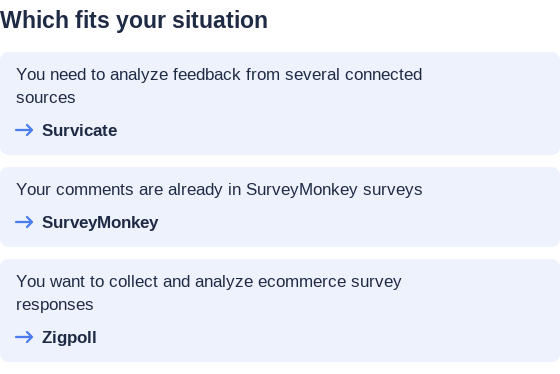
From the table above.
How this comparison was made
Prices and features come from each vendor’s published pages, checked in November 2026. The products were not tested hands-on; Zigpoll publishes this page.


