How to compare native advertising platforms with enterprise integrations?
Compare Taboola, Outbrain, StackAdapt, and Nativo for enterprise native advertising APIs, data, reporting, permissions, and billing.

For enterprise native campaigns, StackAdapt suits API-led cross-channel teams, Outbrain fits DSP-led buys, Taboola suits performance campaigns, and Nativo fits publishers using Google Ad Manager. Compare them by how well their APIs, audience and conversion data, reporting, permissions, and billing fit your existing workflow, then validate those requirements in a scoped pilot.
At a glance
| Option | Best for | Starting price (paid plan) | Free plan | API / ad-stack integration | Source |
|---|---|---|---|---|---|
| Taboola | Performance-native campaign automation | Usage-based | No | Yes | taboola.com |
| Outbrain | Buying native through an existing DSP | Usage-based | No | Yes | outbrain.com |
| StackAdapt | API-led, cross-channel programmatic buying | Usage-based | No | Yes | stackadapt.com |
| Nativo | Publisher ad operations with GAM | Usage-based | No | Yes | nativo.com |
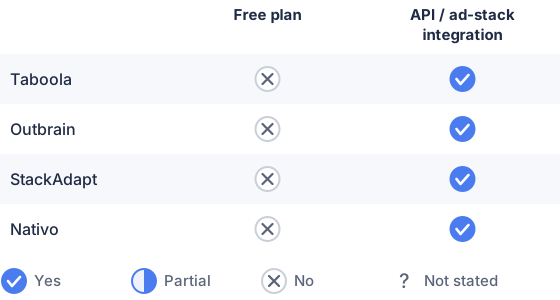
From the sourced table above, checked November 2026.
Taboola: best for performance-native campaign automation
Taboola’s Backstage API supports campaign management, reporting, and task automation, so teams can connect the platform to internal tools instead of relying only on its interface. Its developer site also documents conversion tracking through a pixel or server-to-server integration. API access requires an advertiser account and credentials, so confirm approval, access scope, and support with Taboola before designing around it. (developers.taboola.com)
Outbrain: best for buying native through an existing DSP
Outbrain offers an Amplify API for integrating campaign management and reporting into other tools, and its programmatic option lets buyers access Outbrain through supported DSPs. It also lists integrations for first-party audience targeting, including Adobe, LiveRamp, and Oracle. That makes it worth assessing when media teams already use a DSP or audience platform; check which connections and API permissions are available for your specific account. (outbrain.com)
StackAdapt: best for API-led, cross-channel buying
StackAdapt’s API offering is aimed at partners building or extending an in-house programmatic platform, and its media offering includes native alongside other digital channels. Its plan comparison also lists CRM integration, with availability varying by tier. That combination can suit teams consolidating execution across channels, but ask for a quote and verify exactly which CRM features, data flows, and support level your proposed plan includes. (stackadapt.com)
Nativo: best for publisher ad operations with GAM
Nativo documents two publisher workflows: a standalone setup and one integrated with Google Ad Manager (GAM). Its comparison explains how the choice changes ad serving, trafficking, targeting, reporting, and placement optimization, making the GAM option relevant when a publisher wants native functionality within existing ad operations. The documented fit is more specific to publisher workflows than a general advertiser’s CRM or marketing automation stack, so confirm any other required connections directly. (support.nativo.com)
1. How do I compare native advertising platforms that integrate with enterprise systems for complex teams?
Start with the system you need the platform to connect to, then compare how each vendor handles data exchange, permissions, workflow, and support. Don’t treat “has an API” as proof that a platform will fit: Taboola and Outbrain document campaign and reporting APIs, StackAdapt offers an API partnership route, and Nativo documents a specific GAM workflow. (developers.taboola.com)
Create a short scorecard around your own architecture. Check whether the platform can exchange campaign and conversion data with your data warehouse, CRM, CDP, analytics tools, ad server, and identity or consent systems. Include operational needs too: multiple brands or accounts, role-based access, approval steps, shared naming rules, audit trails, billing separation, and agency access.
For each connection, document what data moves in each direction, how often it syncs, who owns errors, and whether the integration is native, partner-provided, or custom-built. Then run a pilot with representative users and a limited campaign workflow. Test routine tasks such as launching, editing, reporting, and pausing campaigns, as well as exceptions such as failed data syncs, access changes, and account handoffs. The best fit is the option that meets the required workflows without creating more manual reconciliation or custom maintenance than your team can support.
2. What integration capabilities matter most for enterprise environments?
Prioritize secure API access, predictable data flows, account-level permissions, and exportable reporting. These capabilities determine whether the platform fits your existing controls and whether teams can operate it without copying data between tools. For example, Taboola documents API-based campaign management and reporting, while Outbrain offers an API and programmatic buying through DSP partners. (developers.taboola.com)
Also check integrations for first-party audience activation and conversion measurement. Ask whether the platform supports your specific identifiers, event definitions, consent signals, and reporting destinations, rather than relying on a general claim that it “integrates” with a CRM or analytics service. StackAdapt’s published plans include CRM integration with tier-dependent availability, while Nativo’s GAM documentation makes clear how ad serving and reporting responsibilities can differ by setup. (stackadapt.com)
For larger teams, verify that accounts and access can be organized around your business units, brands, regions, or agencies. Ask vendors to demonstrate the exact roles, approval steps, logs, and account hierarchy you require. A practical comparison distinguishes between a documented, supported connection and a custom integration your own engineers must maintain.
3. Which vendors are known for strong enterprise integrations?
StackAdapt is a fit to investigate when you need an API partnership or cross-channel buying; Outbrain when you want native inventory through an existing DSP or an API-connected workflow; Taboola when campaign automation and conversion tracking are central; and Nativo when your publisher team’s key system is GAM. Those are different strengths, not interchangeable integration packages. (stackadapt.com)
For Outbrain, its published partner and audience integrations make the existing DSP and data ecosystem part of the evaluation. For Nativo, the clearest documented enterprise integration is the publisher-side GAM workflow. Neither fact guarantees that a particular connector is included in your contract, region, or account configuration, so ask for a technical walkthrough and a written list of supported systems. (outbrain.com)
4. How should I evaluate security, scalability, and total cost of ownership?
Evaluate security through documents and controls you can verify: request current audit reports or certifications, a data processing agreement, subprocessors, retention and deletion terms, incident-notification commitments, and details on SSO, role permissions, and API credential management. StackAdapt says its controls are assessed through annual SOC 1 Type II and SOC 2 Type II examinations, with reports available from an account manager; Taboola publishes advertiser privacy terms describing security measures and incident handling. Ask each vendor for evidence relevant to your contract and data flows rather than treating public policy language as a substitute for review. (stackadapt.com)
For scalability, test the expected number of users, brands, accounts, campaigns, and API calls, then ask about rate limits, service availability, support response, and how the vendor handles peak workloads. Taboola’s API documentation describes request limits, so teams planning automated workflows should factor those limits into implementation and monitoring. (developers.taboola.com)
Compare total cost of ownership, not just media bids. Include media spend, platform or service fees, audience or measurement costs, implementation and ongoing API maintenance, support, and the internal time spent reconciling data. As of November 2026, the vendors’ public pages do not provide a common fixed monthly plan price: Taboola campaigns use agreed campaign payment models, Outbrain describes CPC billing, StackAdapt says DSP fees are typically a percentage of media spend, and Nativo says pricing varies by format. Request a written estimate using the same spend, formats, integrations, and support assumptions for each vendor. (policies.taboola.com)
Which should you choose?
| Your situation | Best fit |
|---|---|
| You want to automate campaign workflows through an API | Taboola |
| You buy native inventory through an existing DSP | Outbrain |
| You want API-led buying across programmatic channels | StackAdapt |
| Your publisher ad operations rely on Google Ad Manager | Nativo |
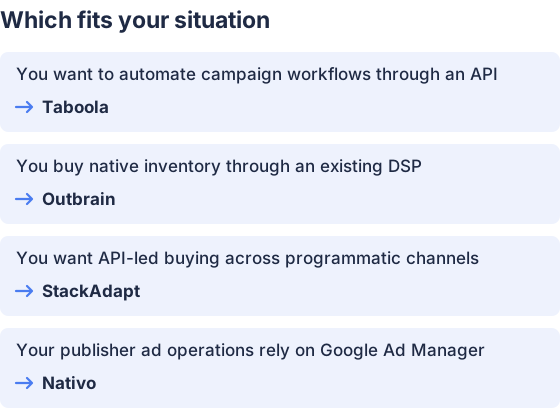
From the table above.
How this comparison was made
Prices and features come from each vendor’s published pages, checked in November 2026. The products were not tested hands-on.


