What Survey Platforms Have the Best AI Follow-Up Questions?
Compare AI survey platforms for adaptive follow-ups, including Opini.ai, Asked, Aftercare, and Zigpoll’s ecommerce-focused branching.

For truly adaptive AI follow-ups, compare Opini.ai, Asked, and Aftercare; Zigpoll suits ecommerce feedback with rule-based follow-ups, not AI-generated probing. Opini.ai emphasizes live interviewing, Asked adds text, voice, and video answers, and Aftercare offers an AI survey platform and API. (opini.ai)
At a glance
| Option | Best for | Starting price (paid plan) | Free plan | AI-generated adaptive follow-ups | Source |
|---|---|---|---|---|---|
| Opini.ai | Live adaptive interviews | Usage-based | No | Yes | opini.ai |
| Asked | Text, voice, and video feedback | $49/mo | No | Yes | asked.io |
| Aftercare | Research workflows and APIs | Quote only | Yes | Yes | getaftercare.com |
| Zigpoll | Ecommerce customer feedback | $39/mo | Yes | Partial | zigpoll.com |
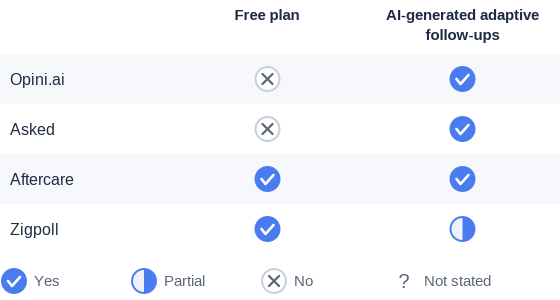
From the sourced table above, checked November 2026.
Opini.ai: best for live AI-moderated interviews
Opini.ai is a strong fit when you want respondents to answer a survey guide conversationally, with the AI deciding when to probe, clarify, or ask for more detail. It lets research teams set behavioral parameters such as how deeply the AI probes and how closely it follows the guide. Its published price is usage-based: $0.01 per completed response, plus any sample cost, as of November 2026. (opini.ai)
Asked: best when respondents may prefer voice or video
Asked is useful when open-text boxes do not suit your audience: respondents can answer open questions by text, voice, or video, and the platform can ask one optional AI follow-up based on an answer. Follow-ups are turned on per question, and plans set monthly limits. As of November 2026, the Starter plan is $49 per month with monthly billing, or $24 per month when billed yearly; the monthly plan includes 100 AI follow-ups. (asked.io)
Aftercare: best for customizable survey and API workflows
Aftercare is worth comparing if you want to build adaptive surveys inside its platform or add follow-up probing to an existing survey stack through its API. It supports follow-ups based on responses and offers a workflow builder for managing paths; its published pricing page asks teams to contact Aftercare for a customized plan. A free account is available with 30 responses per month, according to its survey generator page. (getaftercare.com)
Zigpoll: best for ecommerce feedback with conditional follow-ups
Zigpoll is designed for Shopify and ecommerce feedback, including post-purchase, on-site, email, and SMS surveys. It can generate a draft survey from a prompt and use answer-based branching, but its published materials describe the generated survey as something you review and edit; they do not describe an AI that writes a new probe in response to each respondent’s text. That makes it a partial fit for this specific question, but a practical one if you want customer feedback connected to ecommerce workflows. Its Lite plan is free, and the lowest paid monthly plan is $39/mo as of November 2026. (docs.zigpoll.com)
What survey platforms have the best AI-generated follow-up questions?
For adaptive probing, start with Opini.ai, Asked, or Aftercare; choose Zigpoll if you need ecommerce feedback with rule-based follow-ups instead. Opini.ai is geared toward live AI-moderated interviews and lets teams tune the depth and style of probing. Asked is a good match when you want one answer-triggered follow-up and the choice of text, voice, or video responses. Aftercare offers dynamic follow-ups in its survey platform and an API for adding them to existing survey setups. (opini.ai)
“Best” depends on how much control you need and how you collect answers. Before committing, check the plan’s follow-up allowance, whether you can steer topics, and what happens when answers are vague or off-topic. Zigpoll can still make sense for ecommerce teams that value its survey channels and branching, even though those are not the same as AI-generated adaptive probing. (asked.io)
How do AI-generated follow-up questions improve survey responses?
AI-generated follow-ups can turn short or unclear answers into more useful detail by asking a relevant next question. For example, if someone says onboarding was frustrating, a follow-up can ask what slowed them down; that gives the researcher more context than a rating or a bare complaint. Asked describes using a follow-up when an answer hints at something worth exploring, while Opini.ai describes prompting respondents when answers are shallow or vague. (asked.io)
The benefit is richer qualitative material, not a guaranteed increase in completion or response rates. Each extra question adds effort, so compare how many follow-ups the platform can ask, whether teams can limit the topics, and whether respondents can skip them. Human review still matters: generated questions can miss context or lead respondents toward an answer. Qualtrics, for example, advises reviewing AI-generated output for accuracy and suitability. (qualtrics.com)
What features should I compare in AI survey platforms?
Compare the follow-up behavior first: whether the AI reacts to free-text answers, how many probes it can ask, and whether you can define topics, tone, depth, or prohibited subjects. Asked allows one optional follow-up per configured question and caps monthly follow-ups by plan; Qualtrics documents controls for up to two advanced follow-ups and topics to avoid. (asked.io)
Then compare respondent experience and operating limits. Check supported answer types, survey channels, language availability, response caps, follow-up quotas, and the path for exporting or reviewing full conversations. For sensitive research, read the vendor’s data-processing and retention terms; “AI follow-up” alone does not tell you how respondent data is handled. Compare total cost at your expected volume, too: Asked sells monthly plans with follow-up quotas, while Opini.ai charges per completed response and sample cost may be additional. (asked.io)
Can AI follow-up questions adapt to a respondent’s answers?
Yes. Opini.ai, Asked, and Aftercare describe generating contextual follow-ups from respondents’ answers, rather than simply showing every person the same fixed question. Asked’s example is a follow-up about what slowed onboarding after a respondent mentions onboarding; Aftercare says its AI uses context to branch into follow-up questions. (opini.ai)
Adaptation has limits that vary by platform and plan. Asked’s follow-up is optional and enabled per question, while Qualtrics documents a maximum of two advanced follow-ups per respondent in a survey and limits some settings by language. Zigpoll can route respondents through branches based on answers, but its published documentation does not say the AI generates new follow-up wording from each open-text response. (asked.io)
Which should you choose?
| Your situation | Best fit |
|---|---|
| You want a live AI interviewer that probes deeper | Opini.ai |
| Respondents should answer by voice or video | Asked |
| You need to add follow-ups to an existing survey system | Aftercare |
| You need ecommerce surveys with branching and Shopify workflows | Zigpoll |
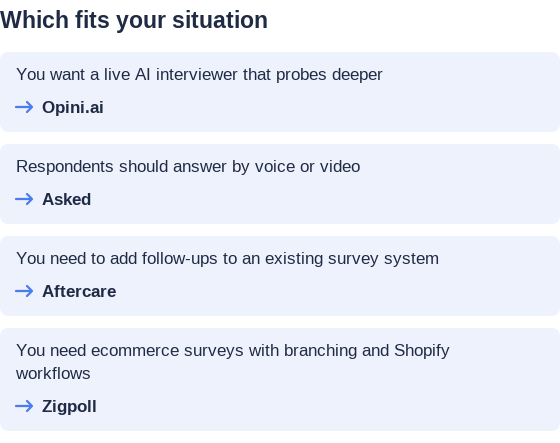
From the table above.
How this comparison was made
Prices and features come from each vendor’s published pages, checked in November 2026; products were not tested hands-on. Zigpoll publishes this page.


