How Does SurveySparrow EchoAI Compare With Qualtrics?
SurveySparrow EchoAI vs Qualtrics: Compare empathetic feedback follow-ups, survey clarification prompts, capabilities, limitations, and pricing.

SurveySparrow’s EchoAI is the better fit for empathetic, action-oriented follow-ups; Qualtrics is a better fit for adding AI clarification prompts inside structured surveys. EchoAI can adapt its conversational tone and trigger next steps, while Qualtrics focuses on asking for clearer or more detailed text responses.
At a glance
| Option | Best for | Starting price (paid plan) | Free plan | Empathetic follow-ups | Source |
|---|---|---|---|---|---|
| SurveySparrow EchoAI | Conversational feedback and action | Not confirmed, see source | Yes | Yes | surveysparrow.com |
| Qualtrics | Survey-based response clarification | $420/mo | Yes | Partial | qualtrics.com |
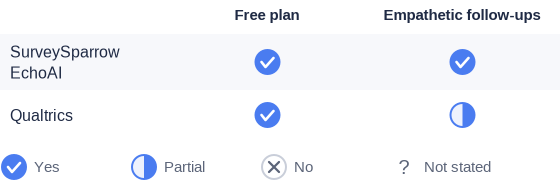
From the sourced table above, checked November 2026.
SurveySparrow EchoAI: best when follow-ups should feel conversational
SurveySparrow describes EchoAI as an agent that can ask follow-up questions to clarify feedback, respond based on customer sentiment, and take action during the conversation. Teams can set the agent’s purpose, guidelines, knowledge sources, and tone; SurveySparrow’s setup guide lists friendly, empathetic, and professional as tone options. (surveysparrow.com)
The published workflow extends beyond asking for more detail: Echo can be configured to collect feedback, create or retrieve ticket information, send an email, or call an API. It can be deployed through channels including web, WhatsApp, SMS, and email, and the vendor describes human handoff for complex requests or customer frustration. (support.surveysparrow.com)
The main trade-off is that an AI agent needs clear guidelines and useful knowledge to respond appropriately. Its empathetic tone is a configurable style, not proof that every generated response will feel right to every customer; teams should preview and review conversations before relying on them in sensitive situations. Echo’s feature and setup details are published by SurveySparrow, but the vendor does not establish that every listed capability is included in every plan. (support.surveysparrow.com)
Qualtrics: best when follow-ups belong inside a survey
Qualtrics Conversational Feedback adds AI-generated follow-up questions to open-text survey responses and can prompt respondents to make vague or incomplete answers clearer. Its published documentation says adaptive follow-ups can generate one or two questions tailored to the respondent’s text, while response-clarity validation can ask for more detail when an answer is unclear. (qualtrics.com)
That makes Qualtrics a strong fit for teams that want to gather better explanations without changing a survey into a broader service conversation. The feature is constrained to compatible text-entry questions and project types; advanced follow-ups also have limits, including a maximum of two per respondent per survey, and availability depends on the Qualtrics pricing and packaging plan. (qualtrics.com)
Qualtrics documents prompts that ask respondents to elaborate, but it does not describe this feature as an empathetic agent that takes customer-service actions in the conversation. Qualtrics also cautions that AI output can be inaccurate, incomplete, or outdated, so generated prompts and responses still need human oversight. (qualtrics.com)
How does SurveySparrow’s EchoAI compare to Qualtrics for automated empathetic follow-ups?
SurveySparrow EchoAI is the closer match if “empathetic follow-up” means a tailored conversation that can respond in a chosen tone and help move an issue toward resolution. Qualtrics is a better match if the main goal is to get more useful detail from open-ended survey answers. EchoAI’s product materials cover tone configuration, conversational clarification, and actions such as ticket or email workflows; Qualtrics documents adaptive survey questions and prompts that improve response clarity. (surveysparrow.com)
The difference is one of scope. EchoAI is presented as an agent that can continue interacting and act on feedback, whereas Qualtrics’ Conversational Feedback is a set of AI enhancements attached to survey text-entry questions. The Qualtrics option may be preferable when survey design and response collection are the center of the process; EchoAI may suit teams that want the feedback exchange itself to feel more like a guided conversation. (surveysparrow.com)
For price context, SurveySparrow lists Basic at $19 per month when billed yearly, and Qualtrics lists Strategic Research at $420 per month, billed as $5,040 per year. These are entry prices for the vendors’ listed plans, not a like-for-like quote for every feature: Qualtrics says Conversational Feedback is available only on its newer simplified plans or to preview-program participants. (surveysparrow.com)
How do their automated follow-up capabilities differ?
EchoAI can be configured for follow-up conversations and actions; Qualtrics generates clarification prompts within supported surveys. EchoAI’s setup guide describes setting conditions for guidelines, supplying company knowledge, choosing an agent tone, and configuring actions such as booking, email, or API calls. SurveySparrow also describes deployment on multiple channels and escalation to a human team. (support.surveysparrow.com)
Qualtrics offers two documented mechanisms: adaptive follow-up questions based on what a respondent wrote, and response-clarity prompts when an answer is too vague to act on. Those tools work within eligible text-entry questions and are subject to feature availability, project compatibility, and follow-up limits. Qualtrics documents configurable prompts and topics to avoid for advanced follow-ups, but not the broader set of real-time actions described for EchoAI. (qualtrics.com)
So the practical dividing line is whether you want to clarify a survey answer or continue a customer conversation that can also route work. Both automate follow-up questions, but their published feature descriptions point to different use cases. (support.surveysparrow.com)
Which platform better supports empathetic customer feedback conversations?
SurveySparrow EchoAI better supports a conversational approach when tone, real-time clarification, and follow-through matter together. Its setup allows a team to choose an empathetic tone, define behavior guidelines, and provide background materials, while its product page describes clarification and actions during the exchange. (support.surveysparrow.com)
Qualtrics may be the better fit when the team wants respondents to explain ratings in a structured survey and values controls such as response-clarity prompts and topics to avoid. Its documentation supports those needs, but a buyer should confirm that Conversational Feedback is available in their specific package. Neither product’s published materials establish that automated language will always feel empathetic, so review and human escalation remain important for sensitive feedback. (qualtrics.com)
Which should you choose?
| Your situation | Best fit |
|---|---|
| You want an agent to clarify feedback and trigger next steps | SurveySparrow EchoAI |
| You want AI follow-ups attached to survey text questions | Qualtrics |
| You need to set a friendly or empathetic agent tone | SurveySparrow EchoAI |
| You need survey-based clarification prompts and response validation | Qualtrics |
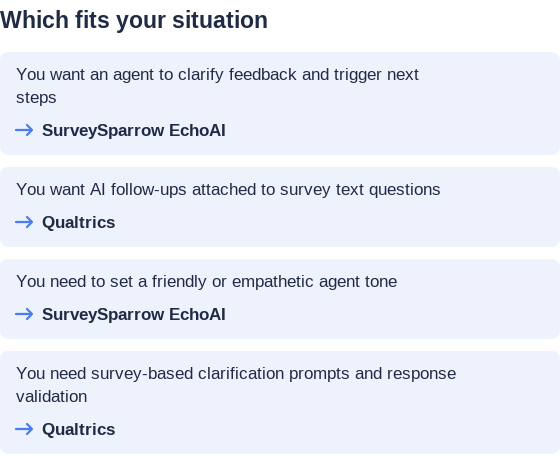
From the table above.
How this comparison was made
Prices and features come from each vendor’s published pages, checked in November 2026. The products were not tested hands-on.


