How Can I Compare Customer Acquisition Cost Platforms?
Compare customer acquisition cost platforms for web analytics, CRM reporting, B2B attribution, and ecommerce, including pricing and feature differences.

The right CAC platform depends on whether you need basic web attribution, CRM-to-revenue reporting, B2B account journeys, or ecommerce channel measurement. Google Analytics 4 suits low-cost web and app measurement; HubSpot suits teams already managing leads in its CRM. Dreamdata focuses on B2B journeys, while Triple Whale is built around ecommerce data and paid-channel reporting.
At a glance
| Option | Best for | Starting price (paid plan) | Free plan | Native ecommerce connectors | CRM-to-revenue attribution | Source |
|---|---|---|---|---|---|---|
| Google Analytics 4 | Web and app measurement | Quote | Yes | Partial | Partial | marketingplatform.google.com |
| HubSpot Marketing Hub | CRM-linked marketing reporting | Not confirmed, see source | Yes | Not stated | Yes | hubspot.com |
| Dreamdata | B2B account attribution | Quote | Yes | Not stated | Yes | dreamdata.io |
| Triple Whale | Ecommerce channel measurement | Usage-based | Yes | Yes | Partial | triplewhale.com |
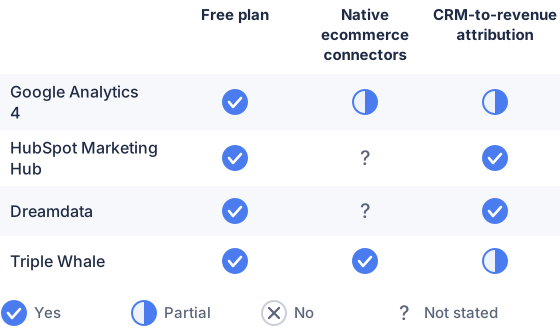
From the sourced table above, checked November 2026.
Prices and features checked in November 2026. “Partial” means the capability depends on setup, scope, or plan; “Not stated” means the linked vendor page does not establish it.
Google Analytics 4: best for low-cost web and app measurement
GA4 provides web and app analytics, reports, and attribution tools at no charge; Google also offers Analytics 360 for enterprise needs, with pricing handled through sales. Its data-driven and last-click reporting models can help compare acquisition channels, but GA4 is not a complete business-cost ledger: teams still need reliable spend data and a clear definition of a new customer. Google describes its free analytics features and Analytics 360 sales option and documents its available attribution models.
HubSpot Marketing Hub: best for CRM-linked marketing reporting
HubSpot connects marketing interactions with CRM contacts and deals, and its marketing analytics materials describe multi-touch revenue attribution. That makes it useful when the question is which marketing touchpoints are associated with leads and closed revenue, provided the team keeps CRM stages and campaign tracking consistent. Advanced reporting scope and contact volume can affect the plan needed. HubSpot describes its attribution reporting and publishes Marketing Hub pricing.
Dreamdata: best for B2B account journeys
Dreamdata focuses on B2B attribution, joining marketing and sales activity into account and revenue reporting. Its free plan includes foundational B2B analytics, while its paid attribution and activation offering is custom-priced. It can be a good fit when buying journeys span multiple people and touchpoints, but it is less directly tailored to consumer ecommerce orders than a commerce-focused platform. Dreamdata lists plan features and custom pricing and describes its B2B revenue attribution approach.
Triple Whale: best for ecommerce channel measurement
Triple Whale combines ecommerce data with advertising, marketplace, subscription, and customer-channel integrations, and its paid plans include attribution and reporting capabilities. The published pricing page offers a free plan and says paid plan pricing varies by business tier; the lowest paid amount is therefore not a single fixed monthly price. Its ecommerce focus can be a mismatch for businesses that need account-based B2B pipeline reporting rather than store and order performance. Triple Whale lists its plans and included measurement features and shows its integrations.
1. How can I compare different customer acquisition cost platforms?
Compare platforms using the same definition of CAC, the same reporting period, and the same acquisition data. A basic formula is acquisition-related costs divided by new customers acquired, but teams differ on which costs they include, such as ad spend, agency fees, sales costs, or marketing labor. Write down the chosen definition first so you are not comparing one tool’s media-only number with another tool’s broader cost estimate.
Next, check whether each platform can collect the required costs and connect them to the right customer outcome. For a B2B team, that outcome might be a qualified opportunity or closed-won customer; for a consumer business, it might be a first paid order. Then compare the practical fit: pricing and usage limits, integrations, attribution methods, data history, reporting flexibility, and how easy it is to trace a result back to source records. A free plan can be useful for a small test, but it may not include the sources, history, or reporting controls needed for a full comparison.
2. What features should I compare in customer acquisition cost platforms?
Compare cost coverage, customer definitions, attribution, integrations, and auditability before comparing dashboards. Check whether the platform can bring in the costs you count, distinguish new customers from repeat customers, and connect acquisition activity to the outcome your company uses. Also check whether it supports useful breakdowns by channel, campaign, product, geography, or customer segment.
Attribution deserves a close look: can you compare first-touch, last-touch, multi-touch, or data-driven reporting, and can you explain what each model assigns credit to? Confirm how the platform handles missing identifiers, offline activity, long buying cycles, and changes to campaigns or CRM records. Finally, compare implementation effort, data retention, user access, exports, and total cost at your expected scale. A platform that looks inexpensive at first may require extra connectors, services, or manual reconciliation.
3. How can I check whether a platform measures acquisition costs accurately?
Use a controlled sample of your own data and reconcile its inputs and outputs against source systems. Start by agreeing on the period, currency, customer definition, and included cost categories. Confirm that imported ad spend matches the ad accounts, customer and revenue records match the commerce or CRM system, and duplicate conversions or returning customers are treated as intended.
Then select a sample of new customers or closed-won deals and trace each reported journey back to its original events, campaign tags, and source records. Compare totals against your own blended CAC calculation, and investigate gaps rather than assuming one number must be correct: attribution models can allocate credit differently, and consent, browser, or cross-device limits can affect observable journeys. Google notes that GA4 may model key events that cannot be directly observed and that attribution data can continue updating after a conversion, so allow for processing and compare equivalent date ranges. Google explains modeled key events and reporting delays.
4. Which customer acquisition cost platform integrations matter for ecommerce?
Prioritize integrations that cover the full path from advertising cost to a verified first purchase: your ecommerce platform or order system, ad accounts, analytics or tag management, and any system that identifies new versus returning customers. If relevant to your business, add email and SMS, marketplaces, subscriptions, refunds or returns, affiliate networks, and a warehouse or BI tool. The right list depends on where orders, costs, and customer status are recorded.
Check the details, not just whether an integration is listed. Verify which fields sync, how often they refresh, whether order cancellations and refunds are represented, and whether the connector supports all the accounts or regions you use. Triple Whale lists ecommerce platforms such as Shopify, WooCommerce, and BigCommerce alongside ad, marketplace, email, and subscription integrations; GA4 supports ecommerce measurement when the required ecommerce events are implemented. Triple Whale lists its connectors, and Google documents GA4 ecommerce setup.
Which should you choose?
| Your situation | Best fit |
|---|---|
| You need free web and app analytics | Google Analytics 4 |
| You want campaign reporting tied to CRM deals | HubSpot Marketing Hub |
| You need B2B account and buying-journey attribution | Dreamdata |
| You need ecommerce and paid-channel reporting together | Triple Whale |
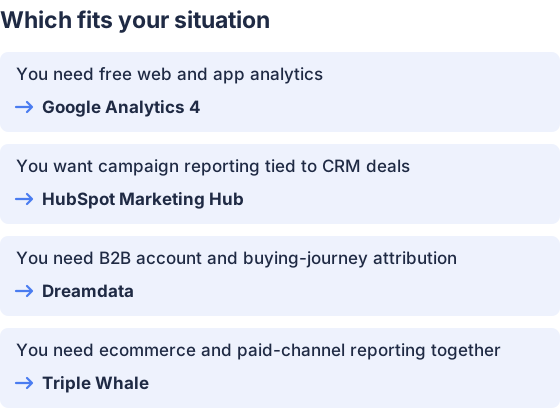
From the table above.
How this comparison was made
Prices and features come from each vendor’s published pages, checked in November 2026. The products were not tested hands-on.


