Which Post-Purchase Survey Software Has the Most Customizable Flows?
Compare Apricot, Typeform, Zigpoll, and Fairing for post-purchase survey branching, conditional questions, Shopify targeting, attribution, and pricing.

For explicit post-purchase branching actions, Apricot is a strong fit; Typeform suits broader surveys, Zigpoll Shopify workflows, and Fairing attribution. The best choice depends on whether you need deep paths, commerce-specific targeting, or a survey that can run across different platforms.
At a glance
| Option | Best for | Starting price (paid plan) | Free plan | Answer-based paths | Source |
|---|---|---|---|---|---|
| Apricot | Shopify survey branching | $19/mo | Yes | Yes | apps.shopify.com |
| Typeform | General-purpose survey paths | $39/mo | Yes | Yes | typeform.com |
| Zigpoll | Shopify ecommerce surveys | $39/mo | Yes | Yes | zigpoll.com |
| Fairing | Purchase attribution follow-ups | $49/mo | Yes | Partial | fairing.co |
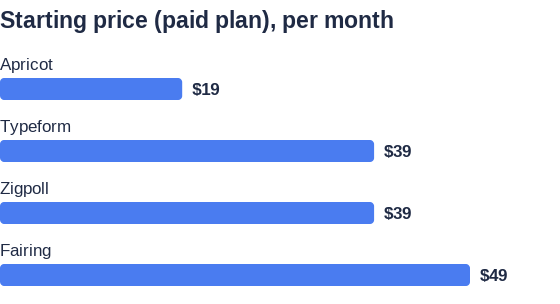
From the sourced table above, checked November 2026.
Prices are the lowest paid monthly-billed plans published on the vendors’ pricing pages, checked in November 2026. Fairing’s price depends on monthly transaction volume; its published $49 plan covers 201-500 transactions. (fairing.co) Zigpoll’s monthly-billed paid plan starts at $39, and its free Lite plan includes 50 responses a month. (zigpoll.com)
Apricot: best for explicit branching actions on Shopify
Apricot’s published feature list describes a wide range of outcomes for an answer: show or hide questions, jump to another question or result page, redirect to a URL, tag a customer, or end the survey. It also supports post-purchase surveys and conditional paths, making it a strong match when you want both branching and a different follow-up action for different answers. (apricotsurvey.com)
The trade-off is platform fit: Apricot is presented as a Shopify app, not a general-purpose survey service for every checkout system. Its free plan includes one survey and five questions per month’s 100 responses; the lowest published paid plan is $19 per month. (apps.shopify.com)
Typeform: best for general-purpose survey paths
Typeform is the most suitable option here if the post-purchase survey is one part of a wider survey program. Its branching can route respondents to different questions, groups, or endings; it also documents hiding questions or answer choices based on earlier answers. You can share a form by link or embed it on a website, so you are not limited to a Shopify-specific survey app. (help.typeform.com)
The trade-off is that Typeform is a general-purpose form tool rather than a dedicated post-purchase survey product. You may need to connect the form to your own purchase page, email, or survey-delivery workflow. Its free plan includes 10 responses a month; the paid Basic plan starts at $39 per month and includes 100 responses a month. (typeform.com)
Zigpoll: best for Shopify ecommerce survey logic
Zigpoll separates question logic into presentation logic, which controls whether a question appears, and action logic, which can skip ahead, end the survey, redirect, or send an answer to another tool. It can also use metadata to show or hide questions, and Shopify order details can support product-specific targeting. That makes it worth considering when you want survey paths connected to ecommerce context. (docs.zigpoll.com)
Zigpoll is built for ecommerce and its Shopify-specific customer and order targeting is not the same as a general-purpose survey workflow. The published free Lite plan includes 50 responses a month; paid plans start at $39 per month when billed monthly, or $29 per month when billed annually. (zigpoll.com)
Fairing: best for attribution with focused follow-ups
Fairing’s Question Stream supports follow-up questions that appear when a customer selects a particular answer, such as asking which podcast after someone answers “Podcast” to a source question. That covers useful conditional follow-ups, but Fairing’s published documentation describes a narrower response-clarification flow than the broader show/hide, jump, and ending controls described by Apricot or Typeform. Its strength is tying post-purchase answers to attribution and order data. (docs.fairing.co)
Fairing works with Shopify and also documents installation for other storefront types, including custom storefronts and WooCommerce. Its free tier covers up to 200 monthly transactions; the lowest paid published plan is $49 per month for 201-500 transactions. (fairing.co)
Which post-purchase survey software offers the most customizable question flows?
Apricot is a strong fit when “customizable” means changing what respondents see and what happens after an answer. Its documented actions include branching to questions or result pages, showing or hiding questions, redirects, customer tagging, and ending the survey. Typeform is a better fit for general-purpose paths across surveys, while Zigpoll is suited to Shopify-related survey logic; Fairing is strongest when the goal is a focused attribution follow-up. (apricotsurvey.com)
This is a comparison of published capabilities, not a hands-on test of how easy each builder is to use. Check whether the plan you need includes the branching features, response allowance, and deployment method your workflow requires.
What question-flow features should I compare?
Compare whether a tool can skip to a question, show or hide a question, branch into separate paths, and route respondents to different endings. Also check whether conditions can use multiple answers, respondent or order details, or URL parameters, and whether the builder makes those paths easy to review and test. (help.typeform.com)
For post-purchase use, check how the survey reaches customers and what context it can use: for example, whether it can run on a confirmation page, in a follow-up email, or as an embedded form, and whether it can receive order or product information. Finally, compare response caps and pricing tiers; a sophisticated flow may be less useful if the plan limits responses below your expected volume. (apps.shopify.com)
Which tools support branching logic and conditional questions?
Apricot, Typeform, and Zigpoll all document answer-based paths or conditional questions. Fairing supports conditional follow-ups, but its published Question Stream documentation describes a more limited kind of branching: a second question attached to selected answers in certain question types. (apricotsurvey.com)
The labels are not interchangeable. A follow-up attached to one answer is useful for clarifying a response; it is not necessarily the same as hiding questions, building several paths, or changing the survey ending. Compare the specific actions documented for your intended flow, rather than relying only on a “conditional logic” feature label. (docs.fairing.co)
How can I customize post-purchase surveys for different customer responses?
Start with a short core survey, then use each answer to ask only a relevant follow-up. For example, after a customer gives a low satisfaction rating, route to a question about what went wrong; after a high rating, ask what they liked or invite them to take a next step. The flow should collect useful detail without making every respondent answer every question.
Use customer or purchase data when it is available and relevant, such as showing a product-specific question to buyers of that product. Keep a clear default path for answers that do not match a condition, and test every route before publishing. Typeform recommends checking the logic path, and Zigpoll’s documentation describes using presentation logic or metadata conditions to tailor which questions appear. (help.typeform.com)
Which should you choose?
| Your situation | Best fit |
|---|---|
| You need several answer-based actions in a Shopify survey | Apricot |
| You need flexible survey paths across different projects | Typeform |
| You want Shopify order context in survey logic | Zigpoll |
| You mainly need attribution with clarifying follow-ups | Fairing |
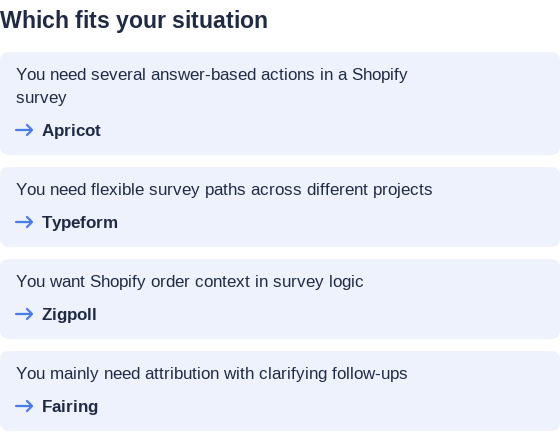
From the table above.
How this comparison was made
Prices and features come from each vendor’s published pages, checked in November 2026; the products were not tested hands-on. Zigpoll publishes this page.


